
Reviewed · DIOCLETIAN'S PALACE TOURS
Chill Walking Tour of Diocletian’s Palace
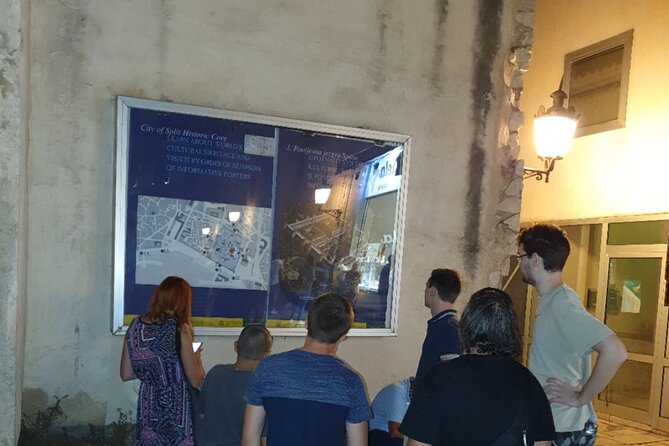
One walk through Diocletian’s Palace is never just sightseeing. I love the chill pace and the way Mili uses 3D reconstructions and pictures to show what you are looking at, instead of tossing dates at you. The one trade-off: the tour focuses on exterior and free areas, so if you want full museum interiors, you may need to buy extra tickets on your own.
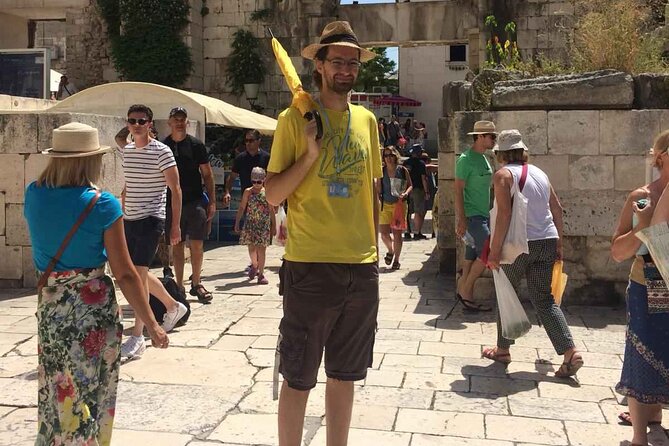
If you like a guide who is genuinely into his city and can answer questions on the spot, this fits. Mili keeps the tone light with humor, and the group stays small, up to 20 people, so the walking feels comfortable.
This palace layout has survived for 17 centuries, and you can still see how it shaped modern Split around it. You will walk from the palace gates to the most intact Roman highlights, with a clear thread that connects Roman planning, church reuse, and later Croatian life.
In This Review
- Key highlights not to miss
- Diocletian’s Palace, the easiest way to understand Split
- Meeting at the Eastern (Silver) Gate, then keeping it chill for 1.5 to 2 hours
- Stop 1: Peristyle, where the palace story makes sense
- Stop 2: Diocletian Palace substructures, and why “free” still teaches a lot
- Stop 3: Cathedral of Saint Domnius, Roman preservation with a living role
- Stop 4: Temple of Jupiter, church reuse that keeps the Roman structure intact
- Stop 5: Triklinij partial reconstruction, seeing what is missing
- Stop 6: Papalićeva ulica, small alley, useful context
- Stop 7: Fruit’s Square (Trg Brace Radic), where Croatian history touches the palace
- Stop 8: The Golden Gate, fortifications and how they changed
- Stop 9: Ending by Grgur Ninski Statue, your quick wrap-up
- What you get for $19.26, and when to add extra tickets
- Who this walking tour suits best
- Should you book this chill palace walk?
- FAQ
- How long is the Chill Walking Tour of Diocletian’s Palace?
- What is the price per person?
- Where do I meet the guide?
- Where does the tour end?
- Are tickets included for the sights?
- Do you enter museums or paid sites?
- Which main stops are included?
- What is the group size limit?
- Is the tour suitable for most travelers?
- What happens if the weather is bad?
- What is the cancellation policy?
Key highlights not to miss
- Eastern (Silver) Gate to Golden Gate route: a logical walk that helps you understand the palace wall line and fortifications.
- Peristyle first: you get oriented early with the palace’s central space.
- Roman-to-church reuse: Saint Domnius Cathedral and the Temple of Jupiter show how buildings changed roles while keeping stone.
- Triklinij partial reconstruction: you get a real sense of what is missing, plus what Diocletian’s south wing would have felt like.
- Golden Gate fortifications: you see how the entrance area was altered from construction to today.
- Grgur Ninski statue finish: the tour ends by one of Split’s major figures, making it easy to lock in what you learned.
Diocletian’s Palace, the easiest way to understand Split
Diocletian’s Palace can feel like a maze if you just wander. This walk helps you read it. You start at a gate, move through the main surviving spaces, and end at another gate, so your brain keeps a simple map: walls in, rooms and corridors, then out.
The best part is that you are not only looking at old stones. You are learning how the palace became part of a living city, where later buildings and street life grew around what Diocletian built. You get the feeling that Split did not replace the palace, it built on top of it.
And you do it at a pace that does not bully you. For me, that matters in Split, because the city is walkable, but the heat and cruise-ship crowds can turn a history lesson into a march. This one feels like a conversation you can stroll through.
Meeting at the Eastern (Silver) Gate, then keeping it chill for 1.5 to 2 hours
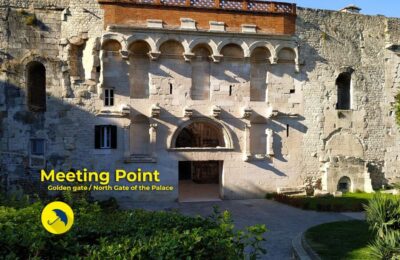
You meet at the Eastern (Silver) Gate, at Poljana kraljice Jelene 5, in Split. The tour ends outside the northern gate, at Dioklecijanova 7, by the bronze statue of Grgur Ninski. That end point is handy, because it puts you right where many people naturally want to continue exploring.
Timing is about 1 hour 30 minutes to 2 hours. The route moves in short segments, with a clear stop at each key feature. In practice, that means you get breaks to look, take in details, and ask questions without the guide having to speed-run everything.
Logistics are simple. You use a mobile ticket, and the group maximum is 20 travelers. It is also near public transportation, so getting to the meeting point is usually straightforward. Service animals are allowed, and the tour is listed as suitable for most travelers, which helps if you want a low-stress intro.
One practical note: the experience requires good weather. If it is rough, the tour can be rescheduled or refunded. So it is worth checking day-of conditions before you assume it will run exactly as planned.
Plenty more to do around Split
Stop 1: Peristyle, where the palace story makes sense
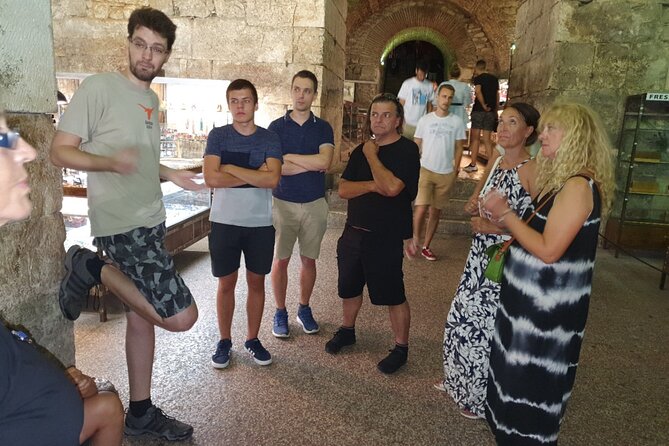
The tour begins at the Peristyle of Diocletian’s Palace. This is the right opening choice because it anchors your visit. The Peristyle is where you learn who Diocletian was in the story and how this palace came to be, before you start picking your way through corridors and side spaces.
What I like here is that you do not just hear facts. You get a mental framework for what you are seeing. When you later move into substructures, temples, and reconstructed corners, you know what kind of place you are in: a palace built with Roman planning, not a random cluster of ruins.
At this first stop, the admission is free for the portion you visit. That keeps the experience accessible and avoids that annoying moment where you finish one section and then discover the next one needs another ticket just to keep up.
Stop 2: Diocletian Palace substructures, and why “free” still teaches a lot
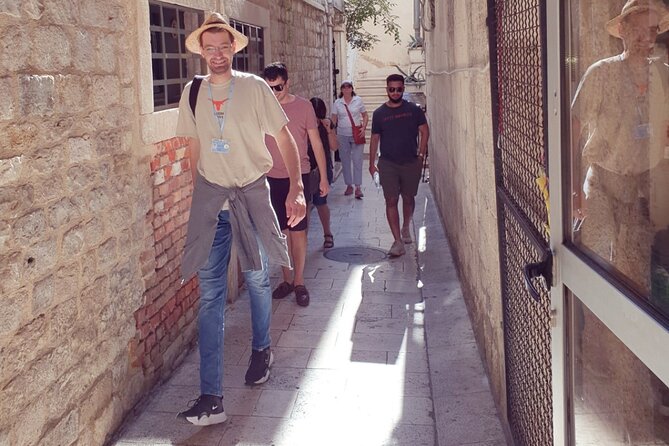
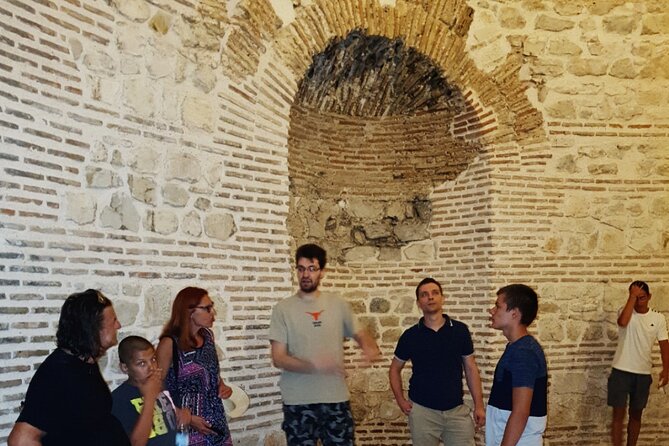
Next you head to the Diocletian Palace substructures for the free part. This is one of those areas where a good guide makes a huge difference. Instead of treating it like a background feature, Mili explains the architecture and history behind the space.
You also get a useful choice. If you decide you want more, there are museum tickets available for the paid museum part of the substructures. The tour itself does not include museum entry, but the guide can point you toward what to consider if you want to extend your visit later.
This stop is also a good reality check about expectations. If you want to do everything indoors and ticket everything, this is not that kind of tour. But if you want strong orientation plus the main surviving Roman landmarks without a stack of admissions, it hits the sweet spot.
Stop 3: Cathedral of Saint Domnius, Roman preservation with a living role
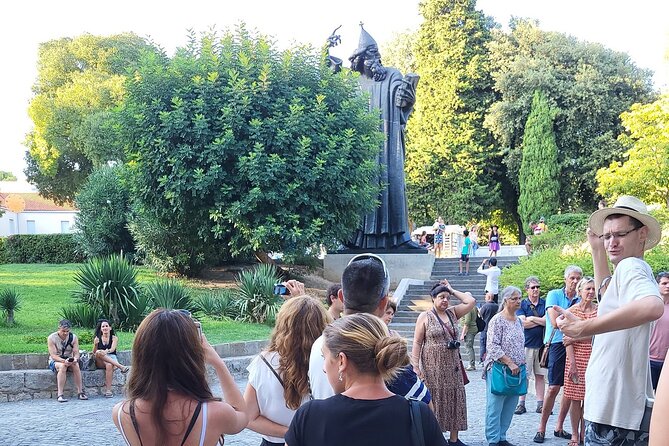
The Cathedral of Saint Domnius is one of the best preserved Roman structures, and it is built as part of Diocletian’s Palace. That single line matters because it tells you what you are looking for: continuity. You are seeing a Roman build that still has a function today.
At this stop, the focus is on the cathedral’s history as part of the palace complex. If you have a ticket for the cathedral, you can go inside. If not, you still get the context that makes the exterior make sense.
Here is the value from a practical viewpoint. A lot of visitors see churches in Europe, take a quick look, and move on. This gives you the reason the structure is special, because it is tied directly to the palace itself rather than just being nearby.
Stop 4: Temple of Jupiter, church reuse that keeps the Roman structure intact
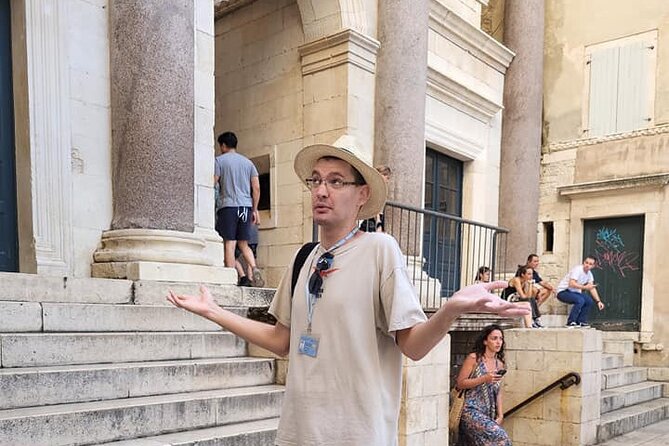
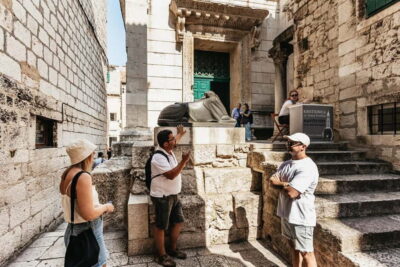
Another standout is the Temple of Jupiter. It is described as fantastically preserved, and it was repurposed by the church, which is why it remains in good condition. That is a strong theme for the whole tour: buildings change owners and uses, but stone often stays.
Like the cathedral, this stop has optional ticketing for interior access. The tour does not include paid entry, but the guide can help you decide if you want to add it based on your interests.
I like this stop because it gives you something visual to compare to Saint Domnius. You get two preserved Roman structures, each with a different role in later religious life, both still rooted in the Diocletian Palace setting. Even if you are not a hard-core architecture person, the contrast lands quickly.
Two days in Split? Here's how to fill the second.
- Split: Krka Waterfalls Trip with Boat Cruise and Swimming★ 4.8 · 10,519 reviews
- From Split: Krka Waterfalls, Food & Wine Tasting Tour★ 5.0 · 9,326 reviews
- Blue cave, Mamma Mia and Hvar, 5 islands speedboat tour★ 5.0 · 7,150 reviews
- From Split: Krka Waterfalls, Food & Wine Tasting Tour★ 4.9 · 6,598 reviews
Stop 5: Triklinij partial reconstruction, seeing what is missing
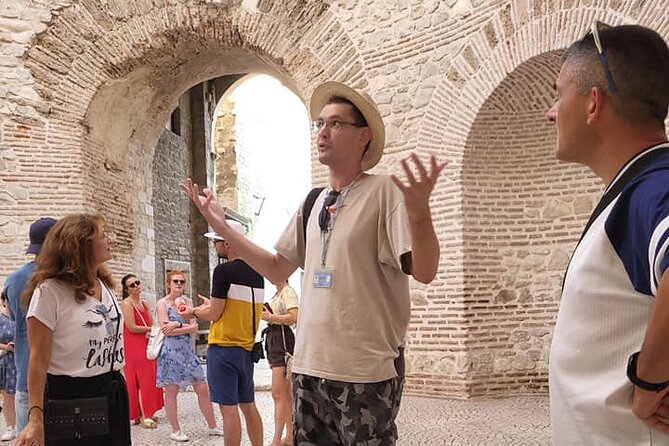
The south eastern corner of the palace has mostly been destroyed, and Triklinij is where you learn how to read a site when parts are gone. Because the structure was built in a certain way, an accurate partial reconstruction was made, giving you an impression of what Diocletian might have experienced in that space.
This is where the 3D reconstructions and pictures really pay off. When something is partially missing, your eyes can feel lost. A guide who can show how the original would have worked helps you avoid the common mistake of thinking the ruins are just incomplete.
One thing I appreciate is the honesty built into the stop. You are not told that everything survived. You are taught how reconstruction can still give you a believable feel for the original layout.
Stop 6: Papalićeva ulica, small alley, useful context
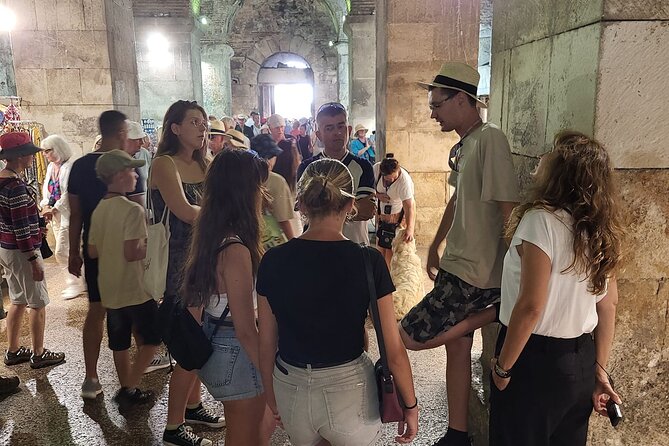
Papalićeva ulica is a quieter moment in the walk, but it is a good one. The tour goes through the north half of the palace area here, and Mili shares a few interesting facts as you move along the alley.
Even when a street is narrow, the details matter. This is one of the places where the palace stops feeling like a single monument and starts feeling like the skeleton of a whole neighborhood.
Also, this is one of those stops that helps you later when you wander on your own. Once you know how to interpret the layout, you will spot palace logic in streets that might otherwise look like any old lane.
Stop 7: Fruit’s Square (Trg Brace Radic), where Croatian history touches the palace
Outside the palace you reach Fruit’s Square (Trg Brace Radic). This stop is about how Diocletian’s Palace connects to an important period of Croatian history, and how the palace has been integrated into newer buildings while still remaining in that state today.
This is a smart mid-to-late tour choice. By now you have walked past Roman structures and church reuse, so the story needs another turn. Fruit’s Square gives you that “city over time” perspective, not just “Rome is old.”
If you like places where daily life continues right next to heritage, this stop is for you. Even if you do not linger long, the explanation helps you see what you are standing on.
Stop 8: The Golden Gate, fortifications and how they changed
Near the end, you visit the Golden Gate. It is the northern gate of the palace and it is where Mili discusses the palace’s fortifications and how they changed between construction and today.
A gate is more than an entrance. It is a clue about defense, movement, and how a site guarded itself while also controlling flow into the interior. By focusing on fortifications here, the tour gives you an understanding of the palace as a protected system, not just a collection of highlights.
This stop also works well for photos. You get a clear sense of the gate as a boundary line, and you can connect it back to what you saw earlier at the Peristyle and substructures.
Stop 9: Ending by Grgur Ninski Statue, your quick wrap-up
The tour finishes outside the northern gate by the bronze statue of Grgur Ninski. This final stop is where the guide consolidates what you learned about Roman construction and the palace logic you followed during the walk.
I like endings like this because they help you convert a lot of information into a simple mental model. Once you have the palace layout in your head, you can keep exploring Split on your own without feeling like you missed the “important part.”
It also sets you up nicely for whatever comes next. You are not marched away to a random pickup point. You end in a central heritage spot, which makes it easy to keep your momentum.
What you get for $19.26, and when to add extra tickets
The price is $19.26 per person, and for that you get an experienced guide, the walk itself, and comparisons using 3D reconstructions and pictures. You also visit multiple key palace areas that are free for the portions included.
That value is strongest if your goal is orientation plus standout sights without paying for multiple museum entries right away. You get the major Roman structure themes: Peristyle as anchor, substructures as architecture and depth, Saint Domnius and Temple of Jupiter as preserved reuse, and Triklinij as reconstructed space.
The main reason you might add extra tickets is the tour does not include museums or paid sites. You can go inside places like the cathedral or the Temple of Jupiter only if you have tickets. The same idea applies to the museum part of the substructures if you want to see more.
So here is the best way to decide. If you want a smart, light, two-hour primer and you are happy with free sections plus context, this is a great buy. If you want a full indoor museum day, treat this as step one, then plan paid entries for later.
Who this walking tour suits best
This experience is ideal if you want your Diocletian’s Palace visit to feel organized and not overwhelming. It also suits you if you enjoy a guide with humor and the confidence to answer questions as you walk.
I would especially recommend it if:
- You are short on time in Split but want a strong overview.
- You plan to keep exploring after the tour and want an easy palace map in your head.
- You like seeing how later uses changed Roman spaces, not just reading plaques.
If you are only interested in deep museum interiors, this may feel a bit more exterior-focused. But even then, the orientation is still useful because it helps you understand what those interiors connect to.
Should you book this chill palace walk?
Yes, if you want a relaxed, well-guided introduction that helps you understand Diocletian’s Palace as part of Split today. The guide style is a big part of why this works, with a pleasant pace, clear explanations, and visual help like pictures and 3D reconstructions.
Book it now if you value context and want to hit the key surviving Roman spaces without stacking admissions. Consider adding ticketed entries separately if you know you want interiors, because the tour itself does not include paid sites.
If the weather looks questionable, wait for the reschedule option or plan an indoor backup. This tour depends on good conditions to keep the walking enjoyable.
FAQ
How long is the Chill Walking Tour of Diocletian’s Palace?
It runs about 1 hour 30 minutes to 2 hours.
What is the price per person?
The price is $19.26 per person.
Where do I meet the guide?
You meet at the Eastern (Silver) Gate, Poljana kraljice Jelene 5, Split, Croatia.
Where does the tour end?
The tour ends at the Golden Gate area, outside the northern gate by the bronze statue of Grgur Ninski, at Dioklecijanova 7, Split.
Are tickets included for the sights?
No admission tickets are included.
Do you enter museums or paid sites?
No, the tour does not include entering museums or other paid sites. You can go inside certain places only if you have your own ticket.
Which main stops are included?
The tour includes the Peristyle, Diocletian’s Palace substructures (free part), Cathedral of Saint Domnius (with optional inside entry if you have a ticket), Temple of Jupiter (with optional inside entry if you have a ticket), Triklinij, Papalićeva ulica, Fruit’s Square (Trg Brace Radic), Golden Gate, and the end near the Grgur Ninski statue.
What is the group size limit?
The tour has a maximum of 20 travelers.
Is the tour suitable for most travelers?
It is listed as most travelers can participate.
What happens if the weather is bad?
The experience requires good weather. If it is canceled due to poor weather, you will be offered a different date or a full refund.
What is the cancellation policy?
You can cancel for free up to 24 hours in advance for a full refund. Within 24 hours, the amount paid is not refunded.
Recently added around Split
- Private VIP Brac and Hvar Day Trip from Split
★ 5.0 · 1 review - Private Transfer From or To the Split Airport
★ 5.0 · 1 review - Brač Half Day Beach Party Transfer to Olife Beach Club
★ 5.0 · 1 review - Private Transfer from Split to Zagreb, Hotel-to-hotel, English-speaking driver
★ 5.0 · 1 review - Transfer from Split to Dubrovnik
★ 5.0 · 1 review - Airport transfers
★ 5.0 · 1 review
Diocletian's Palace Tours, compared.
Walking Tour of Split and Diocletian’s Palace
Read our review →
Diocletian Palace & Old Town Guided Walking Tour
Read our review →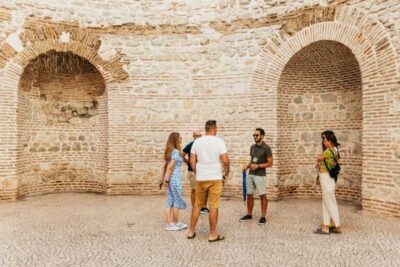

Game of Thrones Tour with Diocletian’s Palace Cellar
Read our review →
Diocletian’s Palace and Old Town SMALL GROUP Walking Tour
Read our review →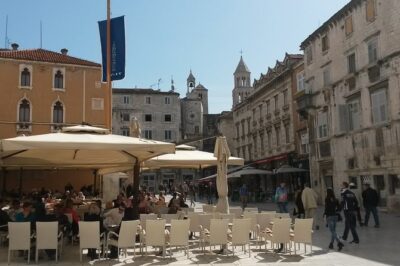
PRIVATE Walking Tour of Diocletian’s Palace & Old Town
Read our review →Browse the lists this tour appears in