Reviewed · GUIDED
Salona & Amphitheater – Private guided tour – Admission incl.
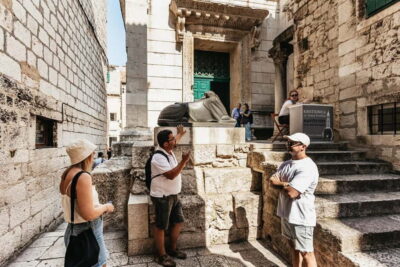
Roman streets to a great amphitheatre. This private 2.5-hour guided walk around Salona and Solin ties together Roman city life and the early Christian burial story, step by step. I like that the pace is tight enough to make sense of a sprawling archaeological area without turning it into a long slog.
Two things stand out fast: first, you get a real guide-led read on what you’re seeing, not just a map and hope. In particular, the guide Ivan has earned very positive feedback for being both knowledgeable and pleasant, which matters when you’re trying to spot details in low-visibility ruins. Second, the itinerary is packed with mostly short stops, and many sites have free entry, so you spend your time on the ground instead of hunting ticket windows.
One drawback to consider: a chunk of the experience is outdoors, and the tour is marked as requiring good weather. Also, while admission is included overall, the Salona open-air museum entrance is listed as about 10 euros for adults and not included for that first stop, so bring a little extra.
In This Review
- Key highlights worth planning for
- Salona feels like a different era than Split
- Getting started: where to meet and how the timing works
- Ancient Salona: the Roman metropolis and the big shift to destruction
- Manastirine and St. Dominius: necropolis to Christian cemetery
- Tusculum and the bishop’s palace: power in architecture form
- The urban spa and Pet mostova: social life and industrial edges
- Porta Caesarea: the gate ruts that make the past physical
- The oldest core: forum remains, a temple, and an ancient theater
- The road to the amphitheatre: 16 sarcophagi and roadside necropolis
- Kapljuc basilica and the martyrs tied to Diocletian
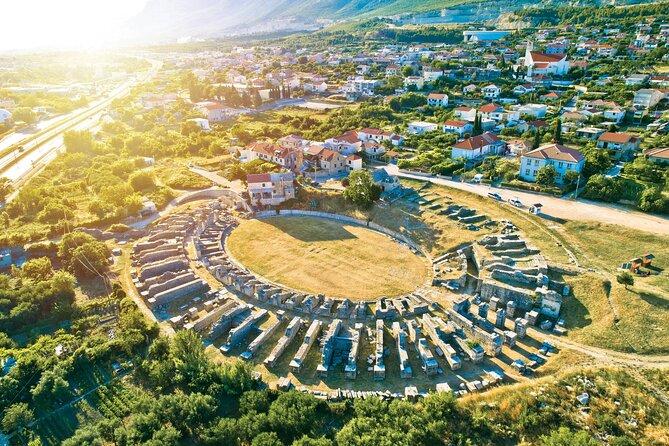
- Amphitheatre Salona: why it’s the highlight
- Value check: is $203.50 per person worth it?
- Practical tips for a smooth walk in Solin
- Should you book the private Salona and Amphitheatre tour?
- FAQ
- How long is the Salona and Amphitheater private guided tour?
- Is the tour offered in English?
- Is this tour private?
- Do I need to buy tickets during the tour?
- Where does the tour start?
- What kind of ticket do I get?
- What happens if the weather is bad?
- Is there a cancellation option?
Key highlights worth planning for
- Private, English-guided walking route that keeps the ruins understandable (no guesswork)
- Amphitheatre Salona as the payoff, with a clear explanation of why it still looks good
- Many free-entry stops between major sights, so you get more than just the headline monument
- Porta Caesarea ruts that show where Roman chariots rolled through the gate
- Christian-era stops tied to St. Domnius and martyrs connected to Diocletian’s persecution
- Cemetery of the 16 Sarcophagi along the approach to the amphitheatre
Salona feels like a different era than Split
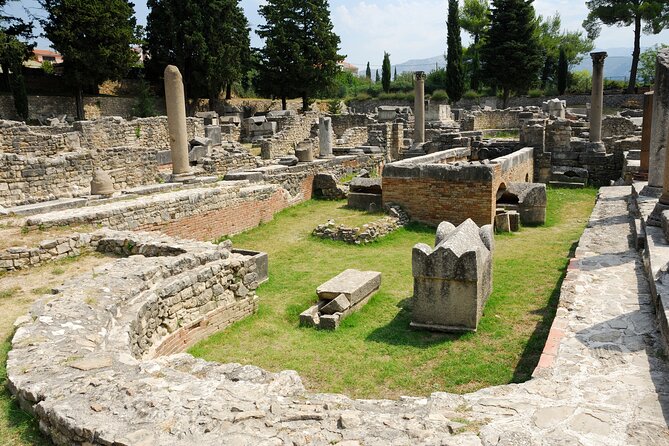
Split is all about walls, waterfronts, and “here’s the next viewpoint.” Salona, though, is archaeology with a plot. You’re walking through the remains of a Roman metropolis that once held around 60,000 people, then into the layered story of what came after, including the destruction in the 6th century. That sense of layers is the point here.
When your guide frames each stop, you start noticing how Roman cities worked: where people gathered, where power lived, where the dead were placed, and what changed when Christianity spread. It’s not just scenery. It’s a city map told through stone, foundations, and a few surviving shapes.
Getting started: where to meet and how the timing works
Your tour begins at the Salona main entrance, at Ul. don Frane Bulića 58, 21210 Solin, Croatia, and ends back at the meeting point. It runs about 2 hours 30 minutes. That’s a sweet spot if you want a meaningful archaeological visit without sacrificing your whole day to ruins.
This is a private tour, so it’s only your group. Expect guided walking with several brief stops, not a slow, museum-style meander. You’ll also have a mobile ticket, and it’s offered in English. Since it’s near public transportation, you can usually plan an easy arrival from Split without overthinking logistics.
Plenty more to do around Split
Ancient Salona: the Roman metropolis and the big shift to destruction
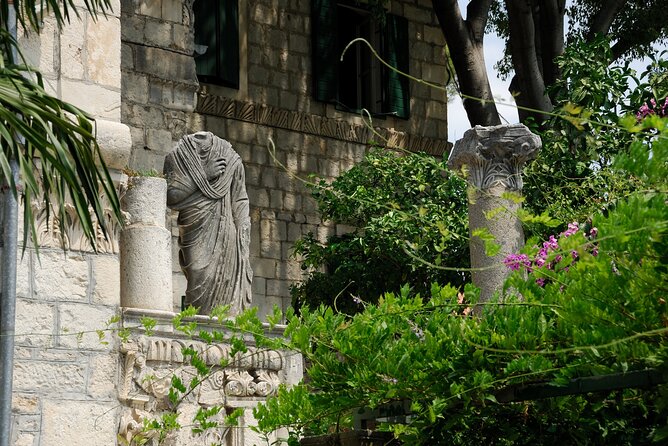
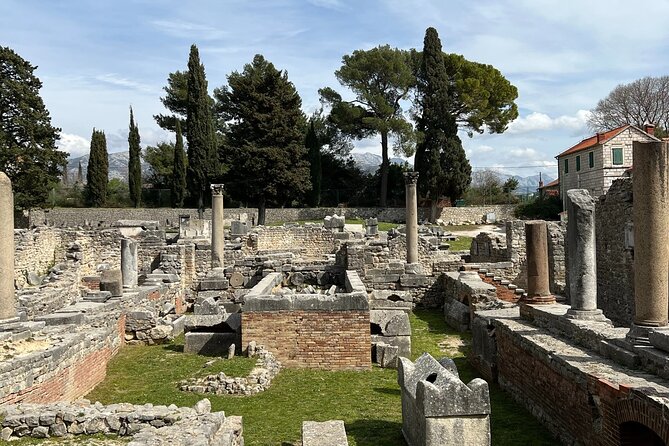
The tour kicks off with Ancient Salona, explored on foot. You’ll get general orientation right at the entrance, then move through the open-air museum grounds. The context matters: Salona functioned as a Roman metropolis with a population around 60,000 until it was destroyed by the Avars in the 6th century.
Look for how much of the story gets told through what’s missing. In places where you’d expect intact buildings, you often get shapes, outlines, and surviving structures that hint at how the city was laid out. With a guide, you also learn what to focus on, instead of staring at random piles of stone.
Important cost note: the entrance fee to the open-air museum is listed as about 10 euros for adults, and for this stop it’s marked as not included. Admission is included in the overall tour description, but this specific first entrance is the one place you should assume you may need to pay on the spot. Budget a small buffer so the start doesn’t feel like a surprise.
Manastirine and St. Dominius: necropolis to Christian cemetery
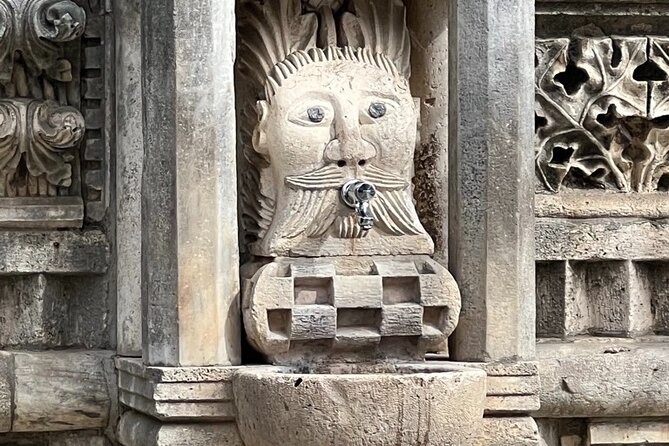
Next comes Manastirine, a site that was already a necropolis in Roman times and later became a Christian cemetery. This is one of the more emotionally resonant stops because it connects everyday burial practices to a later faith identity.
Here you’ll hear about St. Dominius, described as the martyr and city patron of Split. Even if you know the name only vaguely, a guided explanation helps you understand why these burial areas were so important. They weren’t just places to remember the dead. Over time, they became anchors for community identity.
Because the stop is short, your goal is not to “learn everything.” It’s to grasp the theme: Roman burial ground, then Christian cemetery, with a local patron at the center.
Tusculum and the bishop’s palace: power in architecture form
The itinerary includes Tusculum, built by Don Frane Bulić, a famous Split clergyman and archaeologist. He used it as an office and meeting place, which adds a modern layer to what you’re seeing. Some rooms can be visited, so you’ll get beyond outdoor ruins and into a structure tied directly to how archaeology itself is carried out.
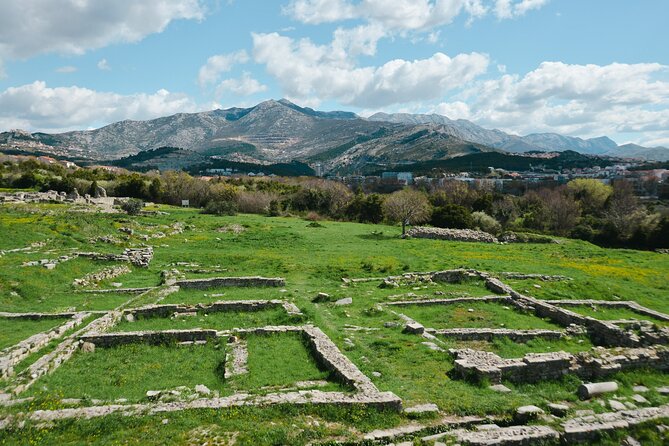
Then you move to Biskupska palača (Palatium episcopi), the bishop’s palace area and remains of two cathedrals from a time when Christians were allowed to practice their religion freely. Today, only foundation walls can be seen. That can feel a little flat at first glance, but it’s exactly the kind of stop where a guide helps you read the outline.
For your experience, these two stops are valuable because they show continuity and change. Roman urban life transitions into Christian leadership structures, and you can literally see the city’s shift from temples and theaters toward church foundations.
The urban spa and Pet mostova: social life and industrial edges
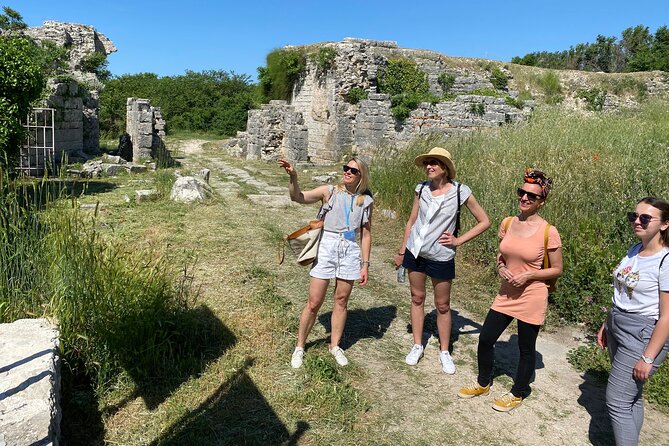
You’ll then visit the Large urban spa, Roman baths that were used for several hundred years and served as the social and cultural life center in Roman times. This is a practical stop. Roman baths tell you how people spent time, not just what they worshipped. When you stand near the remains, you start thinking about routine: meeting friends, conversation, public life.
After that is Pet mostova, the “five bridges.” These used to belong to an industrial area outside the old city center. The bridges are a reminder that Roman cities were not just ceremonial places. They were built to function, move, work, and connect neighborhoods.
The drawback with these stops is that they’re easy to underappreciate if you go in expecting blockbuster monuments. This is where you lean on your guide to help you see how “smaller” ruins still add up to the full city picture.
Two days in Split? Here's how to fill the second.
- Split: Krka Waterfalls Trip with Boat Cruise and Swimming★ 4.8 · 10,519 reviews
- From Split: Krka Waterfalls, Food & Wine Tasting Tour★ 5.0 · 9,326 reviews
- Blue cave, Mamma Mia and Hvar, 5 islands speedboat tour★ 5.0 · 7,150 reviews
- From Split: Krka Waterfalls, Food & Wine Tasting Tour★ 4.9 · 6,598 reviews
Porta Caesarea: the gate ruts that make the past physical
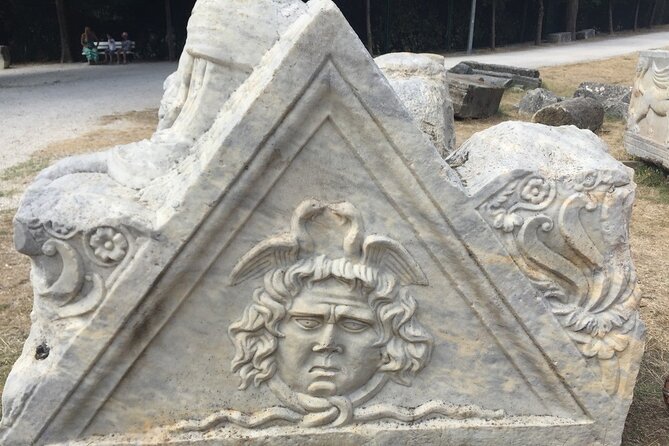
Town Gate, Porta Caesarea is one of the most distinctive moments. You’ll learn it was the capital gate in Roman times, and the real eye-catcher is that you can still see the ruts of old Roman chariots.
This is the kind of detail that changes your whole perception. Instead of imagining traffic, you’re seeing the trace of motion. It’s a good stop for photos too, but don’t just photograph. Pause long enough to let the guide explain where those ruts likely came from and why a gate like this mattered to how the city operated.
Short and sweet, but memorable for the “how did this survive?” feeling.
The oldest core: forum remains, a temple, and an ancient theater
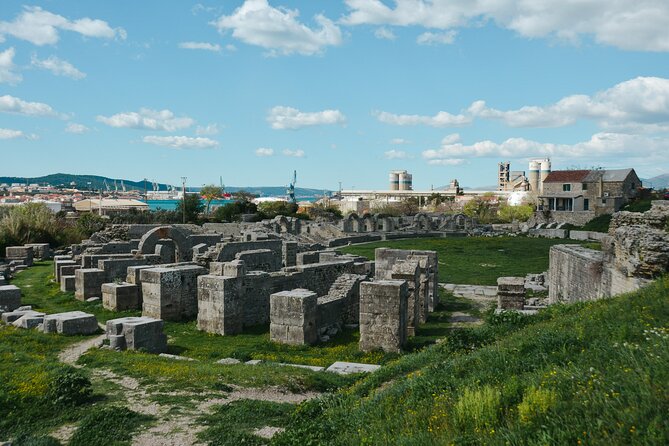
In the oldest part of town, you’ll see remains of the forum, a temple, and an ancient Roman theater. This stop is a useful “big picture” moment because it brings together what you’ve been learning at smaller scales.
Roman theaters were not only entertainment. They were public gathering spaces, tied to civic identity. Forums and temples tell a similar story: power, law, worship, and public speaking all in one urban zone. Even when many elements are only partially preserved, the layout and the guide’s framing make it click.
The road to the amphitheatre: 16 sarcophagi and roadside necropolis
As you approach the main event, you’ll stop near Ul. don Frane Bulića 91, the Cemetery of the 16 Sarcophagi. Roman cemeteries were built outside the city walls, and this area is a good example of that pattern.
This stop hits a nice balance between scale and specificity. Sixteen sarcophagi is an easy number to remember, and once you anchor the cemetery to the idea of “outside the walls,” it becomes a clearer part of the city’s layout rather than an isolated ruin.
If you’re visiting with anyone who likes symbolism, this is a solid checkpoint. You’re moving from living civic structures toward places designed for memory and ritual, right on the route to where public life culminated.
Kapljuc basilica and the martyrs tied to Diocletian
Next is Kapljuc, another basilica and necropolis. Here, burial is linked to five martyrs who died in the amphitheatre of Salona at the beginning of the 4th century during persecution of Christians by Diocletian.
This stop adds the emotional center to the Christian portion of the walk. The guide’s explanation is crucial, because without context, a basilica foundation can feel like a generic church ruin. With the story attached, it becomes part of the human consequences of political power and religious conflict.
Even though the stop is only about 10 minutes, it’s timed well. It prepares you for the amphitheatre by giving you a reason the amphitheatre mattered beyond architecture.
Amphitheatre Salona: why it’s the highlight
The Amphitheatre Salona is the highlight, with about 30 minutes for this final and main sight. It’s described as relatively well preserved. That matters here, because amphitheatres are often damaged or stripped down over time.
One memorable detail you’ll hear is why it looks the way it does. The Venetians removed most of the stones from this site to build churches in Venice. That kind of reuse was common, and it also explains why the amphitheatre survives with a different “shape” than you might expect from a perfectly intact Roman monument.
On-site, your best move is to do three things: stand back first to get the overall form, then follow the guide as they point out features, and finally take a moment in place for the scale. This is a good stop to notice how the space would have handled crowds and sound.
Value check: is $203.50 per person worth it?
At $203.50 per person for about 2 hours 30 minutes, you’re paying for a private guide and a focused route through multiple sites that are not all “right next door” in a way you’d want to explore alone without context.
I think this price makes the most sense if:
- You want someone to explain what you’re seeing at each stop, especially when foundations and traces look subtle.
- You care about themes, Roman urban planning plus early Christian burial and persecution, rather than just collecting landmarks.
- You prefer a private format where you can ask questions and adjust your pace.
If your goal is purely to take quick photos and walk casually at your own speed, you might question the cost. But if you like understanding the why behind each stone, the guide-led route turns the whole area into something coherent.
Practical tips for a smooth walk in Solin
A few practical things will help you enjoy this tour more.
- Wear grippy shoes. This is a walking route across uneven archaeological terrain.
- Plan for sun and shade. Most stops are outdoors, and you’ll be out for a little over two hours.
- Bring a small cash buffer. The open-air museum entrance is listed as about 10 euros for adults and not included for the first stop.
- Go with the weather window. The experience notes good weather is required, and if it’s canceled for poor weather you’ll get a different date or a full refund.
- If you have mobility needs, ask how the route feels for your group when booking. The tour says most people can participate, but “most” is still broad.
- Service animals are allowed, and the meeting point is near public transportation.
Also, since it’s a private tour, you’ll typically get more comfort and attention than in a larger group. That’s a big deal in archaeological areas where small details matter.
Should you book the private Salona and Amphitheatre tour?
I’d book this if you want a guided storyline through Salona, not just a quick hit of ruins. The combination of Roman civic sites, Christian cemeteries, and the amphitheatre makes the area feel like one connected experience rather than a list of stops. The strong points are the private format, the tight pacing, and the guide attention to specific details like Porta Caesarea’s chariot ruts and the amphitheatre’s historical context.
Skip it if you dislike walking in open air or if you hate surprises around entrance fees. The only money-related uncertainty is that first open-air museum entrance listed as about 10 euros for adults and not included, so plan for it.
If you’re staying near Split and want one smart, guided outing that teaches you how this Roman city and its later Christian story actually fit together, this is a very good call.
FAQ
How long is the Salona and Amphitheater private guided tour?
It runs about 2 hours 30 minutes.
Is the tour offered in English?
Yes, it is offered in English.
Is this tour private?
Yes. It is a private tour/activity, and only your group participates.
Do I need to buy tickets during the tour?
Most stops have free admission, but the Ancient Salona open-air museum entrance fee is listed as about 10 euros for adults and is marked as not included for that stop. The other listed sites in the itinerary are marked free.
Where does the tour start?
The meeting point is at the Salona main entrance, Ul. don Frane Bulića 58, 21210, Solin, Croatia. The tour ends back at the meeting point.
What kind of ticket do I get?
You receive a mobile ticket.
What happens if the weather is bad?
The tour requires good weather. If it is canceled due to poor weather, you will be offered a different date or a full refund.
Is there a cancellation option?
Yes. There is free cancellation, and you can cancel up to 24 hours in advance for a full refund.
Recently added around Split
- Private VIP Brac and Hvar Day Trip from Split
★ 5.0 · 1 review - Private Transfer From or To the Split Airport
★ 5.0 · 1 review - Brač Half Day Beach Party Transfer to Olife Beach Club
★ 5.0 · 1 review - Private Transfer from Split to Zagreb, Hotel-to-hotel, English-speaking driver
★ 5.0 · 1 review - Airport transfers
★ 5.0 · 1 review - Private ”Game of Thrones” Walking Tour in Split (entrance tickets included)
★ 5.0 · 1 review
Guided, compared.
Plitvice Lakes Guided Tour with Entry Tickets
Read our review →
Plitvice Lakes National Park Guided Day Tour from Split
Read our review →
Krka National Park Tour with tour Guide & Wine tasting from Split & Trogir
Read our review →
Self-Guided Plitvice Lakes Day Tour with Boat Ride
Read our review →