Reviewed · TOURS
Small-Group Communist Tour of Split – Boutique group tour
Split has another side, the communist one. In about 3.5 hours, you get a focused look at Yugoslavia through local historian explanations and private vehicle comfort, not just the usual waterfront stops.
I like two things a lot here: first, the guide is a history teacher and brings real context to the WWII-to-communism story that shaped Split and Yugoslavia. Second, you cover dispersed sites efficiently, with an air-conditioned ride that keeps you moving without turning the day into a long walk.
One thing to consider: this is politics-focused and covers the 1990s collapse and violence, so it may feel heavy if you’re in Split purely for light sightseeing. Also, the tour needs good weather, since you’ll be out at multiple stops.
In This Review
- Key Highlights You Shouldn’t Miss
- Why This Communism Tour of Split Feels Personal, Not Lecturing
- Meeting at Trg Franje Tuđmana, Then Getting Oriented Fast
- Stop 1: WWII to Communism on Trg Franje Tuđmana
- Stop 2: Poljud Stadium and the China Wall in One Area
- Stop 3: Koteks and the Idea of Shopping Under Yugoslavia
- Stop 4: Split 3, the Planned Neighborhood for Living, Working, and Resting
- Stop 5: Kopilica Station and the Armored Train Symbol
- Guides, Pace, and the Small-Group Advantage (Max 8)
- Price and Value: Is $108.14 a Good Deal?
- What You’ll Learn About Tito, but in a Place-Based Way
- Tips to Get the Most Out of Your 3.5 Hours
- Who Should Book This Communist Tour of Split?
- Should You Book?
- FAQ
- What is the duration of the Small-Group Communist Tour of Split?
- Where do I meet the guide in Split?
- What time does the tour start?
- How large is the group?
- Is the tour offered in English?
- What is included in the price?
- Are there any admission tickets required?
- Do I receive a mobile ticket?
- What is the cancellation policy?
- What happens if the weather is bad?
Key Highlights You Shouldn’t Miss
- Boris as your guide: a local historian and history teacher who explains Yugoslavia-era life in plain language
- Iconic socialist architecture: Poljud Stadium, Split 3, and the China Wall show how the system shaped the built world
- MoMA-level recognition: both Poljud Stadium and Split 3 were highlighted in museum exhibitions in New York
- Everyday consumer life: the Koteks shopping idea shows how Yugoslav life sat between the open West and the closed East
- A dramatic finale at Kopilica: an armored train symbolizes the start of the violent end of Yugoslavia in the 1990s
- Small-group setting: up to 8 people, so you can ask questions and hear details clearly
Why This Communism Tour of Split Feels Personal, Not Lecturing
A communist tour can go two ways. It’s either dry slogans, or it’s real-world stories you can actually picture. This one aims for the second.
You start with WWII-era events in Split and Yugoslavia, and you’re shown pictures of damage done in the war. That matters because the communist state didn’t arrive in a vacuum. It grew from the war’s aftermath, from what people rebuilt, and from what leaders promised would be different.
Then the guide connects that big political frame to specific places you can stand in today. I like how it stays grounded in visible things: stadiums built for major events, housing blocks designed for specific social goals, and consumer spaces meant to feel modern.
Meeting at Trg Franje Tuđmana, Then Getting Oriented Fast
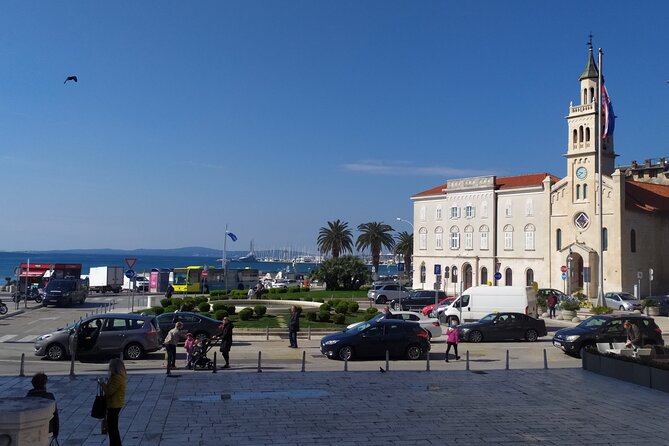
The tour meets at Autobusno stajalište Sv. Frane, on Trg Franje Tuđmana in Split, with a 9:00 am start. You’ll get an intro right away, plus a roadmap of what you’ll cover and why it connects.
This first setup does two useful jobs. It gives you a timeline, so later stops make sense. And it sets expectations that you’ll be looking at architecture and planning through a political lens, especially the era connected to Tito.
Practical tip: the square is central, and it’s described as being near public transportation, which makes it easier to reach if you’re already based in the city.
Split is the launch point for half the Dalmatian coast: islands, waterfalls, and a couple of countries besides.
Stop 1: WWII to Communism on Trg Franje Tuđmana
The first stop is short but important, about 25 minutes. You’re introduced to the Communist tour of Split and you’re walked through major WWII happenings in Split and Yugoslavia that led to the birth of the new communist state.
You also see pictures of wartime damage in Split. That visual grounding can change how you interpret the rest of the tour. Instead of treating the communist period as just a style of buildings, you start seeing it as a response to loss, rebuilding, and power shifts.
If you’re the kind of traveler who likes to understand why a city looks the way it does, this opening is the kind of context that makes the later stops click quickly.
Stop 2: Poljud Stadium and the China Wall in One Area
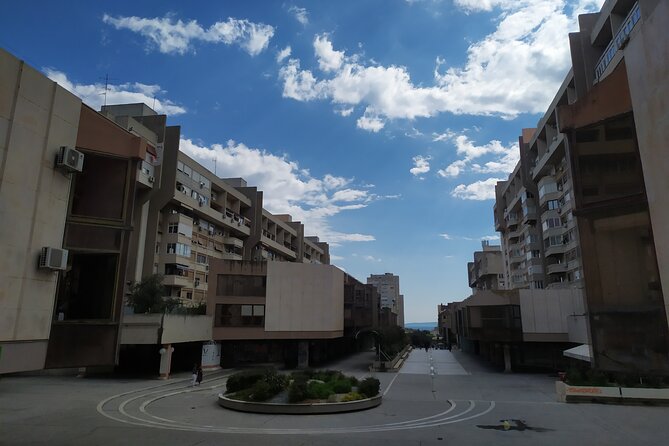
Next you get a quick panoramic break, about 10 minutes, focused on Poljud Stadium and what it represented in communist Yugoslavia.
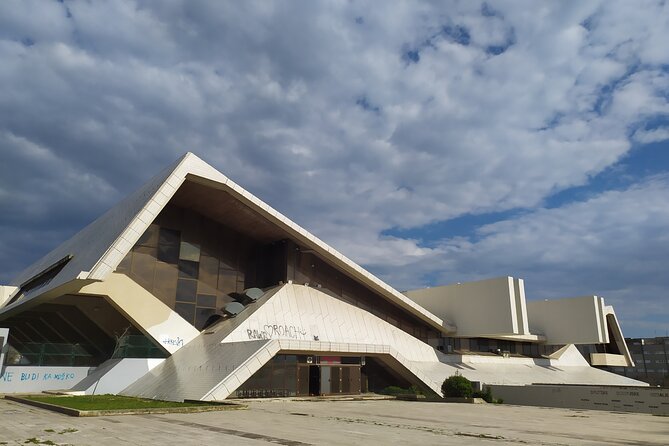
Poljud Stadium was built to host the biggest sport event in Yugoslavia at the time, the Mediterranean Games. The tour also notes that Poljud was one of the top exhibits in a Yugoslavia architecture exhibition held at MoMA in New York. That’s a great detail because it explains why the stadium feels more than just local sports infrastructure. It’s also an example of the international reach of Yugoslav design thinking.
In the same area, the guide brings your attention to the China Wall, described as the widest existing building in Split and a product of Yugoslav socialist architecture.
Why I think this stop works:
- You see how grand public projects were staged as symbols.
- You learn how architecture was used to project order, pride, and modernity.
Stop 3: Koteks and the Idea of Shopping Under Yugoslavia
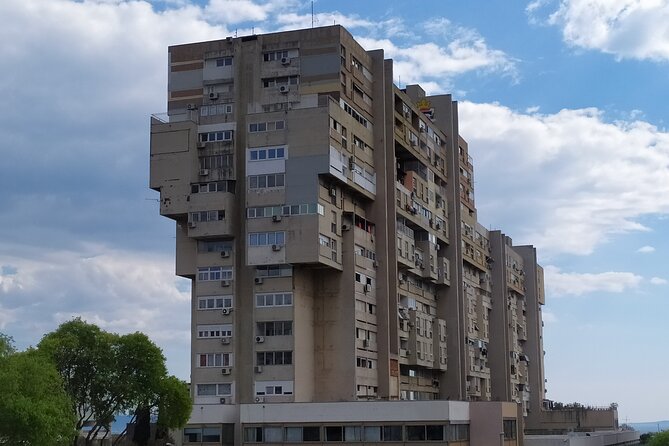
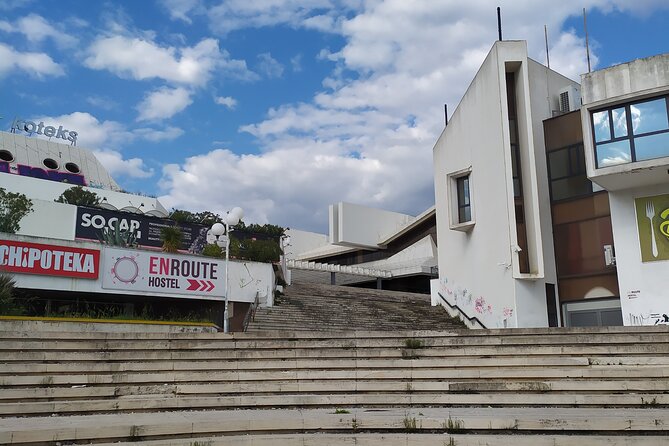
From there, you spend around 30 minutes around Koteks, described as the first shopping mall in Yugoslavia.
This is one of the more fun stops if you like everyday history. You walk around and hear what the communist-era idea of modern shopping looked like, plus why it had a short popularity window and later decay.
The tour also frames Yugoslav consumer life as something constantly balancing between an open West and a closed East. That helps you understand why people often had to be creative in sourcing goods.
A quick note on how to enjoy this stop: don’t expect it to feel like today’s mall experience. The point is the story, not the vibe. You’re looking at how the system tried to shape daily routines, including what people could buy and how easily.
Stop 4: Split 3, the Planned Neighborhood for Living, Working, and Resting
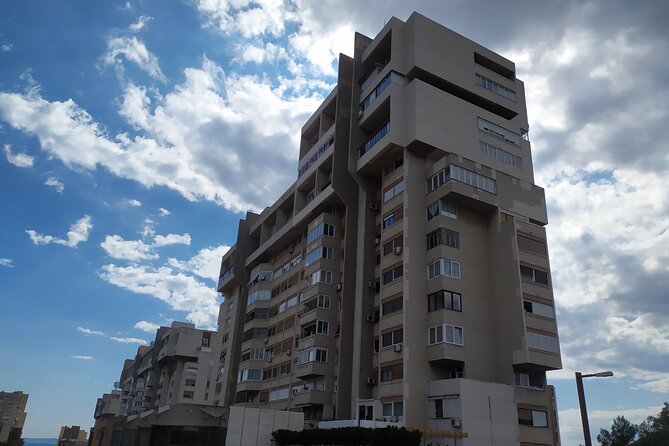
This is the big one, about 1 hour 10 minutes, and it includes free time. You’ll walk around the Split 3 neighborhood, which was purposely built during the communist era as a high-quality plan for living, working, and resting.
The tour points out that Split 3 became known internationally as an example of well-planned modern neighborhoods, and again, it mentions MoMA in New York as a place where Split 3 was featured in a Yugoslavia architecture exhibition. That’s the theme throughout: these were local projects, but the design attracted attention far beyond the region.
As you move around, you’ll hear about housing policy, the educational system, health system, economy, social life, and politics. Tito’s dictatorship is specifically emphasized through examples tied to the Split area.
One building mentioned by name is called Cruiser, which gives you a concrete reference point while the guide compares different architectural styles from local architects.
Why this neighborhood stop is valuable for your own understanding:
You can literally map policy onto streets and blocks. When the guide talks about social life and systems, you’re not just absorbing theory. You’re looking at what people actually inhabited.
And because you get free time here, you can pause, take photos, and choose where to focus. If you want to buy a drink or just decompress, this is the moment.
Two days in Split? Here's how to fill the second.
- From Split: Krka Waterfalls, Food & Wine Tasting Tour★ 4.9 · 6,598 reviews
- Split/Trogir: Blue Cave, Mamma Mia, Hvar and 5 Island Tour★ 4.6 · 6,320 reviews
- Blue Lagoon & 3 Islands Cruise with Lunch from Split★ 4.5 · 5,756 reviews
- Blue Cave and Hvar Tour – 5 Islands Tour from Split and Trogir★ 5.0 · 4,815 reviews
Stop 5: Kopilica Station and the Armored Train Symbol
The final stop centers on Split Predgrađe, around Kopilica railway station, with about 30 minutes.
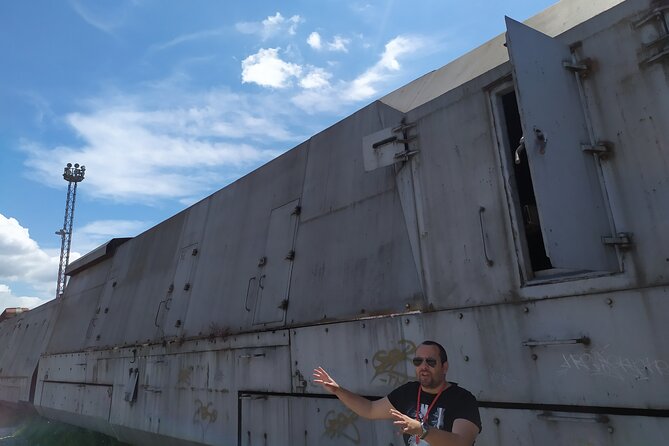
You’ll hear why Yugoslavia didn’t survive and why the end in the 1990s turned violent, ending in bloody war. The story is tied to what you see at the station: an armored train displayed there.
The tour treats the armored train as a symbol for the beginning of the bloody end of Yugoslavia, and it notes that the consequences changed relations among nations and religions in Southeast Europe.
This ending can hit harder than the architecture stops because it connects physical remnants directly to human cost. If you’ve stayed engaged through the earlier context, the finale feels less sudden.
It’s also the part of the tour where you may want to slow down. Stand back and take a moment to connect the object you see with what the guide explained earlier about power shifting and the breakdown of the system.
Guides, Pace, and the Small-Group Advantage (Max 8)
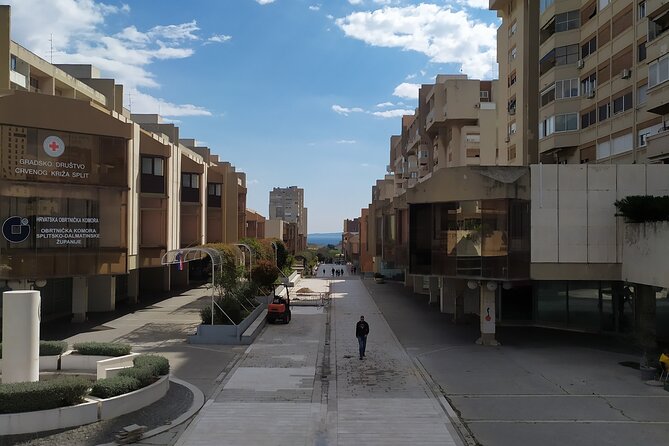
This is a boutique group tour with a maximum of 8 travelers. That matters more than it might sound, especially for a political topic.
In a larger group, the guide’s explanations can become fast and general. Here, it’s easier to ask follow-up questions and hear details without everyone competing for attention. The tour is offered in English, and you’re also given mobile tickets.
One practical bonus: the tour includes private transportation in an air-conditioned vehicle. Split can get warm in daylight, and you’re moving between multiple sites, so the comfort factor is real.
From a value standpoint, I also like that the tour calls out admission ticket free at each stop. That means your money mostly goes to the guide, the ride, and the time.
Price and Value: Is $108.14 a Good Deal?
At $108.14 per person for about 3 hours 30 minutes, you’re paying for three things at once:
- a small-group format (max 8),
- private air-conditioned transportation between dispersed sites,
- and deep, site-based explanation from a local historian and history teacher guide.
You’re not just getting a passive walking loop around the Old Town. You’re covering stadium architecture, planned neighborhoods, consumer-life history, and WWII-to-1990s political context, all without you having to research each location first.
Also included is a soda/pop stop. The soft local drink was popular in communist Yugoslavia and is still available today. It’s a small detail, but it reinforces the tour’s theme: everyday life, not just big dates.
If you normally hate tours that feel like a checklist, this one has a better chance of working because the guide builds meaning from place to place, and the transport helps you actually see the spread of sites.
What You’ll Learn About Tito, but in a Place-Based Way
The tour focuses heavily on Tito’s period and how communist leadership shaped systems in daily life. The key here is that it ties that to the built environment:
- public projects like Poljud Stadium,
- large-scale housing planning like Split 3,
- and consumer and social space ideas like Koteks.
You also get the broader political arc, from WWII to the communist state and then to the violent collapse in the 1990s.
If your goal is to understand Yugoslavia beyond stereotypes, this approach helps. You come away with a mental map of what the system tried to build and how people lived inside it.
Tips to Get the Most Out of Your 3.5 Hours
A few practical ways to make this tour land better:
- Wear shoes for walking and short outdoor stops. You’re moving through neighborhoods and station areas.
- Bring a light layer if it’s breezy. The tour requires good weather, but conditions can still shift.
- Have one question ready about architecture, education, or everyday life. The best tours are the ones where you talk back.
- Use the free time in Split 3 wisely. It’s your chance to slow down and look without rushing.
And if you’re traveling with someone who prefers old stone and sea views only, you can still make it work. The architecture is very concrete and visual, and the story is easier to follow than most political tours.
Who Should Book This Communist Tour of Split?
I’d put this tour on your list if:
- you’re curious about Yugoslavia and how communist planning showed up in real buildings,
- you like architecture with a story attached,
- you want the Tito era explained through Split’s specific examples,
- you enjoy small groups and direct conversation with a guide.
I’d skip it or think twice if:
- you want only postcard tourism,
- politics and the 1990s conflict topics will make you uncomfortable,
- you’re looking for a relaxed, purely scenic afternoon.
Should You Book?
If you’re the kind of traveler who loves figuring out why a city looks the way it does, this is a smart buy. The pairing of a site-based route with a local historian and history teacher guide makes the communist period feel tangible, not abstract. Plus, with a max of 8 people and private air-conditioned transport, the experience stays comfortable while still being information-dense.
If you’re unsure, here’s my simple decision rule: book it if you want Split beyond the usual tourist path. Skip it if your priority is only classic old-town views and light commentary.
FAQ
What is the duration of the Small-Group Communist Tour of Split?
The tour lasts about 3 hours 30 minutes.
Where do I meet the guide in Split?
You meet at Autobusno stajalište Sv. Frane, Trg Franje Tuđmana, 21000 Split, Croatia.
What time does the tour start?
The start time is 9:00 am.
How large is the group?
This tour has a maximum of 8 travelers.
Is the tour offered in English?
Yes, it is offered in English.
What is included in the price?
You get soda/pop, an air-conditioned vehicle, and private transportation.
Are there any admission tickets required?
Admission tickets are listed as free for the stops included in the tour.
Do I receive a mobile ticket?
Yes, it includes a mobile ticket.
What is the cancellation policy?
Free cancellation is available up to 24 hours in advance for a full refund. If you cancel less than 24 hours before the start time, the amount paid is not refunded.
What happens if the weather is bad?
The experience requires good weather. If it’s canceled due to poor weather, you are offered a different date or a full refund.
Recently added around Split
- Private VIP Brac and Hvar Day Trip from Split
★ 5.0 · 1 review - Private Transfer From or To the Split Airport
★ 5.0 · 1 review - Brač Half Day Beach Party Transfer to Olife Beach Club
★ 5.0 · 1 review - Private Transfer from Split to Zagreb, Hotel-to-hotel, English-speaking driver
★ 5.0 · 1 review - Airport transfers
★ 5.0 · 1 review - Private ”Game of Thrones” Walking Tour in Split (entrance tickets included)
★ 5.0 · 1 review
Tours, compared.
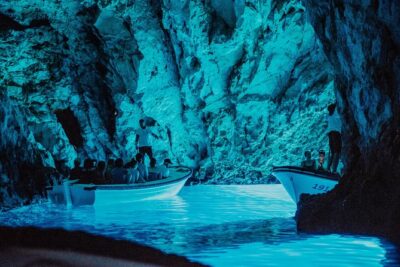
Blue cave, Mamma Mia and Hvar, 5 islands speedboat tour
Read our review →
Blue Cave, Mamma Mia, Hvar and 5 Island Tour
Read our review →
Blue Cave and Hvar Tour – 5 Islands Tour from Split and Trogir
Read our review →
Krka Waterfalls Tour, Boat Cruise & Swimming
Read our review →