
Reviewed · TROGIR TRIPS
Split and Trogir Half Day Tour from Split (with port pickup)
Four hours, two cities, big wow. Split and Trogir are packed with centuries of leftovers, and this tour is built to show you the right parts without wasting time. You get UNESCO-listed Trogir plus Split’s Roman core, all with air-conditioned coach comfort and live commentary in English.
My favorite part is the simple flow: central pickup from your ship area and a finish in the city center so you can hop back into your day fast. I also love how the stops connect the dots, from the Roman emperor palace world to the Venetian-era details you see in Trogir, with guides like Tina and Sandra getting especially strong notes for clear, friendly storytelling.
One thing to plan for: there is some walking, and a couple of the best-known sites are not included in the ticket price, so you may still pay entry at places like Diocletian’s palace and the Cathedral of St. Domnius. It is not a long hike, but it is not a zero-effort stroll either.
In This Review
- Key highlights at a glance
- Why Split plus Trogir works so well in 4 hours
- Price and logistics: what $78.61 buys you
- Coach comfort and the cruise ship timing reality
- Stop 1: Palazzo di Diocleziano, where Roman walls become your street
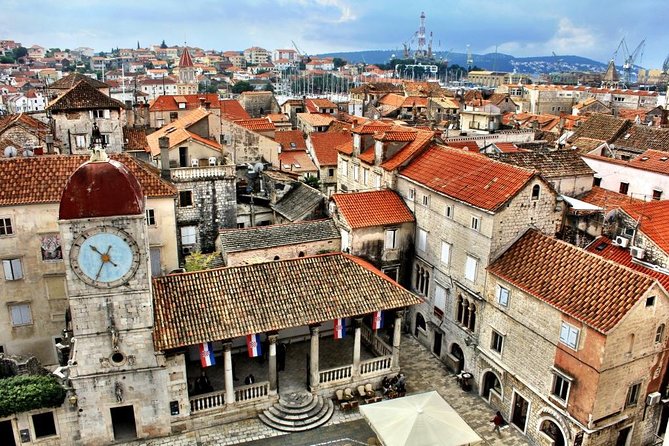
- Stop 2: Trogir UNESCO old town, from Greek roots to Venetian layers
- Stop 3: Cathedral of Saint Domnius, the church and the bell tower story
- Stop 4: Kula Karmelengo, the castle that shows up as performance space
- Stop 5: Prokurative, Split’s Venetian-feeling square
- Stop 6: Saint Lawrence’s Cathedral, a Romanesque-Gothic mix in Trogir
- Walking level, pace, and how to make it comfortable
- Guide quality is the real differentiator
- Who should book this tour, and who should skip it
- Should you book Split and Trogir Half Day Tour from Split?
- FAQ
- How long is the Split and Trogir half day tour?
- What is included in the price?
- Are entrance fees included?
- Where does the tour start and end?
- Is there drop-off included after the tour?
- Do I need to bring anything for the day?
- What language is the tour in?
- What happens if I miss the tour due to late or non-arrival of my cruise ship?
Key highlights at a glance
- Port pickup makes cruise days feel manageable
- Air-conditioned coach keeps the heat down
- Guided time focuses on the most meaningful stops
- Trogir’s UNESCO old town gives you real variety
- Some entrances cost extra, plan for it
- You get a guided route plus time to wander on your own
Why Split plus Trogir works so well in 4 hours
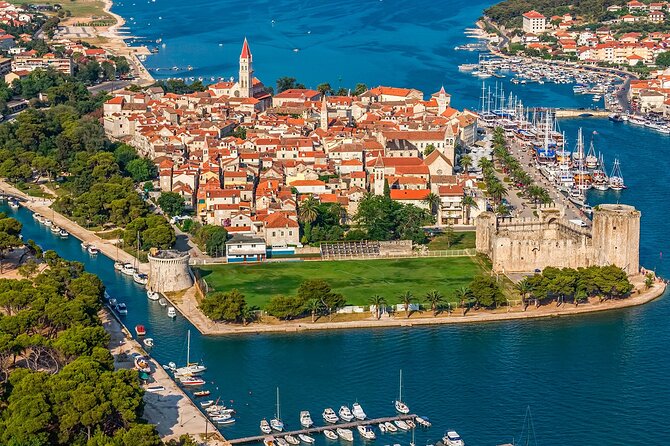
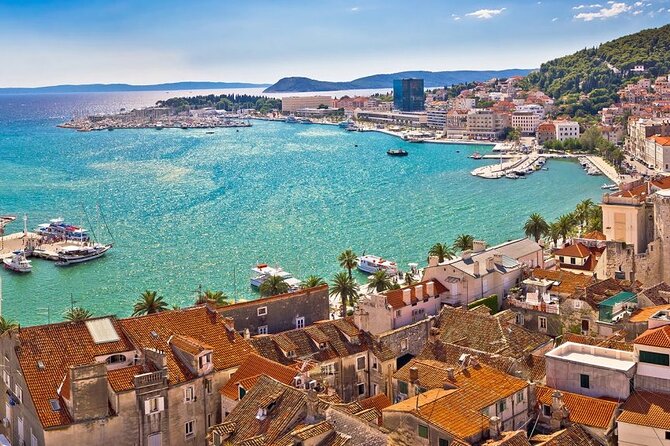
Split and Trogir sit close enough that you can do both on a half day, but far enough that you feel like you changed places. Split gives you the raw power of Roman planning, while Trogir feels more like a refined museum town, shaped by Greek origins and later Venetian influence.
This format matters because the sites themselves take time. Diocletian’s palace is not just a photo spot, it is an active maze of streets and buildings. Trogir’s center, meanwhile, is compact but detailed. Doing both means you see the big story arc in one sitting: Roman foundations, medieval layers, and the coastal city life that kept building on top of itself.
If you are on a cruise stop day, this kind of tight schedule is also the difference between seeing the highlights and just collecting “I was there” pictures.
Price and logistics: what $78.61 buys you
At $78.61 per person for about 4 hours, you are paying for more than sightseeing. You are paying for transportation, a guide, and the time-saving organization that keeps you from figuring out bus routes, meeting points, and timing windows yourself.
What is included that actually helps:
- Live commentary on board and a professional guide
- Port pickup (this is huge for cruise passengers)
- An air-conditioned vehicle
What is not included:
- Entry fees for some stops
- Food and drinks
One practical note: the tour includes pickup, but it does not include drop-off. You end in the city center, and for cruise passengers, you should plan on an about 20-minute walk back to the ship terminal area.
So think of this as a guided “see the must-sees” excursion with transport, not a door-to-door shuttle back to your exact pier gate.
A whole old town on an islet
Coach comfort and the cruise ship timing reality
The tour runs in English and uses a mobile ticket. The day is built around your arrival window, and if you are on a cruise, you are asked for your ship name and key times like docking and re-boarding.
That matters because if your ship is late or you miss the tour due to timing, refunds are not issued. The flip side is that when your timing matches the plan, it usually runs smoothly, which is why this is such a common choice for cruise stops.
Also, the itinerary is planned for weather and operates in all conditions. That is good news if you arrive in summer heat, but it also means you should bring a hat, sunscreen, and a light rain layer if the forecast looks shaky.
Finally, there is a group-size cap of 50 travelers maximum, and in practice many people report a small-group feel. That usually means fewer delays at each stop and more ability to hear the guide without leaning forward the whole time.
Stop 1: Palazzo di Diocleziano, where Roman walls become your street
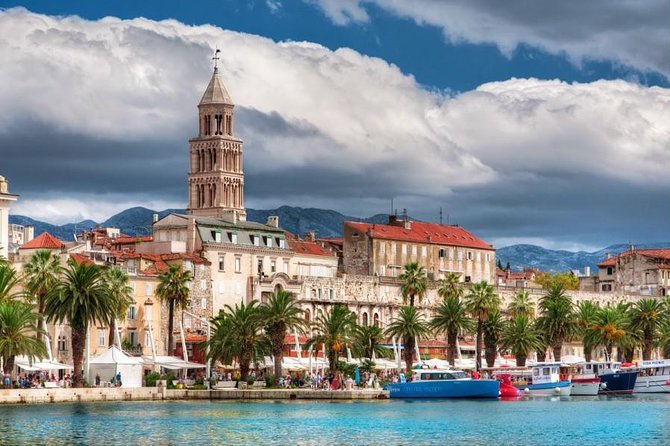
Your first major stop is the Palazzo di Diocleziano, the palace built around the turn of the 4th century by Emperor Diocletian. Today, it is not just ruin. It is about half of Split’s old town and city center, meaning you walk through a living Roman shell.
Time on site is about 20 minutes, and entry is not included. That can feel short if you want to chase every doorway, but it is long enough to orient yourself and understand why this place shaped Split.
Practical tip: use the guide’s orientation time to learn how the palace relates to today’s streets. Once you understand the Roman layout, the rest of Split starts making sense fast, and you will waste less time later.
Why this stop is worth starting with: it sets your “historical map” before you move to Trogir. By the time you reach the medieval and Venetian pieces, you will already know what is older, what was layered later, and what changed because people kept living there.
Stop 2: Trogir UNESCO old town, from Greek roots to Venetian layers

Then you ride along the coast to Trogir, a UNESCO World Heritage Site founded by Greek colonists in the 3rd century BC. The city’s appeal is that it keeps a continuous urban tradition for roughly 2,300 years.
You get about 1 hour here for the UNESCO circuit, and entry is free for this stop. That hour is the heart of the “two-city” magic because it is where Trogir turns from a name to a feeling.
What makes Trogir different from Split for most visitors:
- Split is built around a Roman palace core.
- Trogir is built around a tightly layered old town center, with church architecture sitting right next to Venetian-era styling.
Trogir’s Romanesque churches are part of the story, but you also see Renaissance and Baroque buildings from the Venetian period. The result is a walking route that keeps changing the visual theme every few blocks.
Practical tip: bring comfortable shoes and be ready for uneven stone streets. The route is not extreme, but it is real old-town pavement.
Stop 3: Cathedral of Saint Domnius, the church and the bell tower story
Next up is the Cathedral of Saint Domnius complex. This is a blended structure formed from an Imperial Roman mausoleum, with a bell tower. The church is dedicated to the Virgin Mary, and the bell tower is linked to Saint Domnius.
Time here is about 20 minutes, and entry is not included.
This stop is short, but it is not filler. The cathedral complex helps you see how different religious eras used the same physical starting points. You are basically looking at how one monumental Roman idea got reinterpreted and repurposed.
Practical tip: even if you do not pay to go inside, pause outside and listen to the guide’s explanation. The bell tower and the cathedral together are easier to understand when you know what you are looking for.
Two days in Split? Here's how to fill the second.
- Split: Krka Waterfalls Trip with Boat Cruise and Swimming★ 4.8 · 10,519 reviews
- From Split: Krka Waterfalls, Food & Wine Tasting Tour★ 5.0 · 9,326 reviews
- Blue cave, Mamma Mia and Hvar, 5 islands speedboat tour★ 5.0 · 7,150 reviews
- From Split: Krka Waterfalls, Food & Wine Tasting Tour★ 4.9 · 6,598 reviews
Stop 4: Kula Karmelengo, the castle that shows up as performance space
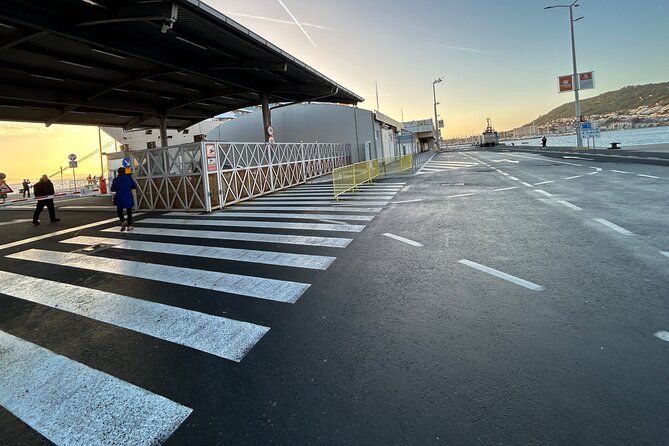
You then see Kula Karmelengo, a castle built in the mid-15th century as part of an expansion connected to the Veriga Tower. In the warmer months, it is used as a location for performances.
Time is about 20 minutes, and entry is not included.
This stop gives you a different kind of historical viewpoint. Churches tell you about belief. Castles and towers tell you about defense and administration. And because this one is tied to performance in summer, it also shows how a historic structure stays in use instead of becoming only a backdrop.
If you are the type who likes city walls and “why this place was built here” thinking, you will probably enjoy this one.
Stop 5: Prokurative, Split’s Venetian-feeling square
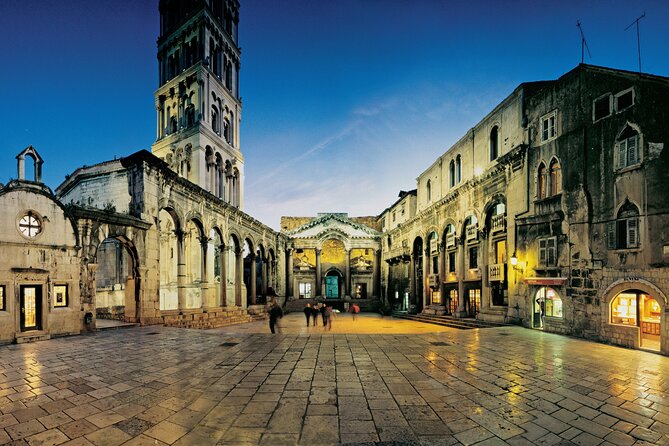
Back toward Split’s visual identity, you stop at Prokurative. This structure was built in the 19th century under supervision of General Marmont, and initiated by Split’s mayor Antonio Bajamonti. The design draws inspiration from Italian architecture of the time and closely resembles Venice’s St. Mark’s Square.
Time is about 15 minutes, and entry is free.
In a half day, a quick square stop can sound like a break. Here, it actually functions as a cultural hinge. You see how Split kept borrowing style cues from Italy and the wider Adriatic world.
Practical tip: spend a minute looking up and around, not just straight ahead. The impact of a square like this is in proportion and framing, not in one single object.
Stop 6: Saint Lawrence’s Cathedral, a Romanesque-Gothic mix in Trogir
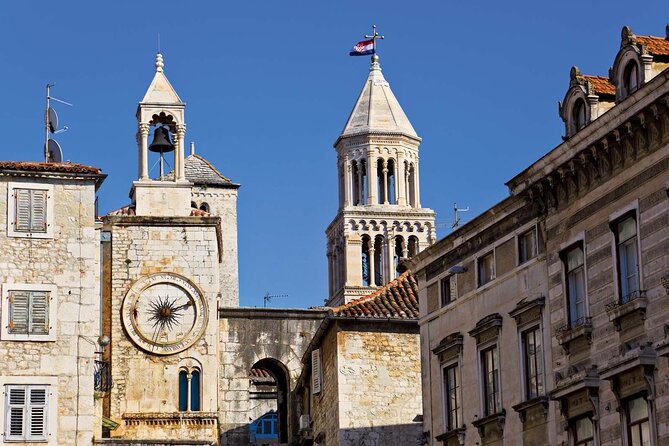
The final stop is Saint Lawrence’s Cathedral in Trogir. This is a Roman Catholic triple-naved basilica built in Romanesque-Gothic. Because construction stretched across several centuries, the church shows styles that succeeded each other in Dalmatia.
Time is about 15 minutes, and entry is free.
Why it lands well at the end: by now you have the Roman story from Diocletian’s palace, the UNESCO old town layout, the cathedral complex basics at St. Domnius, and the tower/castle viewpoint. Saint Lawrence gives you a satisfying “last photo” that also helps you understand how church architecture evolved over time rather than staying frozen.
If you are short on energy, this is the stop where you can take in the look from a respectful distance. A quick stop here still pays off because you can spot the Romanesque-Gothic blend with minimal effort.
Walking level, pace, and how to make it comfortable
This tour is roughly 4 hours, but timing at each stop includes transition time and a guided explanation window. In practice, it is a compact route with a good amount of movement. Some people put it around a Level 2 walking pace, meaning you should expect several blocks of old-town walking and standing periods.
My advice if you want the day to feel easy:
- Wear shoes you trust on stone streets.
- Bring water, even though drinks are not included.
- Use the guided segments to rest your feet, then use free moments for photos and a slow wander.
Also, the tour is designed so you are not constantly rushed. Multiple guides reported a careful approach, with time to explore between structured parts and help for getting the taxi back if needed.
Guide quality is the real differentiator
This is one of those tours where the itinerary could look similar on paper, but the guide makes it work. In the feedback you provided, names like Tina, Sandra, Hrvoje, Roko, Josipa, and Tia show up with strong praise for being organized, friendly, and able to answer questions without making you feel left behind.
If you love history that feels like a story instead of a lecture, you are in the right place. Guides here tend to connect the sites to the city’s larger identity: why Diocletian’s palace shaped Split, why Trogir stayed so tightly preserved, and how Venetian-era choices show up in the architecture.
And they seem to manage group needs well, including handling weather changes like rain and staying on pace.
Who should book this tour, and who should skip it
This tour is a great match if you:
- Want a high-efficiency half day from Split with a serious UNESCO focus
- Like guided context, especially for Roman and medieval architecture
- Are on a cruise stop day and want port pickup
- Prefer comfort during transport, thanks to the air-conditioned coach
You might want to choose something else if you:
- Hate walking on uneven stone streets
- Want long, ticket-heavy time inside major sites
- Expect a fully guided “enter every building” schedule, since some entry fees are not included and most stops are time-limited
Should you book Split and Trogir Half Day Tour from Split?
If you want the smartest use of a tight schedule, I think this is an easy yes. You get the key anchors in both cities, the coach handles the between-town transfer, and the guides are consistently praised for keeping the story clear and fun.
It is also a good value for the logistics alone. Cruise days are stressful, and the port pickup plus guided plan reduces most of the things that normally go wrong.
Just go in with two expectations dialed in: there will be some walking, and you may pay entry at a couple of the big-ticket sites. If that fits your style, you will likely leave with a clear mental map of Split and Trogir, not just a pile of photos.
FAQ
How long is the Split and Trogir half day tour?
The tour lasts about 4 hours.
What is included in the price?
The price includes live commentary on board, a professional guide, port pickup, air-conditioned vehicle, and all taxes and handling charges.
Are entrance fees included?
No. Entry fees are not included for some stops, including Palazzo di Diocleziano and Cathedral of Saint Domnius. Other stops are free, such as Prokurative and Saint Lawrence’s Cathedral.
Where does the tour start and end?
It starts at New Split Berth for cruising ships (Obala kneza Domagoja 16, Split). It ends in Split Riva in the city center.
Is there drop-off included after the tour?
Drop-off is not included. The tour ends in the city center, and for cruise ships there is an about 20 minute walk back to the ship’s terminal. The guide can help with getting a taxi if needed.
Do I need to bring anything for the day?
Wear footwear suitable for walking on old-town streets. The tour runs in all weather, so dress appropriately for heat or rain.
What language is the tour in?
The tour is offered in English, and you will receive live commentary on board.
What happens if I miss the tour due to late or non-arrival of my cruise ship?
Refunds are not issued if the tour is missed because of late or non-arrival of the cruise ship.
Recently added around Split
- Private VIP Brac and Hvar Day Trip from Split
★ 5.0 · 1 review - Private Transfer From or To the Split Airport
★ 5.0 · 1 review - Brač Half Day Beach Party Transfer to Olife Beach Club
★ 5.0 · 1 review - Private Transfer from Split to Zagreb, Hotel-to-hotel, English-speaking driver
★ 5.0 · 1 review - Airport transfers
★ 5.0 · 1 review - Private ”Game of Thrones” Walking Tour in Split (entrance tickets included)
★ 5.0 · 1 review
Trogir Trips, compared.
Blue Cave, Mamma Mia, Hvar and 5 Island Tour
Read our review →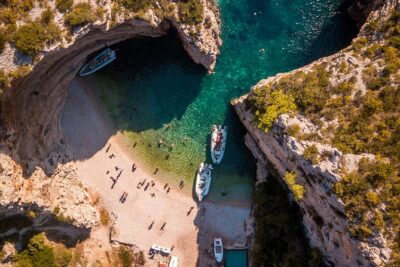
Blue Cave and Hvar Tour – 5 Islands Tour from Split and Trogir
Read our review →
Krka Waterfalls Day Tour with Boat Ride from Split and Trogir
Read our review →
Krka Waterfalls tour with Trogir Walking tour and Krka panoramic boat cruise
Read our review →
Krka National Park Tour with tour Guide & Wine tasting from Split & Trogir
Read our review →
Hvar, Brač & Pakleni islands cruise with lunch & drinks from Split & Trogir
Read our review →
Mostar and Herzegovina Tour with Kravica Waterfall from Split & Trogir
Read our review →Browse the lists this tour appears in