
Reviewed · DIOCLETIAN'S PALACE TOURS
Split Diocletian Palace Highlights – Private walking tour
Roman walls still hum in Split. This private 90-minute walking tour strings together the best Diocletian’s Palace sights, from the Riva promenade to the Peristyle, with small-group attention and an outside-only route that keeps things smooth.
I especially like the way you get lived-in context, not just monuments on a map. With a guide like Dana setting the scene, you walk away understanding why the palace feels more like a neighborhood than a museum.
One consideration: you see these places from the outside only, so if you were hoping for deep interior access, plan for other stops or add-ons.
In This Review
- Key highlights you should care about
- Why Diocletian’s Palace Works Best on Foot
- From the Split Riva to the palace walls
- Diocletian’s Palace: the “not-a-museum” moment
- Diocletian’s cellars, and why scale hits differently
- The Peristyle: ceremony in the open air
- Split Cathedral and the Roman-to-Christian shift
- Gates that lead to markets, not dead ends
- Triclinium and the dining-room story
- Vestibulum of private chambers: where guests do not belong
- Temple of Jupiter, now a baptistery
- The west gate, Propugnaculum, and the square Pjaca
- Golden Gate and the road to Salona
- Green Market and the final return to the Riva
- Price, timing, and what you really get for $137.80
- Who this private palace walk suits best
- Should you book it?
- FAQ
- How long is the Split Diocletian Palace Highlights private walking tour?
- Where does the tour start and end?
- Is the tour offered in English?
- Is a mobile ticket included?
- Are entrance fees included for the sights?
- Does the tour include entry inside the cathedral or the temple?
- What group size should I expect?
- What is included in addition to the walking tour itself?
- Does the tour require good weather?
- What is the cancellation policy?
Key highlights you should care about
- Diocletian’s Palace, lived-in today, with houses and stores inside the walls
- Cellars and the Peristyle, where you get scale and meaning fast
- Gates that connect to markets, so the Roman setting feels real, not staged
- Triclinium and private-chamber views, including the dining-room story and the vestibule
- Cathedral and Temple of Jupiter exteriors, showing how new faiths repurposed old power
Why Diocletian’s Palace Works Best on Foot
Diocletian’s Palace is the kind of place where your eyes need help. Up close, the walls do not feel like a distant landmark, they feel like the frame around real daily streets. That is why this tour format is so useful: it helps you link the big ideas to what you are actually standing next to.
It is also a smart length. At about 1 hour 30 minutes, you get a strong orientation without losing half your day to planning, crowd navigation, or wandering. And since the route is designed as a private walking tour for a small group, you can ask the history questions that usually get ignored when you are stuck in a larger crowd.
The biggest bonus for me is the balance. You get the palace essentials, but you also get the modern Split energy that runs right through the same spaces.
From the Split Riva to the palace walls
You start at the Riva, Split’s promenade, where the mood is instantly recognizable. This is where locals and tourists grab coffee, people-watch, and generally do the very human thing of enjoying the sun and the view. The tour begins here for a reason. It gives you a baseline for where everything sits, so later gates and squares make sense instead of feeling random.
After that easy warm-up, you head into Diocletian’s Palace. The change in feel happens quickly. One minute you are on the promenade with cafes and restaurants all around, and the next minute you are walking within walls built over 1700 years ago.
Expect this start to set the tone. Your guide will use the Riva as your orientation point, then gradually pull you inward toward the palace highlights.
Plenty more to do around Split
Diocletian’s Palace: the “not-a-museum” moment
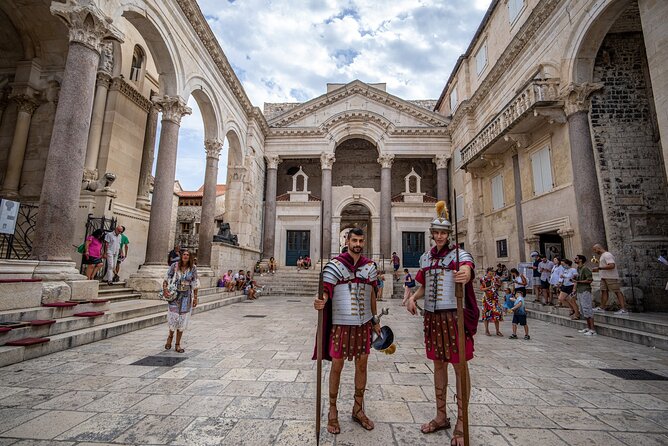
The palace is not a museum in the classic sense. Inside the walls are homes and stores, and there is real activity. That alone changes how you experience the site. Instead of thinking of the palace as something locked away behind ropes, you start thinking of it as a living container that has kept evolving.
You will spend time looking at the palace itself early in the walk, then you will keep returning to its main themes through gates, ceremonial spaces, and storage areas. The guide approach matters here. When the explanations are clear, you start to see patterns, like where authority was displayed, where goods were stored, and where people gathered.
Also, the fact that the tour is outside-only is a practical advantage. You can keep moving, stay focused on context, and avoid the most frustrating part of sightseeing in historic centers, the “where do we line up” problem.
Diocletian’s cellars, and why scale hits differently
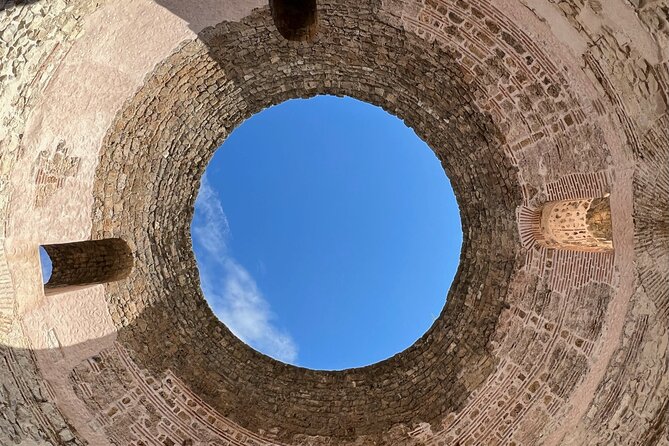
One of my favorite stops on this route is the cellars. You enter through the south gate into the palace’s underground spaces, still built more than 1700 years ago and described as very well preserved. Even from outside views, the cellars do something powerful: they show you the palace’s dimensions.
This is where you stop treating the palace like a single building and start treating it like an entire system. Roman planning was not just about fancy surfaces, it was also about storage, control, and function. The cellars help you understand the practical side that supports everything above.
If you like history that connects structure to everyday reality, this is a key moment. It is not just “ancient stuff.” It is a clue to how the palace operated.
The Peristyle: ceremony in the open air
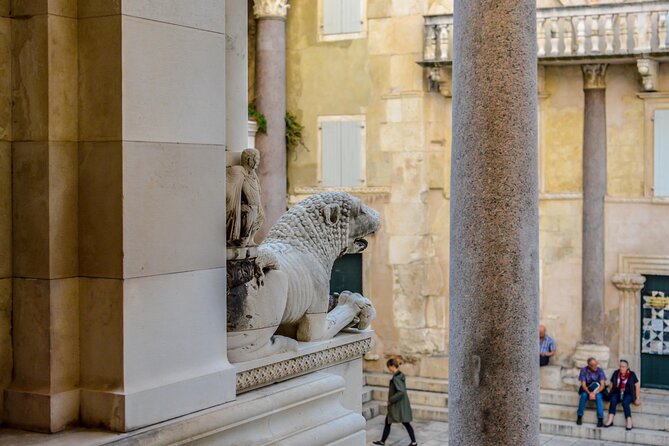
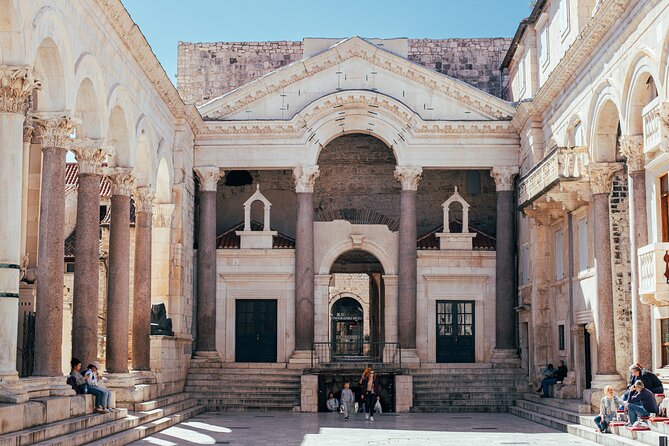
Next comes the Peristyle, the sacral meeting place in Diocletian’s time. This is the spot tied to performance and power, where Diocletian showed himself and was worshipped as the son of the Roman god Jupiter.
Even if you are only looking from the outside, the Peristyle layout is the kind of space that makes the story feel believable. It is easy to imagine that this was where people came to witness authority, not just pass through.
A good guide will keep this stop grounded. You should expect an explanation of what made the Peristyle special, and how its meaning differed from practical spaces like gates or markets.
Split Cathedral and the Roman-to-Christian shift
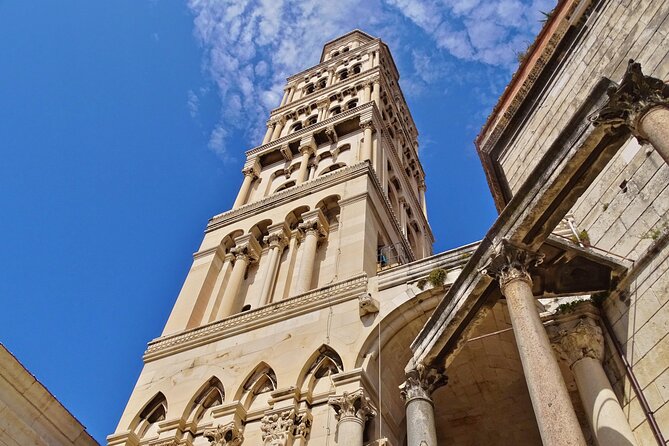
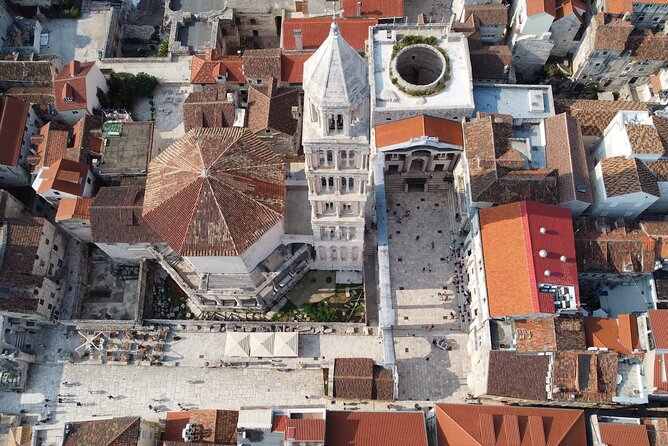
You will also get a look at the Cathedral of Saint Domnius from the outside. The framing is worth paying attention to. The cathedral was for some time the mausoleum of Diocletian, and during Christianization the coffin and mortal remains disappeared, transforming a pagan mausoleum into a Christian cathedral.
From a visitor perspective, the value here is the “continuity with change” idea. You are not just seeing a church facade. You are seeing how later societies reused, reshaped, and reinterpreted existing Roman structures.
Because the tour focuses on outside viewing, your time is efficient. You get the key story beat without spending additional time hunting tickets or fitting in longer interior visits.
Two days in Split? Here's how to fill the second.
- Split: Krka Waterfalls Trip with Boat Cruise and Swimming★ 4.8 · 10,519 reviews
- From Split: Krka Waterfalls, Food & Wine Tasting Tour★ 5.0 · 9,326 reviews
- Blue cave, Mamma Mia and Hvar, 5 islands speedboat tour★ 5.0 · 7,150 reviews
- From Split: Krka Waterfalls, Food & Wine Tasting Tour★ 4.9 · 6,598 reviews
Gates that lead to markets, not dead ends
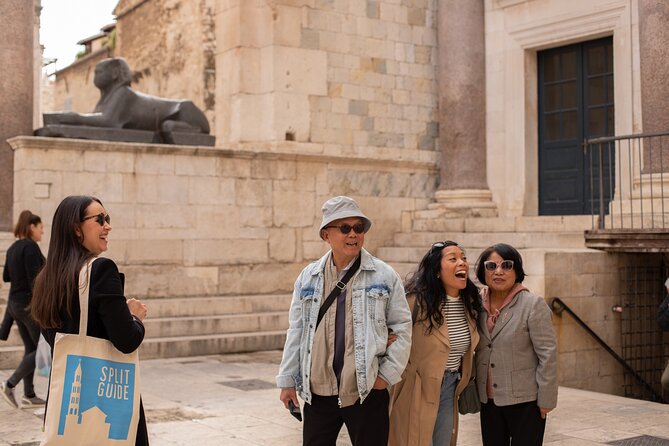
The tour has a smart rhythm: it repeatedly uses gates as transitions between themes. One of the most fun examples is the iron gate that connects you to the market area. The gate was walled up several times over the centuries and reopened in the 1940s, and today it leads into a market where local products are offered.
That is not just a Roman detail. It is a visitor advantage. Instead of finishing one historical zone and backtracking, you naturally flow into another part of the city’s everyday life.
As you keep moving through the palace area, you will also see how different gates served different directions and different purposes. The east side includes the Green Market, where fresh fruits, vegetables, and traditional foods are sold every day. These are short stops, but they make the palace feel less like a separate world and more like the city’s real center.
Triclinium and the dining-room story
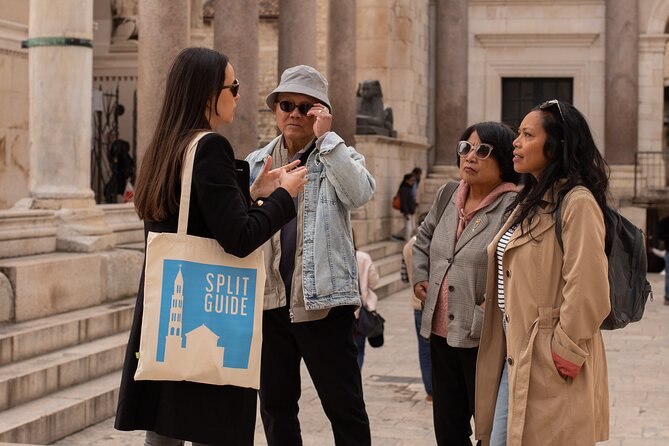
The triclinium stop is where the tour gets a bit more human. Triclinium is Latin for dining room, and it is the space tied to the way Diocletian dined with guests. The details provided for this stop are specific, Mediterranean dishes, local wine and fish, and even honey.
The guide explanation also includes how many courses could show up in one evening, often up to 20. That is the kind of detail that makes the ancient site feel less abstract. You are not just looking at a wall, you are picturing a long dinner with a menu that tells you something about what the region valued.
One practical note: since the tour is outside-only, do not treat this stop like a full interior reconstruction. It is more about the meaning and the spatial logic, with the dining room idea giving you a lens to interpret what you are seeing.
Vestibulum of private chambers: where guests do not belong
Another rewarding stop is the vestibule of Diocletian’s Palace. This was the entrance area to Diocletian’s private chambers, and that detail matters. It helps you understand that not every space in the palace was meant for visitors, crowds, or public ceremony.
Even from the outside, this kind of stop adds depth to everything you have already seen. Once you know where the private spaces begin, the palace becomes less of a single “sight” and more of a layered world with boundaries.
In a good private format, you will have time to ask quick follow-up questions at the exact spot they apply. That is one reason small-group tours feel more efficient for history lovers.
Temple of Jupiter, now a baptistery
The Temple of Jupiter is now a baptistery. You will look at it from the outside, and the concept is a powerful one. The palace does not just survive, it changes roles. A site associated with Jupiter becomes part of later Christian use.
This is also a good stop for understanding Rome’s long afterlife. If you walked through the cathedral section already, this one reinforces the same theme: later eras did not always erase. Often they repurposed.
Because the tour keeps moving, you do not get stuck reading plaques for too long. You get the main story and then you transition into the next visual clue.
The west gate, Propugnaculum, and the square Pjaca
The west gate is where the defensive logic becomes visible. This iron gate was built as a double gate, called Propugnaculum. Between the gates, an enemy could be trapped and hit with stones, arrows, and hot oil.
That is a pretty intense detail, and it is exactly the sort of thing a guide helps you picture. You are standing where the threat-control plan once played out, and suddenly the geometry of gates feels practical, not just decorative.
When you leave the west gate area, you enter the beautiful square called Pjaca. This is a nice shift. After heavy ceremonial and defensive storytelling, you get a more open, city-friendly public space.
Golden Gate and the road to Salona
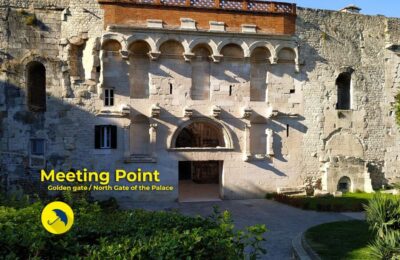
The Golden Gate is the north gate of the palace, described as the most important gate in Roman times. From here, the road led to the city of Salona, the capital of the Roman province.
This stop is brief, but it gives you a big-picture takeaway. When you connect a gate to a road heading out of the palace, you understand how the palace functioned as more than an isolated residence. It was tied to administration and movement across the wider Roman region.
If you like history that includes logistics and infrastructure, this moment is a strong payoff for a short stop.
Green Market and the final return to the Riva
The Green Market is on the east side of the palace and is framed as a daily place for fresh produce and traditional foods. It is a short segment, but it helps you balance the entire tour. After Roman walls and ceremonial spaces, you end up back in a lived, everyday setting.
Then you return along the walls to the promenade again, back to the Riva. It is the same “see and be seen” atmosphere, but now you have context for what you just crossed. That loop matters. Your brain locks the palace into the city map faster when you end back where you started.
Price, timing, and what you really get for $137.80
At $137.80 per person for an approximately 1 hour 30 minutes private walking tour, you are paying for three things: a guide who connects the story beats, a tight route that covers the palace highlights, and a small-group experience that keeps attention on you.
The outside-only format also affects value. You are not buying multiple entrance fees because the sights are visited from the outside only. That usually makes the cost easier to predict for a short tour like this, especially if you were already planning to spend time wandering on your own.
Where the value really shows is in the quality of interpretation. The tour holds a 5 out of 5 rating across 35 reviews and is recommended by 100% of people, with one standout comment about Dana sharing lots of history and stories. That aligns with what you should look for when paying for a guide: clear explanations that help you understand what you are seeing, not just a list of names.
If you were hoping to do the palace like a museum day, this is not that type of tour. But for orientation and the key highlights, it can be a very efficient way to get your bearings fast.
Also, it is booked about 22 days in advance on average. That is a hint to plan ahead, especially if your dates are limited.
Who this private palace walk suits best
This works especially well if you want the major Diocletian’s Palace themes without extra ticket planning. It is also ideal for anyone who likes history told through place-based details, gates and ceremonial spaces, rather than through long museum rooms.
You will likely like it if you are traveling with a partner or small group and want the flexibility for your pace. The tour is designed for a group of maximum 6 participants, and it is capped at a maximum of 10 travelers overall. Either way, the small scale is meant to keep the experience personal.
It is offered in English, includes recommendations for restaurants, bars, and leisure activities, and can be individually customized. The guide can also adapt the tour to special needs if you inform them in advance.
And if you need service animals, they are allowed. The meeting points are near public transportation, which makes it easier to fit into your day.
Should you book it?
Yes, book it if your goal is a focused, guided orientation to Diocletian’s Palace highlights, with outside-only viewing that keeps your time efficient. I would also book it if you care about how the palace ties into the current city, since you are moving between palace spaces and market areas like the Green Market and market-adjacent gate access.
Skip it or pair it with additional tickets if you want lots of interior museum-style exploration. This tour is built for seeing the key spaces, understanding what they meant, and then letting Split’s streets carry you onward.
In plain terms: it is a good choice when you want to leave Split’s old center feeling like you truly understand what you saw.
FAQ
How long is the Split Diocletian Palace Highlights private walking tour?
The tour is about 1 hour 30 minutes.
Where does the tour start and end?
It starts at the Model of the historical core of the city of Split on Obala Hrvatskog narodnog preporoda 23, Split, Croatia, and ends at Republic Square on Prokurative, Split, Croatia.
Is the tour offered in English?
Yes, it is offered in English.
Is a mobile ticket included?
Yes, the tour includes a mobile ticket.
Are entrance fees included for the sights?
The stops are visited without entrance fees. The sights are viewed from the outside only.
Does the tour include entry inside the cathedral or the temple?
No. The itinerary specifies outside viewing, and some stops note no entrance fee and that viewing is from outside.
What group size should I expect?
It is designed for a group of maximum 6 participants, and the activity has a maximum of 10 travelers.
What is included in addition to the walking tour itself?
You get recommendations for restaurants, bars, and leisure activities, and the tour can be individually customized.
Does the tour require good weather?
Yes. This experience requires good weather, and if it is canceled due to poor weather you are offered a different date or a full refund.
What is the cancellation policy?
Free cancellation is available. You can cancel up to 24 hours in advance for a full refund, and changes less than 24 hours before the start time are not accepted.
Recently added around Split
- Private VIP Brac and Hvar Day Trip from Split
★ 5.0 · 1 review - Private Transfer From or To the Split Airport
★ 5.0 · 1 review - Brač Half Day Beach Party Transfer to Olife Beach Club
★ 5.0 · 1 review - Private Transfer from Split to Zagreb, Hotel-to-hotel, English-speaking driver
★ 5.0 · 1 review - Airport transfers
★ 5.0 · 1 review - Private ”Game of Thrones” Walking Tour in Split (entrance tickets included)
★ 5.0 · 1 review
Diocletian's Palace Tours, compared.
Walking Tour of Split and Diocletian’s Palace
Read our review →
Diocletian Palace & Old Town Guided Walking Tour
Read our review →

Game of Thrones Tour with Diocletian’s Palace Cellar
Read our review →
Diocletian’s Palace and Old Town SMALL GROUP Walking Tour
Read our review →
PRIVATE Walking Tour of Diocletian’s Palace & Old Town
Read our review →Browse the lists this tour appears in