
Reviewed · WALKING TOURS
90 Minute Walking Tour of Split
Split can feel like a lot on day one. This 90-minute walk gives you a clear path through the big sights, with a small group size that makes it easy to hear the stories and ask questions. I love that the meeting point is simple to find, and you get a friendly, energetic guide who helps connect the Roman ruins to how the city actually works today.
The best part is how the tour ends with the palace area still fresh in your mind, so the rest of the day is yours. One small consideration: some entrances, like the Cathedral of Saint Domnius and the Temple of Jupiter, are not included, so you may want to budget a little extra if you go inside.
In This Review
- Quick take: what makes it a good deal
- Key highlights you will feel right away
- Price and time value: $18.14 for a real orientation
- Meeting point at Strossmayerova Fountain, then straight into the old town
- Stop 1, Strossmayer Park: the warm-up that makes the palace make sense
- Stop 2, The Golden Gate: where your Diocletian Palace story starts
- Stop 3, Diocletian’s Peristyle: the UNESCO square where power and routine met
- Stop 4, Eastern (Silver) Gate: a less famous gate with real meaning
- Stop 5, Temple of Jupiter: religion, power, and an extra ticket choice
- Stop 6, Cathedral of Saint Domnius: mausoleum or church?
- Stop 7, Old Split: the medieval contrast that prevents burnout
- Stop 8, Palazzo di Diocleziano: 55 minutes inside the palace zone
- Small-group feel: hearing the guide and asking questions
- What to do after the tour: keep the rest of your day flexible
- Who should book this walking tour
- Should you book this 90-minute Split tour?
- FAQ
- How long is the 90 Minute Walking Tour of Split?
- What is the price per person?
- Where does the tour start and end?
- Is the tour offered in English?
- What is the maximum group size?
- Is there a mobile ticket?
- Are entrances included for all stops?
- Does the tour include pick up and drop off?
- What is the cancellation policy?
- What happens if weather is bad?
Quick take: what makes it a good deal
For about $18.14, you’re paying for a focused route, not just “someone walking with you.” You’ll cover several major stops that shape Split’s identity, then spend the most time in Diocletian’s Palace, where the city story becomes real. And you’re not stuck all day, so you can shift gears to beaches, food, and wandering on your own.
Key highlights you will feel right away
- Easy start at Strossmayerova Fountain near the waterfront, so you waste less time hunting
- Small group cap of 12 for better questions, better listening, and less crowd pressure
- Stroll through UNESCO Split with stops at the palace gates, square, and key monuments
- Most entrances are free, with a few notable exceptions where you can choose to pay
- Tour finishes after about 1.5 hours, then you’re set up to explore independently
Price and time value: $18.14 for a real orientation
At $18.14 per person for roughly 1 hour 30 minutes, this tour is priced like a “starter course,” not a long, expensive day. That matters in Split, where the center is dense and easy to waste time in if you don’t have a plan.
You’re getting a licensed professional guide, a structured route through ancient and medieval Split, and practical recommendations at the end. For many people, that is the true value. Knowing what you’re looking at saves hours of guesswork later, especially around Diocletian’s Palace.
Also, the timing is friendly. You get the historical framework early, then the rest of the day stays open for your pace, your meals, and your beach time.
Plenty more to do around Split
Meeting point at Strossmayerova Fountain, then straight into the old town
You start at Strossmayerova Fountain, Ul. kralja Tomislava 12. The good news is that it is easy to locate and it is close to the waterfront area, so you can anchor your day without stress.
You end at Ul. kralja Tomislava 15, also near the waterfront. That landing spot is useful. It keeps you close to the places you likely want after a tour, like coffee, quick bites, and wandering toward the harbor.
Stop 1, Strossmayer Park: the warm-up that makes the palace make sense

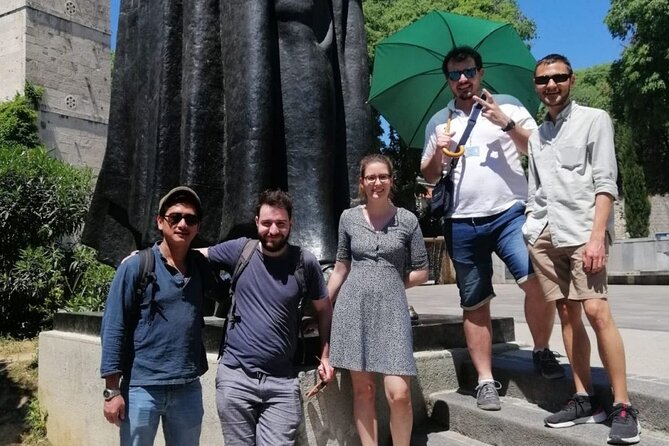
The tour begins with a brief meeting at the fountain in Strossmayer Park. It is not a long stop, but it sets the mood. Your guide introduces the big idea of what you are about to see and helps you settle into the geography of Split.
Even five minutes here can pay off. If you understand where the palace fits in the city, the rest of the walk feels less like a scavenger hunt and more like a story you can follow.
Stop 2, The Golden Gate: where your Diocletian Palace story starts
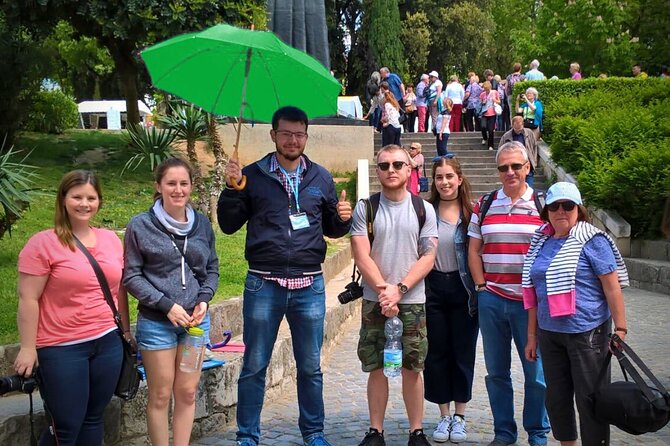
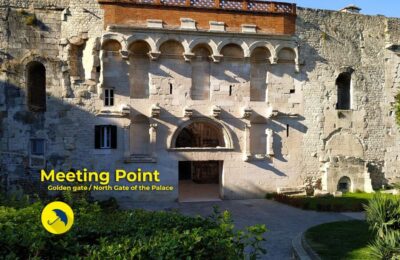
Next comes the Golden Gate, the entry point into the famous ancient palace complex. Here, your guide explains the background story of when it originated, why it was built, and how it worked as a power center.
This is the kind of context that changes how you look at the stones. Instead of just seeing an old gate, you start to understand how gates, walls, and entrances shaped daily life in the palace world.
Stop 3, Diocletian’s Peristyle: the UNESCO square where power and routine met
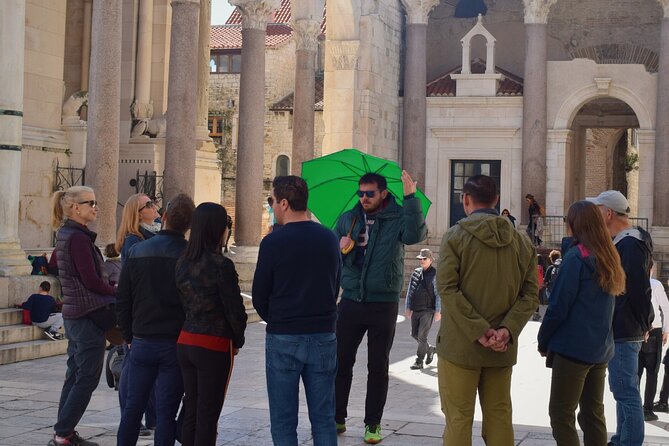
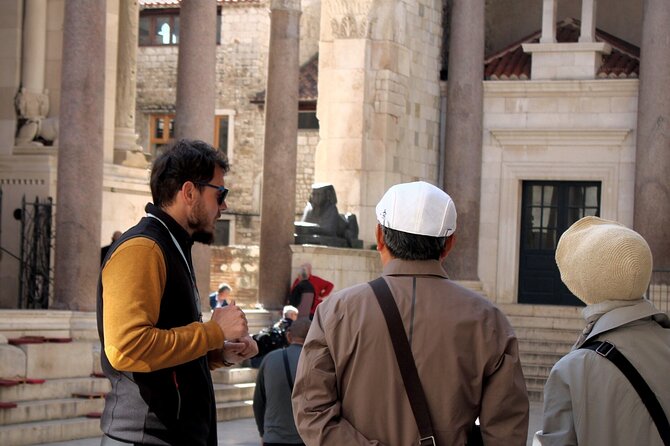
At the Peristyle of Diocletian’s Palace, you’re in the main square space that sits at the heart of the UNESCO protected site. Your guide focuses on how the emperor used the area and what roles military personnel and servants had in daily routine.
This is one of the most important stops because it explains the “why” behind the palace layout. You get a sense that this was not just architecture for pictures. It was a working environment, with movement, labor, and authority in specific places.
A practical note: because the stop is short, listen closely to the guide’s cues. This is where you want to lock in the palace orientation for the rest of your time in Split.
Two days in Split? Here's how to fill the second.
- Split: Krka Waterfalls Trip with Boat Cruise and Swimming★ 4.8 · 10,519 reviews
- From Split: Krka Waterfalls, Food & Wine Tasting Tour★ 5.0 · 9,326 reviews
- Blue cave, Mamma Mia and Hvar, 5 islands speedboat tour★ 5.0 · 7,150 reviews
- From Split: Krka Waterfalls, Food & Wine Tasting Tour★ 4.9 · 6,598 reviews
Stop 4, Eastern (Silver) Gate: a less famous gate with real meaning
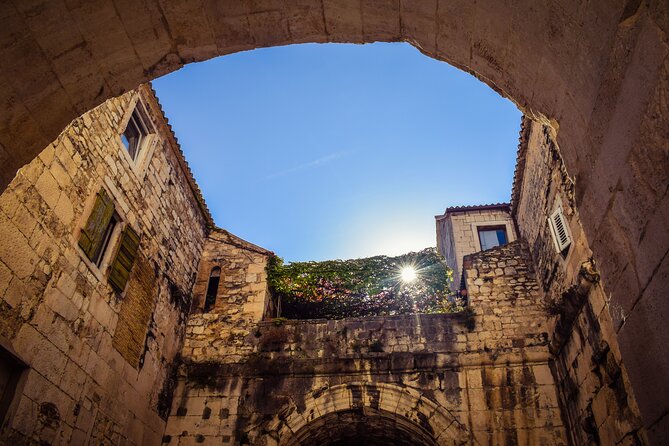
The Eastern (Silver) Gate is one of four gates. It may not be the most photographed entrance, but it has an important function. Your guide shows you what remains and what it was used for.
This kind of stop is valuable because it teaches you to look past the “top three” sights. In Split, smaller details often lead to the bigger understanding of how the palace operated.
If you like architecture, gates, and layout clues, you will enjoy this moment. It turns the palace from a single landmark into a system of entrances and routes.
Stop 5, Temple of Jupiter: religion, power, and an extra ticket choice
Next is the Temple of Jupiter. Roman religion was tied to politics, and emperors used symbolism to reinforce authority. Your guide explains why an emperor connected himself to a god and how the temple fits that message.
Important for your plan: entrance is not included. Your guide gives tips and tricks, and you can decide after the tour whether to visit inside. If you are the type who likes to go inside major monuments, you can treat this as a prompt, not a deal-breaker.
If you want to avoid extra costs, you can still enjoy the exterior context and move on. The tour is designed so you do not feel like you missed the whole point.
Stop 6, Cathedral of Saint Domnius: mausoleum or church?
Then you reach the Cathedral of Saint Domnius. One of the best parts of the tour is that it sets up a question: is it a Roman mausoleum, or a church? Your guide walks you through why people interpret it that way, and the story is tied into the massive cat statue nearby.
Again, entrance is not included, but the guide explains what to look for and you can visit later if you choose.
This stop works well for mixed-interest groups. Even if you do not care about religious architecture, the “what is this and why does it look like that” angle keeps it interesting.
Stop 7, Old Split: the medieval contrast that prevents burnout
After the ancient palace core, the tour shifts to Old Split, the newer but still historic middle-aged area. This stop gives you a contrast to the Roman space.
Why that matters: if you only see one era, the city can start to feel repetitive. Switching to Old Split helps you see how the city kept evolving instead of freezing in time.
This is also a nice pacing break. You get the feeling that you can step away for coffee or a snack later without losing your sense of where you are.
Stop 8, Palazzo di Diocleziano: 55 minutes inside the palace zone
The tour spends most of the time at Palazzo di Diocleziano, about 55 minutes, and a lot of what you see on the route happens mostly inside the palace complex.
This is the “payoff” stop. The palace is the main reason Split is famous, and spending real time inside is what turns your orientation into actual understanding. You see how spaces connect, where movement makes sense, and how the city grew around a Roman framework.
One key thing: admission is not included for this part. That means you have to decide how deep you want to go. Still, the guide’s explanation helps either way. Even if you do not buy entrance, the story you heard before can help you read the palace layout on your own.
Small-group feel: hearing the guide and asking questions
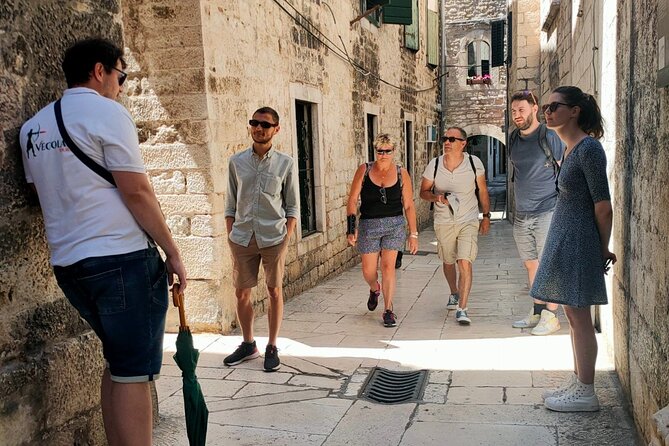
This is capped at 12 travelers, and that size shows. In a place like Split, where streets can funnel you together fast, smaller groups help you stay in conversation with the guide.
From past experiences with this tour, the guide has been praised for clear communication and humor, which keeps the route from turning into a lecture. You also get time to ask questions, and that can be the difference between knowing “facts” and understanding how the whole place fits together.
If you are traveling with a mix of interests, this group size helps everyone keep up.
What to do after the tour: keep the rest of your day flexible
Since the tour is about 1.5 hours, you are not locked into a long schedule. You finish in the central waterfront area, and you can immediately shift into self-guided exploration.
Here is the smart way to use the rest of the day:
- Revisit the palace areas you liked most during the tour
- Walk toward viewpoints at a slower pace than you did on the guided route
- Use your guide’s recommendations to pick one or two food stops, then wander
In past groups, the guide has also sent out helpful suggestions by email, including restaurant and gelato ideas. That kind of follow-up is practical because it saves you decision fatigue later.
Who should book this walking tour
This tour is a strong match if you:
- want a first-day orientation without committing to a half-day block
- like Roman and medieval sites, but you also want the practical city context
- prefer a small-group experience where questions are easy
- want to keep costs down by focusing on stops with free admission, then choosing optional entrances
It may be less ideal if you want a long, museum-style experience where every major interior is included. Since several entrances are not included, you will have to be selective based on your interests and budget.
Should you book this 90-minute Split tour?
I think you should book it if you want a fast, well-structured introduction to Split’s core. For the price, you get a guided route that touches the palace gates, the Peristyle square, key monuments like Saint Domnius, and a big block of time inside Diocletian’s Palace.
It is also a good choice for value because many stops do not require extra tickets. You can spend less upfront, then pay only when you genuinely want the extra inside time at places like the Cathedral, the Temple of Jupiter, or the palace admission area.
One final tip: wear comfortable shoes and expect you will keep walking after. Split’s center rewards motion, and this tour sets you up to enjoy that freedom instead of feeling lost.
FAQ
How long is the 90 Minute Walking Tour of Split?
It lasts about 1 hour 30 minutes.
What is the price per person?
The price is $18.14 per person.
Where does the tour start and end?
It starts at Strossmayerova Fountain on Ul. kralja Tomislava 12, and ends at Ul. kralja Tomislava 15 near the waterfront.
Is the tour offered in English?
Yes, it is offered in English.
What is the maximum group size?
The maximum is 12 travelers.
Is there a mobile ticket?
Yes, the tour uses a mobile ticket.
Are entrances included for all stops?
Not all entrances are included. The Temple of Jupiter, the Cathedral of Saint Domnius, and the Palazzo di Diocleziano have admission not included. Other stops listed have admission ticket free.
Does the tour include pick up and drop off?
No pick up and drop off is included.
What is the cancellation policy?
You can cancel for a full refund up to 24 hours in advance.
What happens if weather is bad?
This experience requires good weather. If it is canceled due to poor weather, you will be offered a different date or a full refund.
Recently added around Split
- Private VIP Brac and Hvar Day Trip from Split
★ 5.0 · 1 review - Private Transfer From or To the Split Airport
★ 5.0 · 1 review - Brač Half Day Beach Party Transfer to Olife Beach Club
★ 5.0 · 1 review - Private Transfer from Split to Zagreb, Hotel-to-hotel, English-speaking driver
★ 5.0 · 1 review - Airport transfers
★ 5.0 · 1 review - Private ”Game of Thrones” Walking Tour in Split (entrance tickets included)
★ 5.0 · 1 review
Walking Tours, compared.
Walking Tour of Split and Diocletian’s Palace
Read our review →
Krka Waterfalls tour with Trogir Walking tour and Krka panoramic boat cruise
Read our review →
Walking Tour of Split with a ‘Magister’ of History
Read our review →
Split Walking Tour with Professor of History
Read our review →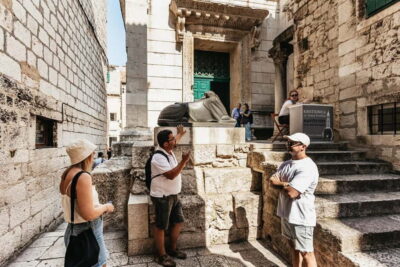
Diocletian Palace & Old Town Guided Walking Tour
Read our review →
Browse the lists this tour appears in