
Reviewed · HISTORICAL TOURS
Walking Tour of Split with a ‘Magister’ of History
Split’s walls tell stories. This walking tour with Toni Šare is built to help you read the streets of Split with real historical context, not just landmarks. I especially love the 3D reconstructions that show what you are looking at before and after centuries of change, and I like the tight route that connects Roman, medieval, Renaissance, and early modern layers in one smooth walk. One possible drawback: you mostly view major sites from the outside, and you do not enter museums or paid interiors.
You get a small group experience, up to 18 people, in English, for a price that is easy to swallow when you compare it to museum tickets plus a guided interpretation. It is also a good pick when you want a smart first visit to Split’s old center, then freedom to explore on your own after.
In This Review
- Key things to know before you go
- A 1h40 walk that turns Diocletian’s Palace into a timeline
- Meeting at Brass Gate (Porta Aenea) and ending at Narodni trg
- Riva Harbor: the southern wall view and why the walk starts here
- Peristyle of Diocletian’s Palace: the Roman square that still anchors Split
- Saint Domnius: Diocletian’s mausoleum turned cathedral
- Temple of Jupiter: why late Roman engineering gets interesting
- Silver Gate and Grgur Ninski: views plus meaning in early Croatian culture
- Vestibulum and noble palaces: the Palace as someone’s home
- Game of Thrones filming locations and the fan shop pass
- Golden Gate and the Renaissance courtyard at the City Museum
- Old Town Hall at Piazza Square, then freedom
- Price and value for a guide-led Roman to Renaissance walk
- Who should book, and when it makes the most sense
- Should you book Toni Šare’s Split history walk?
- FAQ
- How long is the Walking Tour of Split with a Magister of History?
- How much does the tour cost?
- Is the tour offered in English?
- Who is the guide, and how many people are in the group?
- Where do I meet, and where does the tour end?
- Do we enter museums or paid attractions?
- What if the weather is bad?
- Can I cancel for a full refund?
- Can service animals join the tour?
Key things to know before you go
- Small group, max 18 keeps the pace friendly and question time realistic.
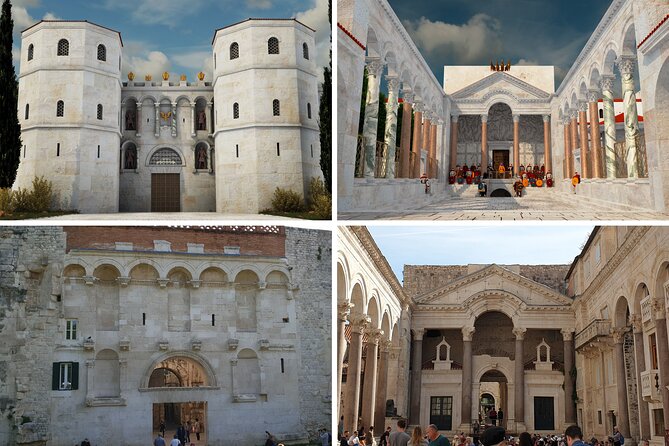
- 3D reconstructions help you visualize Diocletian’s Palace as it once looked.
- Roman to Renaissance connections turn scattered ruins into a timeline you can follow.
- Outside views, no museum entry means fewer queues, but fewer indoor highlights.
- GoT filming stops can be added if your group is interested, plus you pass the fan shop.
A 1h40 walk that turns Diocletian’s Palace into a timeline
Split can feel like a maze at first. That is exactly why this tour works. Instead of asking you to memorize names, Toni Šare teaches you how the city grew by showing you what stayed, what was reused, and what was transformed.
The big hook is the way he explains the place in layers. Yes, Split is famous for Roman remains, but the walk also gives you medieval, Renaissance, and early modern context that you might miss if you only chase the obvious highlights. The result is that the stone stops start making sense. You will look at a gate and understand why it matters, then walk a few minutes and grasp how the surrounding city used the Roman structure for defense later.
If you like learning through visuals, the 3D reconstructions are central. Toni uses them to show you how Diocletian’s Palace would have appeared when it was functioning, and how those decorations and buildings changed over time. It is the difference between seeing ruins and actually picturing the original whole.
Meeting at Brass Gate (Porta Aenea) and ending at Narodni trg
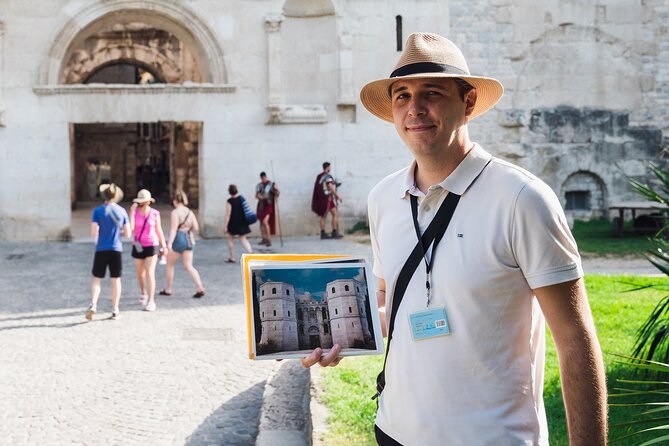
The start point is Brass Gate (Porta Aenea) on Obala Hrvatskog narodnog preporoda 22. This matters because Porta Aenea sits right at the edge of the Roman core, so you begin in the right mindset: palace, city, and reuse of Roman walls.
The tour ends at Narodni trg, also called Pjaca, the main square. I like ending in a place with natural orientation. You are not dumped into another random alley. From the square, it is easier to choose what to do next, whether that is grabbing a meal, heading toward the coast, or circling back to a street you want to see longer.
Duration is about 1 hour 40 minutes to 1 hour 50 minutes, so plan it as a “primer” for the rest of your day. Many people prefer an earlier start to beat peak crowds, and some choose later departures because old stone streets can still feel warmer in summer.
Two thousand years, one afternoon
Riva Harbor: the southern wall view and why the walk starts here
The tour begins at Riva Harbor, Split’s Riviera area and a key spot for local life. Even though you are outdoors in a modern coastal setting, Toni uses the harbor position to orient you to what is coming next.
This stop gives you two useful things. First, Toni introduces what you are going to see inside Diocletian’s Palace with graphic and model representations. Second, from here you get a beautiful view of the southern wall of Diocletian’s Palace. That sight is not just pretty. It is practical, because it helps your brain map the palace walls onto the routes you will walk later.
You will notice that the tour does not jump straight into the most famous photo angles. It sets context first, so the palace buildings later on feel less like disconnected sights.
Peristyle of Diocletian’s Palace: the Roman square that still anchors Split
Next comes the Peristyle, the central square of Diocletian’s Palace and a major public space today. If you only know Split as a Roman city, this is where you learn it is also a living city built on top of Roman planning.
You spend time here seeing incredibly preserved Roman structures. More importantly, Toni shows 3D reconstructions of the Peristyle area, so you can visualize the original decorations and buildings that are no longer fully standing. That matters because the Peristyle is crowded with details, and without context it can feel like stone plus tourists. With context, each arch, column line, and open space starts telling you how the palace was designed.
This is also a short stop, about 10 minutes. You do not get a drawn-out lecture. You get enough time to look, understand, then move.
Saint Domnius: Diocletian’s mausoleum turned cathedral
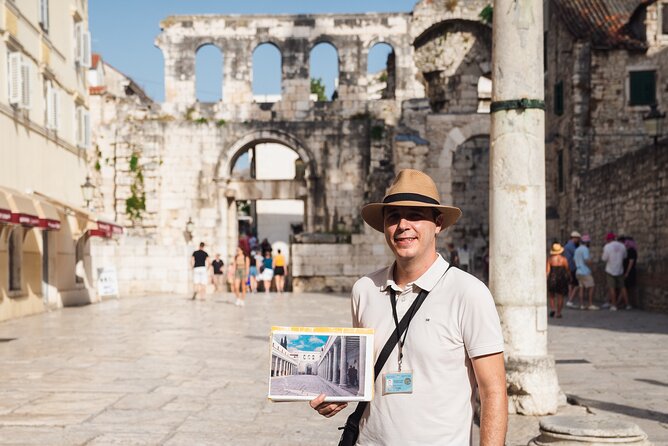
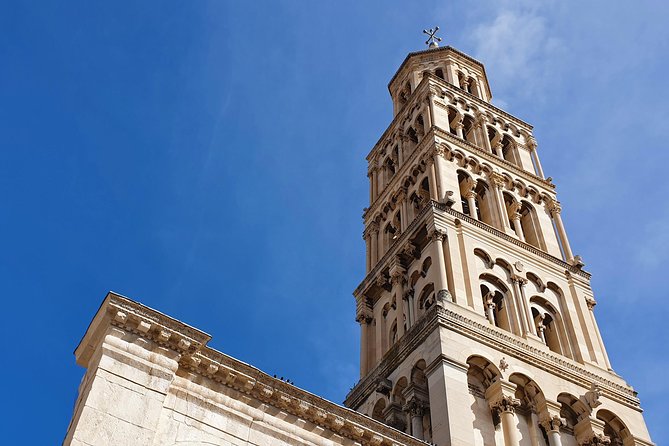
The Cathedral of Saint Domnius is next, and it is a standout because it is still actively used. Toni frames it as the cathedral and the grave of Emperor Diocletian, often described as one of the best-preserved Roman structures in Split.
You will not enter the cathedral. Instead, you will get what you need from the outside, including an explanation of the bell tower and how the structure was converted from a grave to a cathedral by Christians. Even from outside, that story changes how you see the building. You stop treating it like an old church and start seeing it as a political and religious handoff across centuries.
Plan for about 10 minutes here. Also note that admission is not included, and you will not be going in. If you are hoping for an interior visit, this may not be your style.
Temple of Jupiter: why late Roman engineering gets interesting
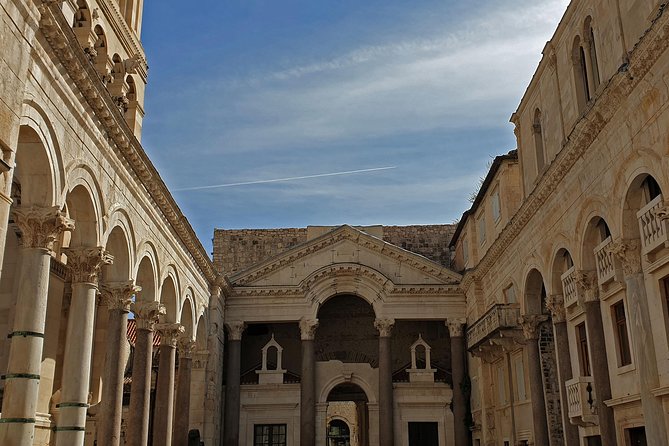
Then comes the Temple of Jupiter, often called one of the best-preserved late-Roman temples in the world. Toni keeps it from becoming a static history stop by focusing on the quirks.
Expect to hear about anomalies and even mistakes Romans made while constructing it. You will view it from outside only, and you will not go inside. But the idea is that the temple is not just a perfect monument. It is a real construction project with real decisions, and that makes it more human.
This stop is about 15 minutes, which is a comfortable length. It is enough time to look closely at the overall shape and understand what Toni means when he points out the oddities.
Plenty more to do around Split
- Split: Old Town and Diocletian Palace Walking Tour★ 4.9 · 4,727 reviews
- Walking Tour of Split and Diocletian’s Palace★ 5.0 · 2,588 reviews
- Krka Waterfalls tour with Trogir Walking tour and Krka panoramic boat cruise★ 5.0 · 1,659 reviews
- Split & Diocletian’s Palace Walking Tour★ 5.0 · 1,125 reviews
Silver Gate and Grgur Ninski: views plus meaning in early Croatian culture
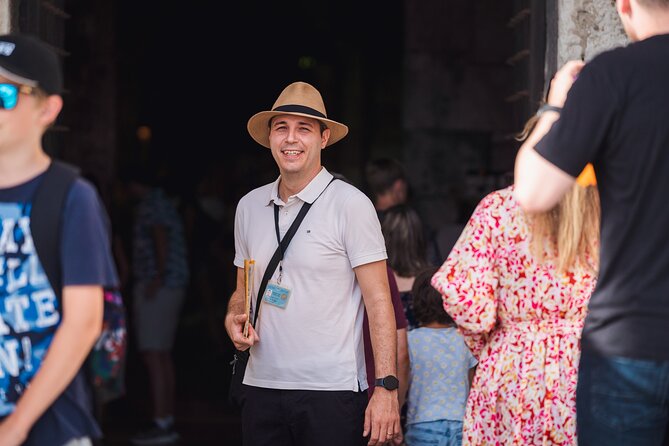
The Eastern (Silver) Gate gives you one of the best views of Diocletian’s Palace. You see the cathedral area on one side, the Silver Gate on the other, and beneath you the only preserved part of the original road. It is a great moment for photos, but it is also a good moment for understanding how the palace entrances connected to the surrounding city.
Next is the Grgur Ninski Statue, which is a dominant landmark in Split. Toni explains what it represents and why it matters for Croatian language and culture in early medieval times. This is one of those stops that can be easy to skip if you only chase Roman ruins, because it reminds you that later history did not stop when the empire faded. It grew its own symbols.
These are brief stops, around 5 minutes each. Fast, focused, and useful.
Vestibulum and noble palaces: the Palace as someone’s home
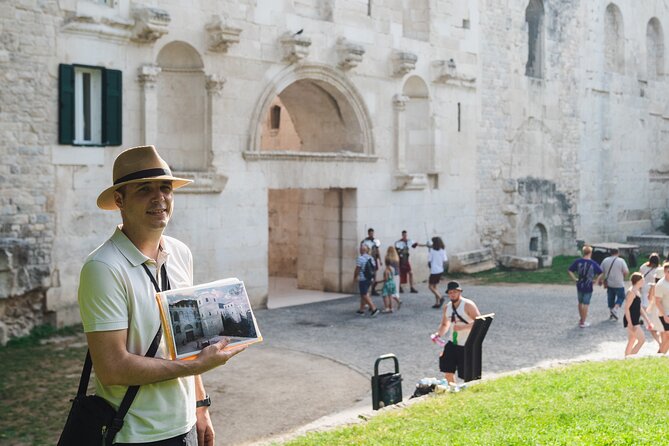
At the Vestibulum of Diocletian’s Palace, you are moving from public space into the feel of private space. Toni presents it as an ancient entrance to Diocletian’s private residence and then takes you around the remains of Diocletian’s private quarters.
From there, you will also see the palaces of noble families along the way. This is the city learning to reuse its own bones. The Roman palace did not just become a relic. Over time, parts of it and the surrounding palace-like structures became settings for later elites.
If you like architecture, this stretch is where the walk turns from “what happened” into “how people lived and adapted.” You begin to notice the pattern: Roman planning created the frame, and later eras moved in.
Game of Thrones filming locations and the fan shop pass
If your group is interested, Toni also shows you Game of Thrones filming locations in Split that you pass during the route, and you will go by the fan shop. I like that this is optional. It keeps the tour grounded in history, while still acknowledging that pop culture can be a real entry point for some visitors.
Even if you are not a fan of the series, it can still help you place certain streets and angles in your head. When you later walk them on your own, you can connect the location to something concrete.
Golden Gate and the Renaissance courtyard at the City Museum
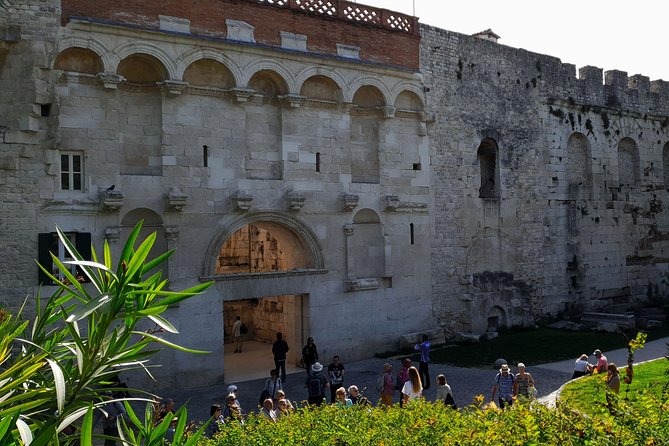
The highlight entrance stop is the Golden Gate, described as the most preserved of the four palace entrances and the most decorated. Toni explains it while pointing out the strategic view: from here you can see the northern wall and understand how the medieval city used Roman-made structures for defense.
He also explains how the city removed what it did not need. That theme of reuse and selective removal is one of the strongest ideas in this whole walk. You are not just seeing buildings, you are seeing decisions.
After that, there is a stop tied to the City Museum of Split, located within one of the best-preserved Renaissance noble palaces. You do not enter the museum itself. Instead, you only see the courtyard area to view the Renaissance palace from within, and Toni connects this to Venetian history, explaining how this kind of palace style appeared during Venetian influence.
This is a nice compromise: you get a sense of what the Renaissance interiors and courtyards feel like, without turning your walk into a museum day.
Old Town Hall at Piazza Square, then freedom
The ending point is Old Town Hall on Pjaca (Piazza Square). Toni frames it as the main square since medieval times, and you see the 14th century Town Hall and other structures around it.
This final stop is brief, about 5 minutes, but it is a smart finish. You are back in a central hub, with easy routes outward. If you want to spend more time later, you have a clean starting location.
If you are planning the rest of your day, I recommend using the tour as your “first map.” Come back to the Roman sections you want to photograph longer, and spend time on any street corners that Toni’s explanations made you notice.
Price and value for a guide-led Roman to Renaissance walk
At $34.83 per person, this tour is priced for people who want high interpretive value without paying for multiple museum entries. The structure also supports value: you are not paying extra to enter museums as part of the standard flow.
Most stops are outside or have free admission tickets for viewing. There are also specific points where admission is not included and you will not enter, like the Cathedral of Saint Domnius and the Temple of Jupiter. That is worth knowing up front. You are paying for the storytelling, routing, and visual reconstructions, not for a stack of interior admissions.
With a group cap of 18, you are not stuck in a huge herd either. That small size helps with questions, and it keeps the walk from feeling like a race.
If you are budget-minded, you also have options mentioned in the tour setup: group discounts and an upgrade to a private tour if you want more one-on-one pacing.
Who should book, and when it makes the most sense
This tour is a great match if you:
- want a first-day introduction to Split’s Roman core and later reuse
- like learning with visuals, especially 3D reconstructions
- prefer short stops that help you keep your bearings
- want an efficient way to understand what you are seeing, before you go off on your own
It may not be ideal if you:
- want long museum time or interior visits as the main event
- are only interested in one era and do not care about the layers after Rome
For timing, consider going earlier in the day for comfort, or later if you want to avoid peak heat. The route is mostly walking through old streets, so your comfort will depend on weather and time of day.
Should you book Toni Šare’s Split history walk?
If you are trying to decide between wandering Split alone or getting a guided framework, I would book this. It gives you the key thing most self-guided walks miss: the “why.” You look at gates, squares, and statues and understand what changed and why people cared.
The big win is how Toni Šare blends Roman structure viewing with later meaning, using 3D reconstructions to help you picture the city as it once operated. Add in the small group size, plus the option for Game of Thrones filming stops, and you have a walk that feels both practical and fun.
FAQ
How long is the Walking Tour of Split with a Magister of History?
It runs about 1 hour 40 minutes to 1 hour 50 minutes.
How much does the tour cost?
The price is $34.83 per person.
Is the tour offered in English?
Yes, it is offered in English.
Who is the guide, and how many people are in the group?
The guide is Toni Šare (DiocleSpot Tours), and the group size is capped at a maximum of 18 travelers.
Where do I meet, and where does the tour end?
You start at Brass Gate (Porta Aenea), Obala Hrvatskog narodnog preporoda 22, Split, and you end at Narodni trg (Pjaca) in Split.
Do we enter museums or paid attractions?
You do not enter any museums or paid sites. Some major stops are viewed from outside, and admission for those is not included.
What if the weather is bad?
This experience requires good weather. If it is canceled due to poor weather, you will be offered a different date or a full refund.
Can I cancel for a full refund?
Yes. There is free cancellation up to 24 hours in advance for a full refund.
Can service animals join the tour?
Yes, service animals are allowed.
Recently added around Split
- Private VIP Brac and Hvar Day Trip from Split
★ 5.0 · 1 review - Private Transfer From or To the Split Airport
★ 5.0 · 1 review - Brač Half Day Beach Party Transfer to Olife Beach Club
★ 5.0 · 1 review - Private Transfer from Split to Zagreb, Hotel-to-hotel, English-speaking driver
★ 5.0 · 1 review - Airport transfers
★ 5.0 · 1 review - Private ”Game of Thrones” Walking Tour in Split (entrance tickets included)
★ 5.0 · 1 review
Historical Tours, compared.
Split Walking Tour with Professor of History
Read our review →
Split History and Gastro Small-Group Tour with Food and Drinks
Read our review →
PREMIUM Emperor’s Walking Tour for History Lovers + Museum
Read our review →
Local History and Culture 90-Minute Walking Tour
Read our review →
Private History Split Walking Tour in English
Read our review →
Historical & Gastro Treasures Tour with Green Market
Read our review →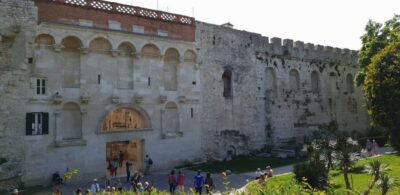
Walking tour of Split with a ‘Magister’ of History
Read our review →Browse the lists this tour appears in