
Reviewed · DIOCLETIAN'S PALACE TOURS
History & Cultural Walking Tour of Split and Diocletian’s Palace
Split’s palace walls tell stories fast. This 90-minute history walk turns the UNESCO center into something you can actually picture, from Diocletian’s Peristyle square to the Golden Gate and Riva Harbor. I especially like the small group size (max 15) because you can ask questions and actually hear the details, and I also love that the itinerary hits major landmarks without making you hunt for them on your own. One thing to consider: you will be walking the old town, and it is not recommended if high steps are an issue for you.
Here’s the deal. You start at Peristil ulica (Peristil ul.), then your guide leads you through the palace spaces that shaped modern Split, plus a quick pass through city squares and key cultural sites. The tour is in English, and most stops have no entry cost, so the $22.98 price feels like you’re paying for guidance and context, not for ticket lines.
If you want a first-night orientation that helps everything else make sense, this is a strong pick.
In This Review
- Key tour takeaways before you go
- Why Diocletian’s Palace is the right starting point in Split
- Price and logistics that actually matter for a first-day tour
- Entering the Peristyle, the palace square that organizes everything
- Vestibule stop, where the palace can sound alive
- Walking the palace substructures without the museum detour
- The Golden Gate, Gregory of Nin, and the language story
- Riva Harbor and the bronze model that makes Split feel whole
- Fruit’s Square and Marko Marulić, a culture stop that fits
- Split Synagogue pass-by, what to expect with admission not included
- Guides make it, and this one has a track record of great guiding
- What this tour does best, and where it may not fit
- Value check: is $22.98 a fair deal?
- Should you book this History & Cultural Walking Tour of Split?
- FAQ
- How long is the Split history and cultural walking tour?
- What does the tour cost?
- What languages is the tour offered in?
- How many people are in the group?
- Where does the tour start and where does it end?
- Are entrance tickets included?
- Will I visit the museum portion of the Diocletian Palace substructures?
- Is the tour suitable for people who have trouble with steps?
- Is the tour confirmed right away after booking?
- What is the cancellation policy?
Key tour takeaways before you go
- Diocletian’s Palace, explained in a walkable route that connects the dots between what you see and what it used to mean
- Free access at nearly every stop, so you spend money on the guide, not multiple entrances
- Small group experience, with time for Q and A and a guide who can slow down when questions come up
- Music and local flavor may be included, with the chance to hear traditional Dalmatian singing around the palace areas
- Real cultural variety beyond the palace, including Fruit’s Square and a pass by the Split Synagogue
- A practical pace that fits a 1.5 hour block, with the occasional longer session when the group stays engaged
Why Diocletian’s Palace is the right starting point in Split
Split can feel like two cities layered on top of each other. One is the modern seaside town with cafés and promenades. The other is the part that still lives inside a Roman emperor’s palace complex, built into the city fabric so long ago that it feels normal now.
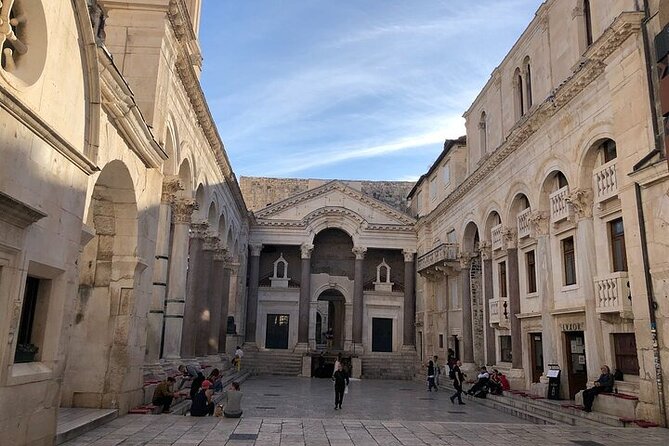
That is why this tour works so well as an early stop. You start at the Peristyle, the central square of Diocletian’s Palace, and from there the guide helps you understand the palace layout like a map you can walk. Once you get that mental picture, other sights in Split click into place. The Golden Gate becomes more than a photo spot, and Riva Harbor stops feeling like a generic waterfront because you learn how the palace and the promenade’s story connect.
Also, it is not just Roman ruins for the sake of Roman ruins. This walk points out how the site shaped everyday life in Split and how later chapters, like Venetian influence and Croatian literary history, show up in the street-level details.
And yes, the scale is big, which is why a guided route beats wandering. You get the important landmarks in a sensible order, without time wasted guessing where to go next.
Price and logistics that actually matter for a first-day tour
At $22.98 per person, this is priced like an orientation tour, not a full-day deep ticket crawl. The value comes from two things: you get a guide who connects the architecture to stories, and most stops are listed as admission ticket free.
Duration is about 1 hour 30 minutes, and that time window is realistic for seeing the major palace highlights plus a couple of city stops. If your group is very small, the guide may spend extra time answering questions, and you might feel you got more than the stopwatch suggests. That flexibility can be a plus.
The tour is capped at 15 travelers, which is key in a dense old town like Split. You are not packed in a long line. You can look up, step aside for photos, and still follow along.
Practical notes:
- It is offered in English.
- Your ticket is mobile.
- Service animals are allowed.
- It is near public transportation.
- It is not recommended if you have issues with high steps, since you will be moving through historic streets and palace areas with uneven surfaces and steps.
If you are visiting around peak season, I’d book early. This one is commonly reserved about 80 days in advance, so it helps to lock in your preferred time before your schedule gets tight.
Two thousand years, one afternoon
Entering the Peristyle, the palace square that organizes everything
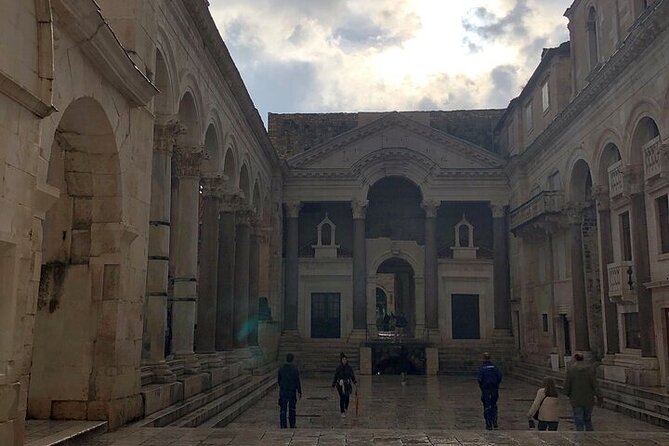
Stop 1 is the Peristyle of Diocletian’s Palace, the central hub. This is the place where you can get to almost every other important area inside the palace. So instead of “seeing ruins,” you start learning how the palace functioned as a whole.
What I like here is that it gives you structure. From the Peristyle, the rest of the route stops feel less random. The guide’s explanations help you notice things you would otherwise miss, like how the square relates to the entrances and interior spaces.
The stop itself is about 15 minutes, and admission is free. You are not stuck for long, which keeps the tour moving while still giving you enough time to orient yourself and ask the first few questions.
If you are the type who likes to understand before you photograph, this is a good moment to slow down. Take a full look around first. Then point out what you want clarified. The guide can connect what you see here to what you’ll walk past later, like the Golden Gate and the substructures.
Vestibule stop, where the palace can sound alive
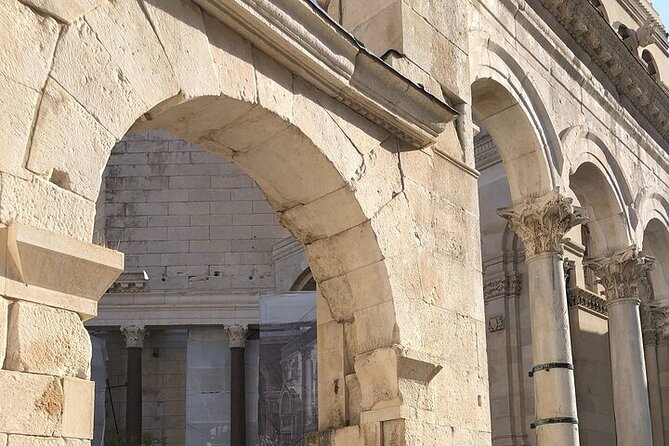
Stop 2 is the Vestibulum of Diocletian’s Palace. This area acts like a threshold space, and the guide focuses on the history connected to Diocletian himself.
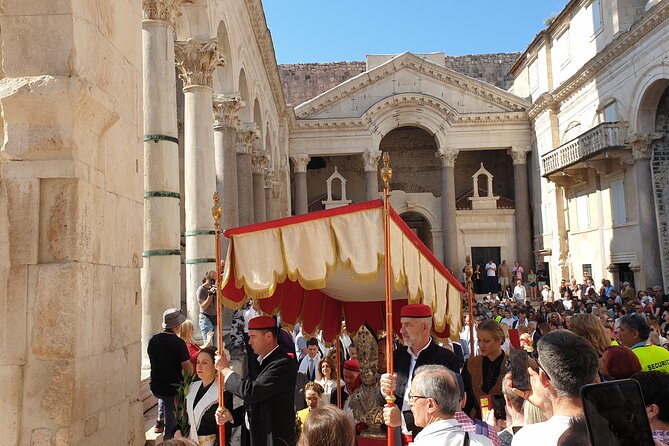
What makes this stop feel special is the chance of hearing traditional Dalmatian singing. The tour description says it may happen, so don’t treat it like a guaranteed concert. But even if you only catch a short performance, it adds something that a guidebook can’t do: sound in a place that was designed for movement, ceremony, and daily flow.
This stop is short, about 5 minutes, and it is also admission free. Think of it as a quick “pause and listen” moment before you head into deeper, more architectural parts of the palace.
If you love cultural context, this is one of the reasons I like this style of tour. It is not only visual. You get a sense of how local traditions fit into historic spaces.
Walking the palace substructures without the museum detour
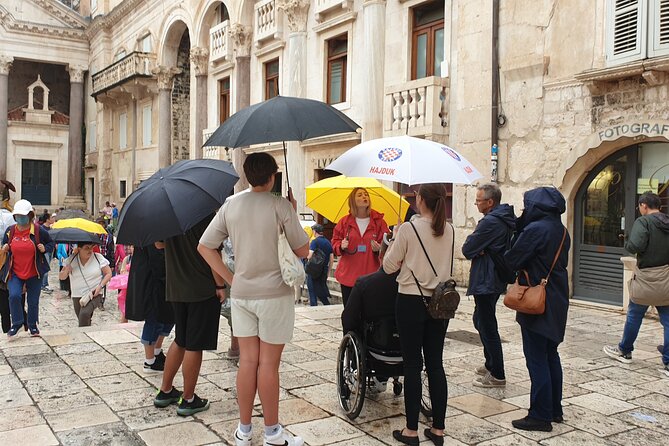
Stop 3 is the Diocletian Palace Substructures. This is where the tour shifts from the palace as a surface-level site into the engineering side of what made the complex work.
You will go through the substructures and learn about:
- how the construction happened, and
- what their function was over the ages.
One practical detail: the tour does not visit the museum part of the substructures. That is actually helpful if you want to keep your walking tour time tight. You can always return later on your own to see the museum content without feeling like you have to absorb everything in one sitting.
This stop is about 10 minutes and marked admission free. The short time window is part of the tour’s strength. You get guidance and key takeaways, then you can decide whether a deeper stop makes sense for you later.
The Golden Gate, Gregory of Nin, and the language story
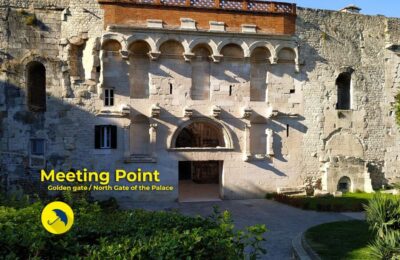
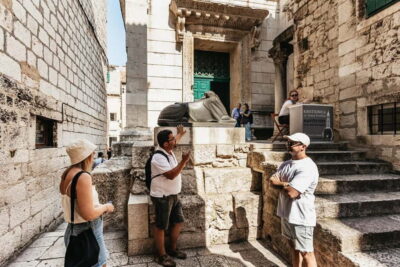
Stop 4 is the Golden Gate, the main entrance of Diocletian’s Palace. Your guide uses this as a moment to connect architecture with history, including the statue of Gregory of Nin.
This is where the tour moves beyond Roman trivia. Gregory of Nin is important not just as a historical figure, but because the guide explains his role in history and even how this connects to language. If you’ve ever wondered why certain cultural identities show up in public spaces, this stop gives you a clear answer through one specific monument and the story attached to it.
Time here is about 10 minutes, and again it is listed as admission ticket free.
For your photo planning, this is a great stop because it is a clear focal point. Stand where the guide suggests so you can frame the entrance and the statue properly, then take a couple of wide shots before you move on.
Plenty more to do around Split
- Split: Old Town and Diocletian Palace Walking Tour★ 4.9 · 4,727 reviews
- Walking Tour of Split and Diocletian’s Palace★ 5.0 · 2,588 reviews
- Split & Diocletian’s Palace Walking Tour★ 5.0 · 1,125 reviews
- Split: Diocletian Palace & Old Town Guided Walking Tour★ 4.7 · 882 reviews
Riva Harbor and the bronze model that makes Split feel whole
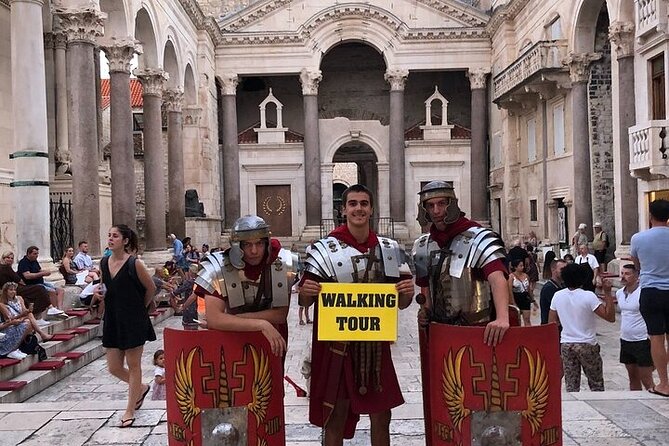
Stop 5 is Riva Harbor, and the highlight is a bronze model of Diocletian’s Palace. This kind of model is underrated. In a palace that can feel confusing at street level, a small-scale overview can snap your understanding into place.
The guide also explains the history of Split’s Riva promenade, so the walk becomes both historical and practical. You learn why the harbor area became what it is now, rather than treating Riva as just a scenic backdrop.
This stop is about 15 minutes and admission is free. I like that the tour uses this as a natural transition out of the palace focus and into the rest of Split’s old town.
Tip: if you are planning to linger later, ask your guide which side of the harbor they recommend for an easy return walk, especially if your schedule is tight.
Fruit’s Square and Marko Marulić, a culture stop that fits
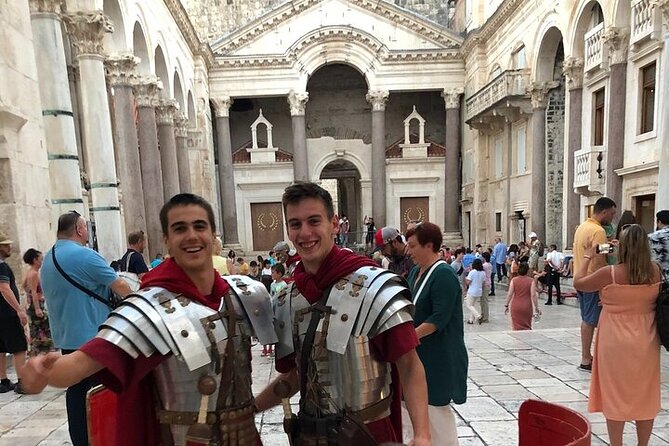
Stop 6 is Fruit’s Square (Trg Brace Radic). Here you switch gears again, but in a good way. This is not another “Roman-only” minute. You learn about a 15th-century Venetian citadel and the importance of Marko Marulić, described as the father of Croatian literature.
This matters because it shows how Split kept changing after the Roman period. Different powers left different marks, and culture did not stop when empires did.
The stop is about 10 minutes, and it is listed as admission ticket free. It’s short enough that it does not stall the pacing, but substantial enough that you leave with something memorable beyond the palace.
If you want to read more later, this stop gives you a name to search and connect to Croatian literature.
Split Synagogue pass-by, what to expect with admission not included
Stop 7 is a pass by the 16th-century Split Synagogue. The important point for planning is that admission is not included.
Your tour approach here is straightforward: you see the site from the outside and learn about the history of the Jewish people in Split. Then you move on.
This stop is about 10 minutes. Since you are not doing an inside visit with a guide as part of this tour, you should only expect exterior context unless you decide to go back later.
One more practical thing: this helps keep the tour time inside your 1 hour 30 minutes window.
Guides make it, and this one has a track record of great guiding
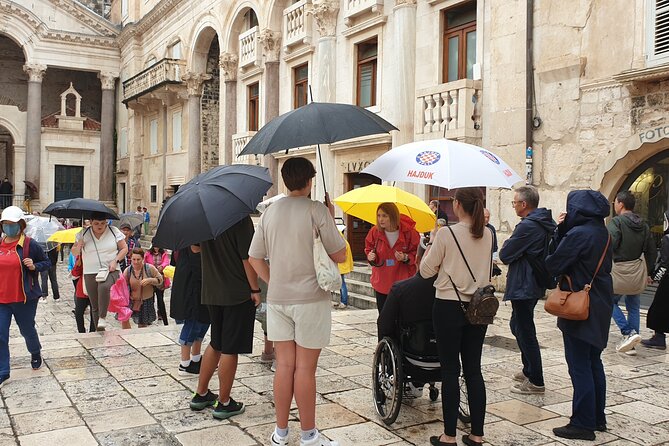
The most consistent strength here is the guides. I’ve seen names like Darko, Ante (Anthony), and Ivana connected to standout experiences, and the pattern is clear: the guide explains what you are seeing in plain language, then adds local story details that make it stick.
I also like how the best guides here handle engagement. There is time for Q and A, and when questions pop up, the explanation tends to get better, not shorter. One guide I’d follow again is the kind who talks with energy but keeps it factual, so you feel you are learning rather than being talked at.
Performance moments can also add warmth. Around the palace areas, you might catch a traditional klapa or Dalmatian singing moment depending on timing. Some guides also weave in nearby art or small cultural touches, like a Meštrović statue seen in a public park, even if it is not the main headline of the official stops.
You should also know the tour is designed to be interactive without being chaotic. With a max group size of 15, the guide can keep everyone oriented, not just repeat the same sentence to a dozen people at once.
What this tour does best, and where it may not fit
This tour is at its best when you want:
- a fast but meaningful introduction to Diocletian’s Palace,
- a route that connects palace architecture to modern Split,
- and a guide-led walk where you can ask questions.
It may not fit if:
- you need a very low step or fully flat route (it is not recommended for travelers who have issues with high steps),
- you want a long museum-style visit inside interiors (the itinerary emphasizes key stops and skips the substructures museum portion),
- or you expect paid-entry experiences at every stop (the synagogue admission is not included).
That said, the route still gives you a lot of payoff for the time. It is a strong “get oriented” tour, not a heavy-ticket commitment.
Value check: is $22.98 a fair deal?
For $22.98, the price feels fair because you are not paying for multiple admissions. The stops tied to the palace and main public sights are listed as free, so your money supports what you truly need in a place like this: interpretation.
Also, group size matters. A max of 15 means the guide can give more attention per person, and that often makes the explanations sharper.
If you have only one or two nights in Split, this tour is a practical way to start. You will likely spend the rest of your trip understanding what you’re seeing, instead of guessing.
Should you book this History & Cultural Walking Tour of Split?
Book it if you are trying to make Split easier on your brain and your feet. This is one of those tours that helps you understand the city’s biggest defining object, Diocletian’s Palace, then extends that understanding to squares, landmarks, and cultural notes around the old town.
Skip it or pick a different style if you want only indoor time, need a fully step-free route, or you are mainly interested in museum tickets rather than a guided orientation walk.
If you do book, bring comfortable walking shoes, plan for some steps, and arrive ready to ask questions. The best part is not just seeing the palace. It is learning how Split grew out of it and why certain public monuments and names still matter today.
FAQ
How long is the Split history and cultural walking tour?
The tour is about 1 hour 30 minutes.
What does the tour cost?
The price is $22.98 per person.
What languages is the tour offered in?
The tour is offered in English.
How many people are in the group?
The maximum group size is 15 travelers.
Where does the tour start and where does it end?
It starts at Peristil ulica (Peristil ul.), 21000, Split, Croatia, and it ends back at the meeting point.
Are entrance tickets included?
Most listed stops show admission ticket free. The Split Synagogue pass-by does not include admission.
Will I visit the museum portion of the Diocletian Palace substructures?
No, the tour goes through the substructures but does not visit the museum part. You can visit the museum after the tour.
Is the tour suitable for people who have trouble with steps?
It is not recommended if you have issues with high steps.
Is the tour confirmed right away after booking?
Confirmation is received at the time of booking.
What is the cancellation policy?
Free cancellation is available up to 24 hours in advance for a full refund. If you cancel less than 24 hours before the start time, the amount you paid is not refunded.
More Walking Tours in Split


Recently added around Split
- Private VIP Brac and Hvar Day Trip from Split
★ 5.0 · 1 review - Private Transfer From or To the Split Airport
★ 5.0 · 1 review - Brač Half Day Beach Party Transfer to Olife Beach Club
★ 5.0 · 1 review - Private Transfer from Split to Zagreb, Hotel-to-hotel, English-speaking driver
★ 5.0 · 1 review - Airport transfers
★ 5.0 · 1 review - Private ”Game of Thrones” Walking Tour in Split (entrance tickets included)
★ 5.0 · 1 review
Diocletian's Palace Tours, compared.
Walking Tour of Split and Diocletian’s Palace
Read our review →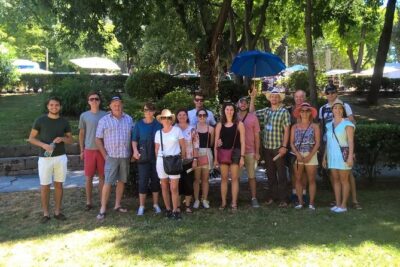
Diocletian Palace & Old Town Guided Walking Tour
Read our review →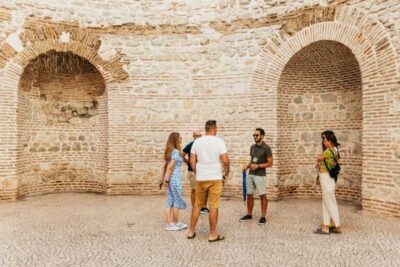

Game of Thrones Tour with Diocletian’s Palace Cellar
Read our review →
Diocletian’s Palace and Old Town SMALL GROUP Walking Tour
Read our review →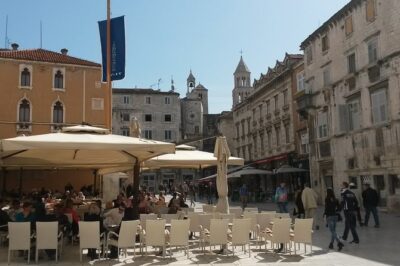
PRIVATE Walking Tour of Diocletian’s Palace & Old Town
Read our review →Browse the lists this tour appears in