
Reviewed · DIOCLETIAN'S PALACE TOURS
Jewish Heritage & Diocletian’s Palace Private Split Tour
Jewish Split has a second, quieter layer. In this private, 2.5-hour tour, you connect Roman power at Diocletian’s Palace substructures with the lived Jewish story in Split. I love the way the route makes sense of the basements, including menorah carvings, and ties it to how people from nearby Salona ended up here. I also love the synagogue moment, where you meet a community member like Albert and hear stories you cannot pick up from a guidebook. One thing to consider, this is still a walk through old stone, including underground areas, so if you have mobility limits, ask ahead, the guide can adjust based on your needs.
You’ll also get the kind of pacing that keeps history from turning into a lecture. The best version of this tour feels like you’re getting your bearings fast in the Old Town, then watching the city click into place around a single theme: how Split has been shaped by many communities over time.
In This Review
- Key highlights you’ll care about
- Diocletian’s Palace substructures, where the story starts
- Vestibule and Peristyle, the palace spaces you see every postcard
- Grgur Ninski statue, a Croatian thread inside the Roman core
- Split synagogue and the Jewish ghetto walk, the tour’s emotional center
- Narodni Trg, memorial meaning and the look of Venetian-era Split
- Fruit’s Square and Marko Marulić, a literary reset outside the palace
- Riva Harbor and Prokurative, where the city feels like it is still moving
- Marmontova Ulica and the fish market option
- Price and value: what you actually get for $187.05
- Who this tour fits best
- Should you book this Jewish Heritage and Diocletian’s Palace tour?
- FAQ
- How long is the Jewish Heritage & Diocletian’s Palace private Split tour?
- Is this tour private?
- Where do we meet, and is pickup available?
- What is included in the price?
- Is the tour offered in English?
- Is it suitable for families or people with mobility needs?
- What is the cancellation policy?
Key highlights you’ll care about
- Menorah carvings in Diocletian’s Palace substructures, linked to early Jewish life in the region
- A synagogue visit inside the Jewish ghetto, with time to meet and talk with a community member
- A private licensed guide, with guides such as Jelena Vrancic, Emil, Vinka, and Pero noted for adapting the tour to the group
- A smart Old Town loop, from the palace core to squares and promenades like Riva and Prokurative
- Memorial context on Narodni Trg, including a bronze plaque remembering destruction on 12 June 1942
Diocletian’s Palace substructures, where the story starts
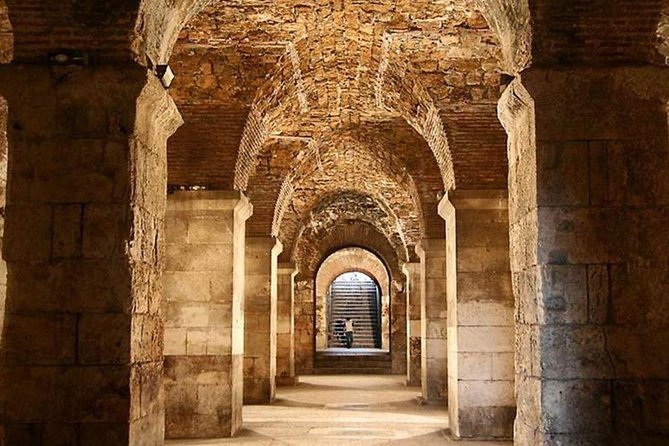
Start inside the Old Town core, with Diocletian’s Palace substructures. This is the part of Split that feels most like archaeology you can walk through: stone basements and the “underworld” layers beneath the palace spaces people see above ground.
What makes this stop valuable is the specific Jewish thread tied to the Roman city. The tour frames the Jewish presence in Split as one of the oldest in Europe, using archaeological findings from nearby Salona to place Jewish life in the region as far back as the 2nd and 3rd century AD. Then the story shifts forward when Salona’s residents fled attacks and settled in Diocletian’s Palace. That’s the kind of context that turns a pretty ruin into a timeline.
The guide then points out the menorah carvings in the basements. Even if you know nothing about Jewish symbolism, seeing these details in place is a concrete way to understand that this community was not just a later chapter. One of the best review moments for this tour is exactly this combination: palace atmosphere above, Jewish markers below, and a guide who connects the dots without turning it into a dry lecture.
Practical note: substructures can mean uneven ground and stairs, depending on what route you take. Your guide should be able to adjust pace and placement, and one family with ambulation problems reported that the guide made changes on the spot. Still, if walking underground is a challenge, tell them before you arrive so you can plan the safest route through the space.
Vestibule and Peristyle, the palace spaces you see every postcard
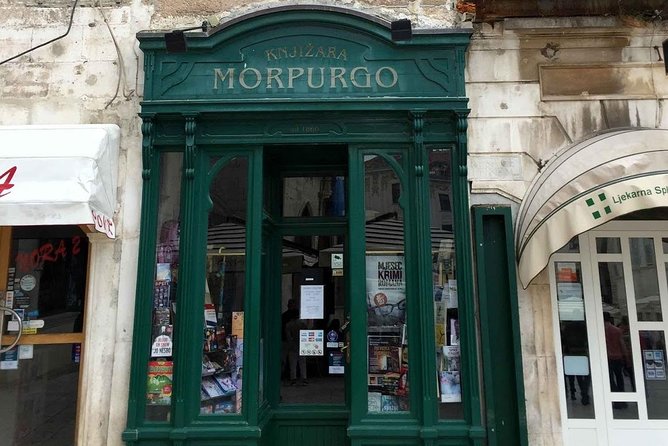
After the basements, the route moves into areas that most visitors recognize, but rarely understand as a system.
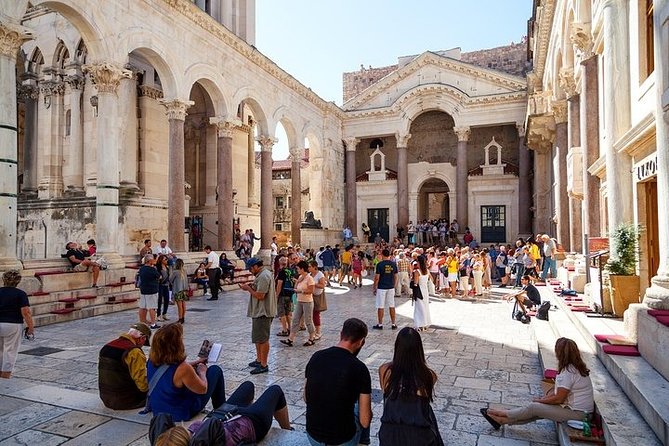
First comes the Vestibule, described as a former foyer of the palace. It’s a short stop, yet it’s useful because it gives you a reference point for how these palace spaces worked as transitions between major rooms and public movement.
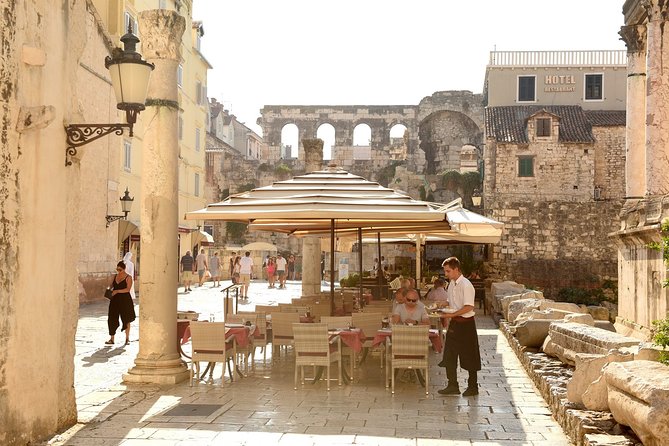
Then you’ll spend time at the Peristyle, the main square of Diocletian’s Palace. This is where you learn to read the “wow” you already feel. The Peristyle is famous for its columns, which were brought from different parts of the empire when the palace was built in 305 AD. That detail matters. It’s not just decoration. It tells you how the Roman Empire expressed power and reach through architecture, moving building pieces like they were political trophies.
One of the best ways to enjoy stops like these is to keep your eyes up. You’ll likely look at columns and architectural layout. Try to also listen for what the guide says about changing functions over time, because today’s square is still being used in daily ways, even if the original job was different.
And here’s the simple benefit of doing this with a private guide: you can ask quick questions while you’re standing in front of the stone, instead of trying to remember what you saw later while you’re tired and hungry.
Two thousand years, one afternoon
Grgur Ninski statue, a Croatian thread inside the Roman core
You’ll also pause near the Grgur Ninski statue, named for Bishop Grgur Ninski. This stop is brief, but it plays an important role in keeping your mental map of Split from being only Roman and Jewish.
Croatia’s religious and civic identity is part of the city story, and this statue is a visible reminder. You get just enough context so the statue feels less like a random piece of public art and more like a chapter marker in Split’s longer arc.
This is also one of the places where a guide’s personality helps. Several guides associated with this tour, including Jelena Vrancic and Emil, are praised for keeping the talk low-key and easy to follow, with a sense of humor that helps when the walk is starting to feel long.
If you like history but want it practical, this style works well: you get context in small bursts, then you move on.
Split synagogue and the Jewish ghetto walk, the tour’s emotional center
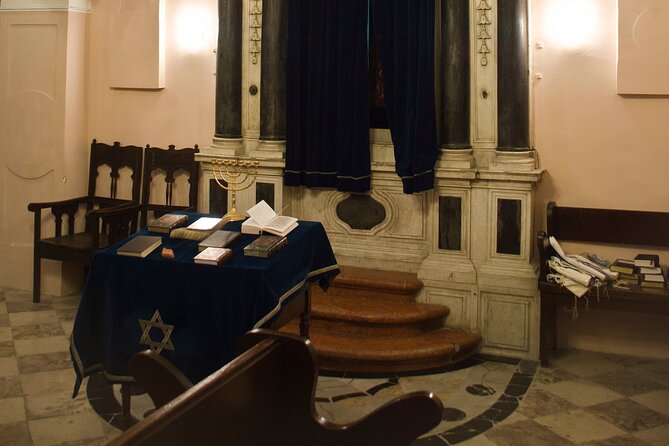
The highlight in many people’s minds is the synagogue visit, and for good reason. Your tour includes a walk through the Jewish ghetto area, with stories about the Jewish community’s role and daily life in Split.
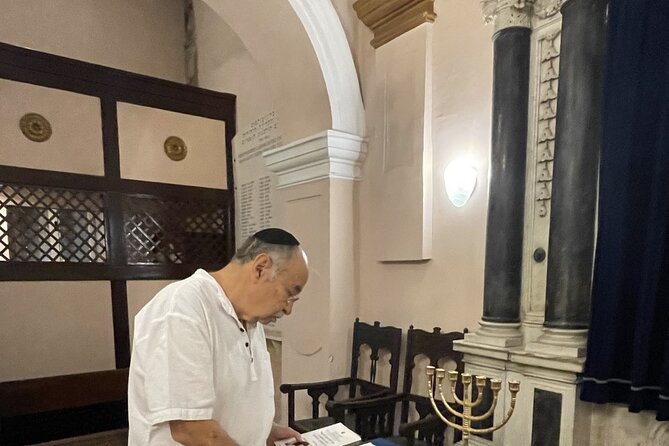
Then you visit the synagogue and meet a member of the Jewish community. One review praised time with Albert in particular, and that kind of on-the-ground conversation is what makes this experience feel different from a standard “see the building” stop. A caretaker-led visit can also answer questions you didn’t know you had, like how a small congregation keeps a historic space meaningful today.
The tour timing here is longer than most exterior stops, and it matters. You’re not rushed through. You’re given room to absorb the setting and hear stories tied to Split specifically, including references to how prominent community members helped with the economic and historical development of the city.
There’s also a practical reason this stop earns its place: the synagogue is still in use, which shifts it from museum to living place. If you care about authenticity, this is where the city’s past meets a present day reality.
One more detail to keep in mind: sometimes the synagogue can be arranged to be open for your visit, and one group specifically noted that the guide was able to have it opened for their time. That means you should still be flexible, follow your guide’s direction on what’s possible, and plan to ask questions if anything seems unclear once you arrive.
Narodni Trg, memorial meaning and the look of Venetian-era Split
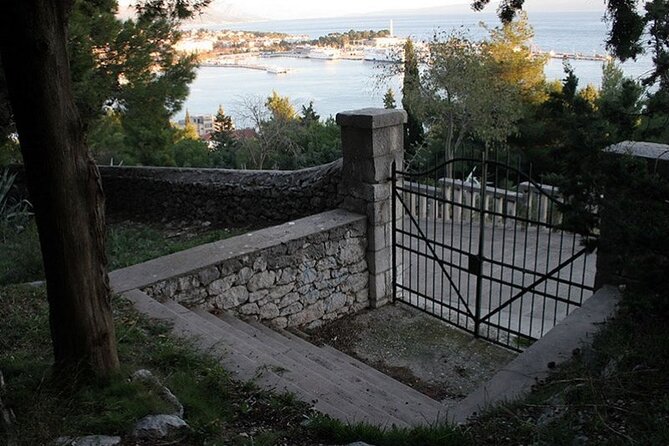
After the synagogue area, you’ll head toward Narodni Trg, where you can see a bronze plaque placed in memory of the destruction of precious items and archives from the synagogue on 12 June 1942.
This is not “scenic content.” It’s the opposite of vague. You get a specific date, a specific act of loss, and a direct connection to the Jewish story in Split. For many people, this is the moment the tour becomes more serious and personal, because it forces you to think beyond centuries and architecture.
You’ll also get a sense of how Split blends styles. Narodni Trg is described with Venetian architecture cues, which shows you that Split isn’t trapped in one era. It’s been influenced by different powers and cultural currents, then lived through by real communities over time.
When you stand in a city square like this with a guide, you’re often learning two things at once: what the buildings are, and what they’ve witnessed. The plaque gives the second part teeth.
Fruit’s Square and Marko Marulić, a literary reset outside the palace
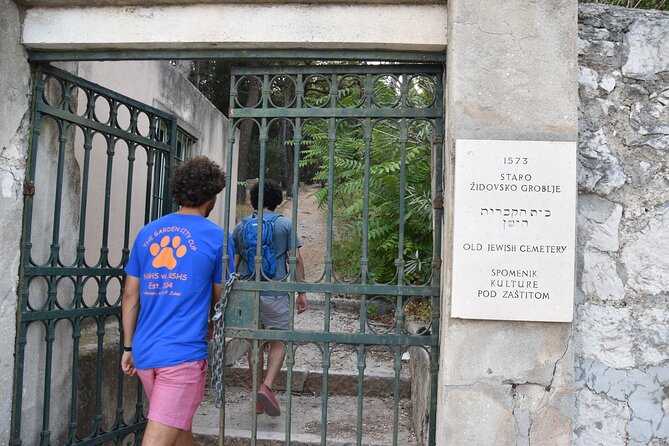
Next comes Fruit’s Square (Trg Brace Radic), just outside the Diocletian palace area. The stop is short, but it functions like a mental reset.
Here, you learn about Marko Marulić, often referred to as the father of Croatian literature. A statue marks the center of the square, making it easy to orient and easy to remember. This is a good moment to breathe, snack if you have something small, and get ready for the more open waterfront section of the walk.
This is also a reminder that your tour route is not only about monuments. It’s designed to weave Jewish heritage through the broader fabric of daily Split, including the places locals use for meeting and passing through.
Plenty more to do around Split
- Split: Old Town and Diocletian Palace Walking Tour★ 4.9 · 4,727 reviews
- Walking Tour of Split and Diocletian’s Palace★ 5.0 · 2,588 reviews
- Split & Diocletian’s Palace Walking Tour★ 5.0 · 1,125 reviews
- Split: Diocletian Palace & Old Town Guided Walking Tour★ 4.7 · 882 reviews
Riva Harbor and Prokurative, where the city feels like it is still moving
Then you reach the waterfront mood shift: Riva Harbor. This is described as a pedestrian haven, a living room for locals with cafés and restaurants along the promenade. Even if you don’t stop for a drink, you’ll feel the change in atmosphere.
After Riva, you visit Prokurative, also called Republic Square. The tour notes that it resembles Venice’s St. Mark’s Square, and that the area is known for neo-Renaissance buildings with arches, plus views toward the harbor and the Riva from certain sides.
This is a great pairing after the synagogue stop because it shows the full range of Split in one tour: memory in one hand, everyday life in the other. The guide’s commentary is what keeps it from becoming a “look at the sea” moment. You want context, and that is exactly what this route provides.
Marmontova Ulica and the fish market option
Your walk continues along Marmontova Ulica, another popular promenade for locals and visitors. The key practical detail here is the mention of the fish market off the street, with the option to take a look at where people buy fresh Adriatic fish.
This is the kind of detail that makes a guided walk feel real. It’s not just big landmarks, it’s how a neighborhood functions. If you like seeing how food culture operates, this stop is a low-effort way to do it without turning your schedule into a full food tour.
Even if you skip the market, you still get a smooth transition toward the end of the loop, and you’ll probably have enough city rhythm in your head to enjoy the rest of your day on your own.
Price and value: what you actually get for $187.05
At $187.05 per person for about 2 hours 30 minutes, this tour can feel pricey at first glance. But the value comes from how much is included and how specific the theme is.
You’re paying for a private guided tour with a licensed guide, plus direct synagogue time and a paid fee for the palace substructures. Many standard Split tours skim the surface of the palace, then leave you to find the Jewish sites on your own. Here, you get the connections handled for you, including the practical historical framing from nearby Salona and the on-site Jewish symbolism.
You also get flexible pickup options, group discounts, and a mobile ticket. It’s not a “grab a ticket, wander” experience. It’s a guided stitch between sites that you might not link yourself, especially when the Jewish history is less obvious to the untrained eye.
If you’re traveling as a couple, or with a small group that wants a focused theme, private usually starts to make sense. If you’re traveling solo and don’t care about meeting anyone in the community, you might compare it against a general Old Town walk. But if Jewish heritage and palace architecture both matter to you, this tour is aimed exactly at that overlap.
One booking tip: the tour is often booked in advance, with an average lead time of about 65 days. If you’re visiting during peak summer weeks, booking sooner tends to help you lock in the time that works for your schedule.
Who this tour fits best
This tour is a strong match if you want Split’s big architecture but you also want the human layer behind it. The route works for history-minded people, yes. It also works for curious generalists, because the story is told in place, at the pace of a real walk.
It’s especially good for anyone who likes authentic access. Meeting a community member inside the synagogue is the kind of experience that can change how you see the city. Guides linked to this tour have been praised for being personable, funny in a relaxed way, and for answering questions instead of rushing you past them. One group even noted that the guide stayed steady when rain started, adjusted the timing, and helped them keep moving with umbrellas.
If you have mobility concerns, plan to communicate clearly. The tour includes basements and older surfaces, but you have evidence that guides can make adjustments when needed.
Should you book this Jewish Heritage and Diocletian’s Palace tour?
Book it if you want a meaningful, theme-driven Split experience. The combination of Diocletian’s Palace substructures, Jewish ghetto context, and a synagogue meeting is the rare mix that makes this more than a standard highlights walk.
Skip it, or reconsider if you mostly want postcard photos and you prefer to move at your own pace without a guide. The route is still a walk, and the value is tied to the guide’s storytelling and access.
If you do book, here’s how to get more out of it: come ready with one or two questions about Roman Split or Jewish life in the region. With a private guide, you’re not limited to memorizing the script. You can get answers while you’re standing right where the story happened.
FAQ
How long is the Jewish Heritage & Diocletian’s Palace private Split tour?
It lasts about 2 hours 30 minutes.
Is this tour private?
Yes, it is private. Only your group participates.
Where do we meet, and is pickup available?
Meeting is at Obala Hrvatskog narodnog preporoda 23, 21000, Split, by the bronze map of the city at Riva. Pickup is offered, and the start time is on request. All cruise ship guests are met at the port, and the guide will be waiting with your name. Apartment pickup is available if you are staying in the Old Town, otherwise meeting is at Riva.
What is included in the price?
The tour includes a private guided tour with a licensed guide, the synagogue and Jewish ghetto visit, and the fee for the substructures of Diocletian’s Palace. A mobile ticket is provided. Meals and beverages are not included.
Is the tour offered in English?
Yes, it is offered in English.
Is it suitable for families or people with mobility needs?
Most travelers can participate. Children must be accompanied by an adult. If mobility is an issue, it is best to mention it so the guide can adapt as needed.
What is the cancellation policy?
You can cancel for a full refund up to 24 hours in advance of the experience start time. Changes made less than 24 hours before the start time are not accepted.
Recently added around Split
- Private VIP Brac and Hvar Day Trip from Split
★ 5.0 · 1 review - Private Transfer From or To the Split Airport
★ 5.0 · 1 review - Brač Half Day Beach Party Transfer to Olife Beach Club
★ 5.0 · 1 review - Private Transfer from Split to Zagreb, Hotel-to-hotel, English-speaking driver
★ 5.0 · 1 review - Airport transfers
★ 5.0 · 1 review - Private ”Game of Thrones” Walking Tour in Split (entrance tickets included)
★ 5.0 · 1 review
Diocletian's Palace Tours, compared.
Walking Tour of Split and Diocletian’s Palace
Read our review →
Diocletian Palace & Old Town Guided Walking Tour
Read our review →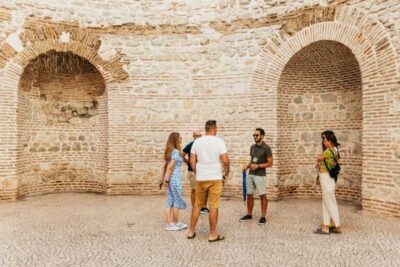

Game of Thrones Tour with Diocletian’s Palace Cellar
Read our review →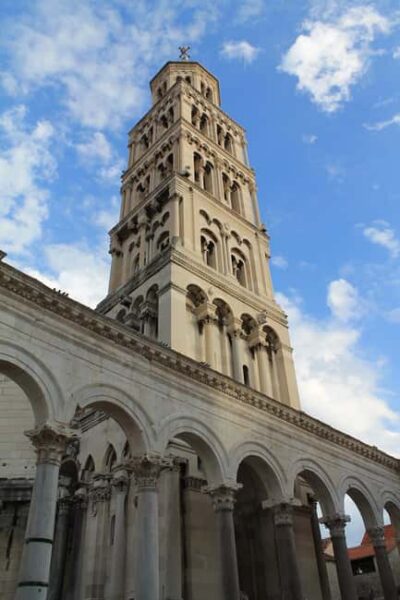
Diocletian’s Palace and Old Town SMALL GROUP Walking Tour
Read our review →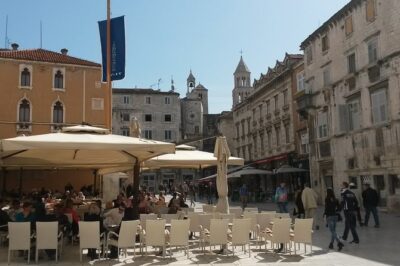
PRIVATE Walking Tour of Diocletian’s Palace & Old Town
Read our review →Browse the lists this tour appears in