
Reviewed · WALKING TOURS
Small Group Walking Tour of Split for First Time Visitors
Split clicks into place fast on this walk. You’ll get a 90-minute orientation through Diocletian’s Palace, from the Golden Gate to the Peristyle and cathedral, then finish at the Riva waterfront. I also love how the route keeps key sights close together, so you spend less time guessing where to go next and more time understanding what you’re seeing.
The only real consideration is comfort: it’s an easy walking tour with some steps and older stone surfaces. If you’re bringing a stroller, it can work, but bring a plan for bumps and take your time.
In This Review
- Key highlights
- Split in 90 minutes, from Diocletian’s Palace gates to the Riva
- Starting point at Gregory of Nin, ending by the 3D map on the Riva
- Golden Gate: Diocletian’s main landward entrance and why it matters
- Narodni Trg: the old town square that still acts like a town square
- Temple of Jupiter turned baptistery: how sacred space changes
- The Peristyle of Diocletian’s Palace: access, ceremony, and scale
- Cathedral of Saint Domnius: the mausoleum that became a cathedral
- Vestibulum of Diocletian’s Palace: acoustics, domes, and a memorable photo moment
- Substructures beneath the palace: Roman function and medieval reuse
- Riva Harbor finish: where to take your next steps
- Price and logistics: $24 for a tight, high-value highlights route
- How the guide style helps you actually remember what you saw
- Comfort, steps, and stroller reality in old Split
- Should you book this Split small group walking tour?
- FAQ
- How long is the Small Group Walking Tour of Split?
- What is the price per person?
- Is the tour offered in English?
- What is the maximum group size?
- Where do we meet at the start, and where does the tour end?
- Do I need a printed ticket?
- Are admissions included for the stops on the route?
- Is free cancellation available, and how far in advance do I need to cancel?
Key highlights
- Golden Gate to Riva in one loop, so you get oriented without a long day
- Diocletian’s Palace stops in quick succession, including the Peristyle and cathedral
- Temple of Jupiter becomes St. John’s Baptistery, a clear example of reuse over centuries
- Vestibulum acoustics and photos, a special stop made for sound and sight
- Substructures beneath the palace, including later medieval use and Game of Thrones filming
- Small group size (up to 15), which makes questions feel welcome
Split in 90 minutes, from Diocletian’s Palace gates to the Riva
This is the kind of tour that helps you land in Split and immediately feel you know your way around. The whole experience runs about 1 hour 30 minutes, and it’s built as a compact walk through the most important Roman and medieval spaces, then it ends in the easiest possible place to continue on your own: the Riva promenade.
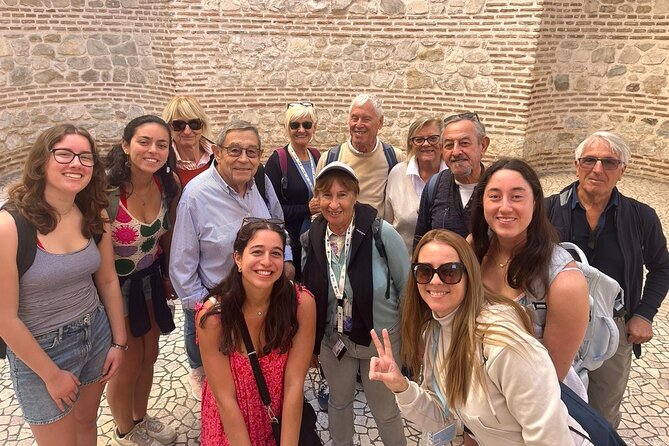
The group is small, with a maximum of 15 people, so it does not turn into a stampede. It also runs in English, and you get a mobile ticket, which is simple if your day is already full of ferry times, tickets, and bag juggling.
One more practical win: the stops are timed like a sampler plate. You do not need to pick between a “Roman stuff” day or a “church stuff” day, because you get both. And because multiple sights are listed as admission ticket free, you’re not constantly wondering whether you need to line up and pay again.
Starting point at Gregory of Nin, ending by the 3D map on the Riva
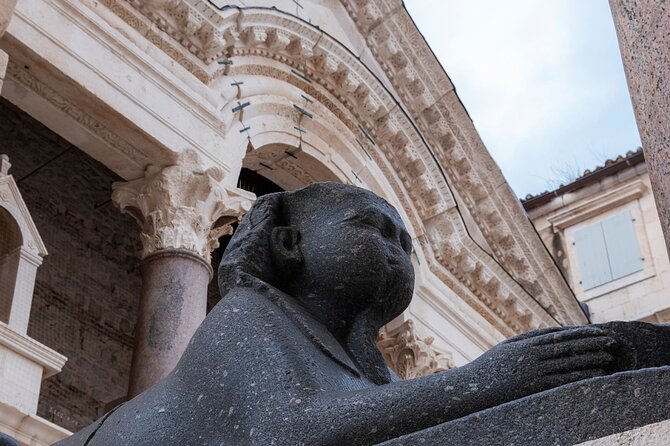
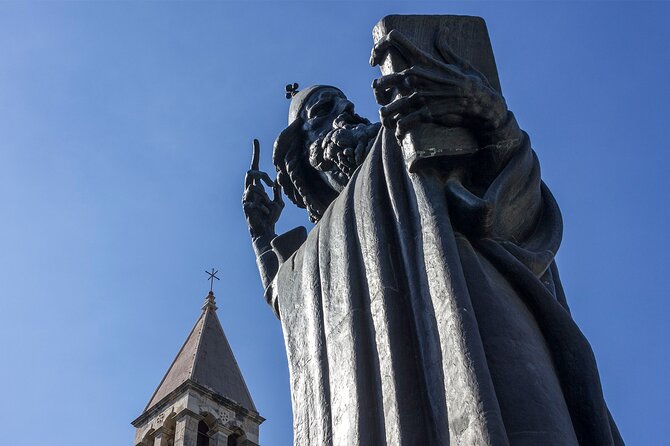
You start at the Gregory of Nin Statue, on Ul. kralja Tomislava 12. That choice matters more than you might think. This is a natural launchpad into the old core of Split, not a random curb in a quiet street.
Your walk ends on the Riva, by the 3D map. That is smart for first time visitors because the promenade is your “reset zone.” If you want lunch, a drink, a quick rest, or simply a place to orient yourself again with views, you can do it right away without backtracking.
Plenty more to do around Split
Golden Gate: Diocletian’s main landward entrance and why it matters
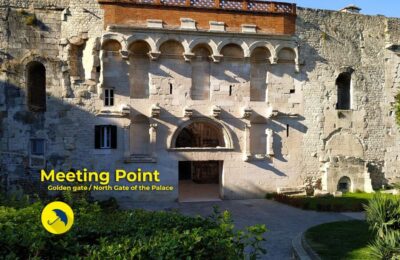
The tour starts with the Golden Gate, the northern entrance to Diocletian’s Palace. This was the main landward gate, meaning it was designed for movement in and out of the palace complex, not just decoration.
What I like about this stop is that it sets the mental map. After the Golden Gate, everything else makes more sense because you start to understand the palace as a functioning city inside the city: entrances, movement corridors, power spaces, and religious spaces. It’s not just “cool old rocks,” it’s a layout you can mentally walk again later.
The stop is short, about 20 minutes, so you get the core meaning without turning it into a lecture marathon. For first timers, that matters because your brain is already working to learn street names and directions.
Narodni Trg: the old town square that still acts like a town square
Next comes Narodni Trg, which you can think of as Split’s living room. It’s the heart of the old town, surrounded by historic buildings, including the old Town Hall, and it has been a gathering place for centuries.
Here’s the practical reason I’m glad this is on the route: squares are navigation tools. Once you learn where Narodni Trg sits, you can find your bearings. You’ll see the mix of old stone and everyday life too, because the area is lined with cafés and shops, which makes it easy to pause and people watch without committing to a long stop.
It’s only 10 minutes, but it gives you a “pause point” right in the middle of the ancient-world momentum.
Temple of Jupiter turned baptistery: how sacred space changes
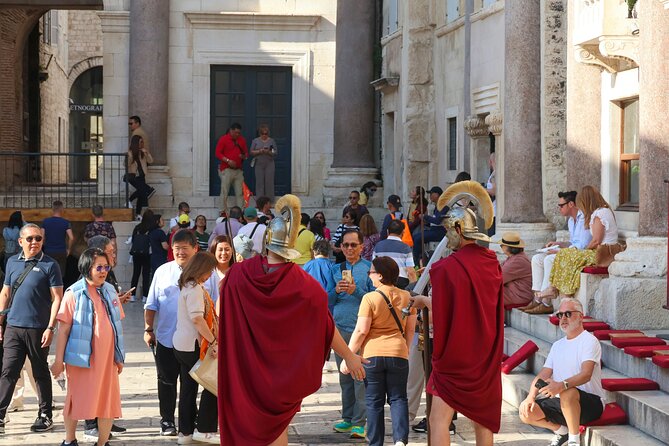
At the Temple of Jupiter, you’re looking at a site that began in the Roman world. Built in the 4th century AD, it was dedicated to Jupiter, the main Roman deity. Then, over time, it became the baptistery of St. John the Baptist.
This is one of my favorite kinds of stops because it answers a question you’re probably already wondering: how does a Roman temple become Christian worship space? Instead of treating it like a random historical fact, the tour explains the how and the why, so you walk away with a clearer story of cultural change.
The time here is brief, about 5 minutes, which helps you keep the flow. It’s the perfect add-on after Narodni Trg, because you’re still in “old town mode,” and then you snap into “Roman to Christian transformation mode.”
The Peristyle of Diocletian’s Palace: access, ceremony, and scale
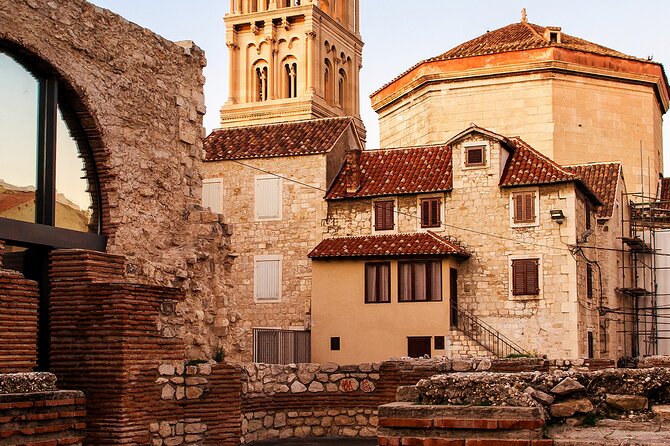
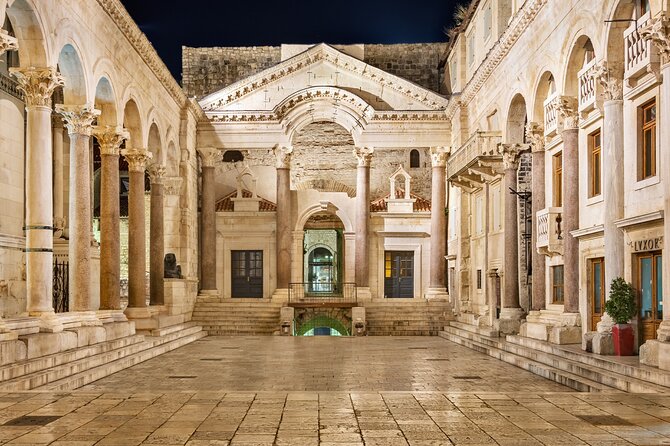
Then you reach the Peristyle of Diocletian’s Palace, the central courtyard. The Peristyle is flanked by monumental columns and arches, and it served as the main access point to the imperial apartments and religious buildings.
This stop is about scale and orientation. In pictures, courtyards can look like they’re just pretty. On site, you start noticing why a space like this would matter. It’s designed for movement, visibility, and status, so the architecture guides how people approach the center of power.
The tour keeps it to about 10 minutes, which is a sweet spot. You’ll have time to look up at the columns and arches, then move on while the sight is still fresh in your mind.
Two days in Split? Here's how to fill the second.
- Split: Krka Waterfalls Trip with Boat Cruise and Swimming★ 4.8 · 10,519 reviews
- From Split: Krka Waterfalls, Food & Wine Tasting Tour★ 5.0 · 9,326 reviews
- Blue cave, Mamma Mia and Hvar, 5 islands speedboat tour★ 5.0 · 7,150 reviews
- From Split: Krka Waterfalls, Food & Wine Tasting Tour★ 4.9 · 6,598 reviews
Cathedral of Saint Domnius: the mausoleum that became a cathedral
After the Peristyle, the tour moves to the Cathedral of Saint Domnius. This is a big one. Originally built as Emperor Diocletian’s mausoleum, it was transformed into a cathedral in the 7th century and dedicated to Saint Domnius, the patron saint of Split.
What’s especially useful for first time visitors is that this is a single structure carrying multiple eras. Roman emperor burial space becomes Christian cathedral, and the building is still in use, based on what the tour explains. It’s also described as one of the oldest Catholic cathedrals still in its original structure.
This stop is also around 10 minutes, so you get the key story without waiting around for a longer visit. I think it’s a strong pairing with the Peristyle because it shows the palace court as both political and religious space, not two separate worlds.
Vestibulum of Diocletian’s Palace: acoustics, domes, and a memorable photo moment
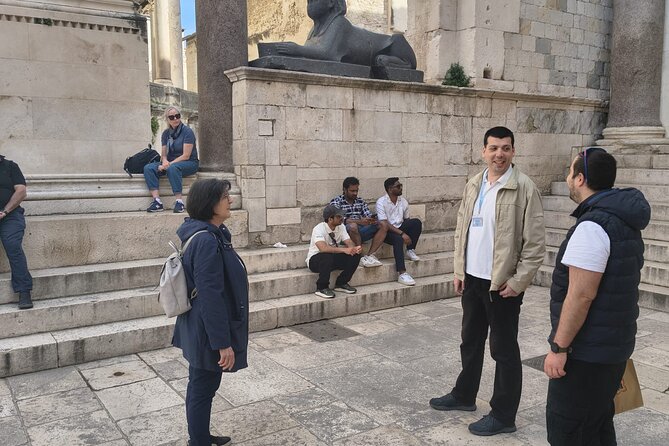
The Vestibulum is a grand circular foyer that once led to the emperor’s private quarters. If you like spaces where you can feel the design working, this is a standout.
The domed ceiling is impressive, but the real twist is the acoustics. The tour points out that this is a place where Klapa singing can sound especially good, and where you can take photographs that actually show the shape and mood of the room. Even if you do not plan on doing a full photo session, it’s worth leaning in here for a minute. The space rewards you for slowing down.
The time is short, about 5 minutes, so don’t treat it like a quick glance. Spend your best minute looking up and letting the space do its thing.
Substructures beneath the palace: Roman function and medieval reuse
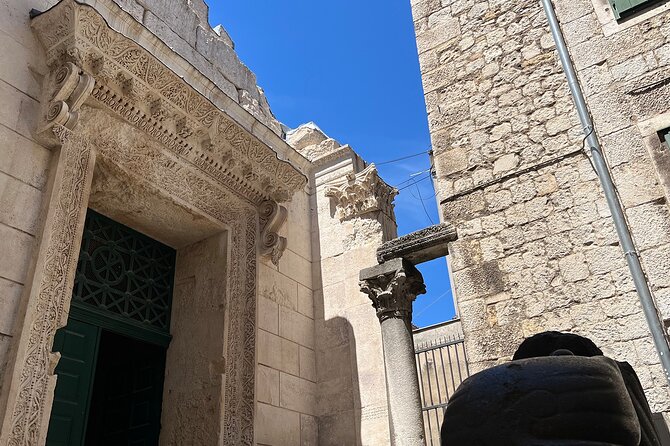
Next comes the Diocletian Palace Substructures, located beneath the imperial apartments. These palace basements are among the best-preserved ancient complexes of their kind, and the tour also notes their connection to filming, including Game of Thrones.
What I like about this stop is that it’s not only about what the Romans built. It also explains what later people did with the space. The tour helps you understand what the Romans used these areas for, and then how medieval people adapted them for their own needs.
This is your “behind the scenes” moment. If you’ve only seen the bright courtyard and church exteriors, the substructures add the functional layer. It’s where you start imagining daily movement, service areas, storage, or other roles that don’t show up in postcards.
It’s about 10 minutes, which is right for keeping momentum while still giving you something that feels different from the upper-level sights.
Riva Harbor finish: where to take your next steps
The tour ends at Riva Harbor, Split’s iconic waterfront promenade. Expect palm trees, cafés, and restaurants, plus the kind of view that makes you want to slow down without needing a big plan.
This matters because it closes the loop. After walking through gates, courtyards, temples turned baptisteries, and cathedral stories, you end in a place that feels like the present. You can take a break, grab food, or start exploring nearby streets with your orientation now built.
It’s about 10 minutes at the end stop, so it works as a gentle wrap-up rather than a hard cutoff.
Price and logistics: $24 for a tight, high-value highlights route
At $24 per person for about 1 hour 30 minutes, this is priced like a practical orientation tool rather than a long-form deep history experience. And in a city where time can disappear fast, that’s exactly what you’re paying for.
The value gets better when you look at the structure. The group stays small, the tour runs in English, and the stops are concentrated within the old core. On top of that, the tour listing notes admission tickets free for the stops included in the route, which helps you budget without surprises.
I also like the way it fits first-day planning. If you want one walk that introduces you to Diocletian’s Palace and the old town power centers, this is a clean option. You won’t need to choose between reading and wandering for hours. You get a guided thread that you can follow again later when you’re doing your own self-guided exploring.
If your schedule is tight, booking ahead is wise. This tour is commonly booked around 23 days in advance on average, so grab your slot when you know your dates.
How the guide style helps you actually remember what you saw
One reason this tour keeps getting top marks is how the guide handles questions and follow-through. A guide like Helena is mentioned as friendly and encouraging with questions, plus the tour allows time for extra recommendations. That kind of interaction changes the experience from a checklist into something you can use.
Here’s the real payoff for you: when a guide takes questions, you get answers tailored to what you noticed. And when you leave with recommendations, you’re more likely to spend your remaining time on stops that match your interests, not just the most obvious ones.
So if you’re the type who likes to ask things like, Why did this get turned into that, or What was this space for, this tour format fits you.
Comfort, steps, and stroller reality in old Split
This is an easy walking tour in terms of pacing, and it’s designed so most people can participate. Still, old town paths can be uneven, and there can be some steps. One review notes it’s manageable with a stroller and an infant, but it’s still worth planning for handholds, tight turns, and a slower pace at stone steps.
Practical tip: wear shoes you trust. You do not want to be thinking about your footing while someone is explaining why a building changed function centuries ago.
Also, since it’s a walking tour, pack like you’re going out for a city stroll. Keep water handy and avoid trying to turn it into a sightseeing marathon.
Should you book this Split small group walking tour?
If it’s your first time in Split and you want high-impact orientation through Diocletian’s Palace and the surrounding old town core, I’d book it. The route is compact, the pacing works for a short visit, and the mix of Roman structures, transformation into Christian worship spaces, and the substructures gives you a fuller picture than you’d get from wandering randomly.
Skip it only if you already know Split’s palace layout well and you want longer time at fewer sites, or if you cannot handle some steps. For everyone else, it’s one of the best ways to get your bearings fast and start exploring with confidence.
FAQ
How long is the Small Group Walking Tour of Split?
The tour lasts about 1 hour 30 minutes.
What is the price per person?
It costs $24.00 per person.
Is the tour offered in English?
Yes, the tour is offered in English.
What is the maximum group size?
The tour has a maximum of 15 travelers.
Where do we meet at the start, and where does the tour end?
You meet at the Gregory of Nin Statue, Ul. kralja Tomislava 12, 21000, Split. The tour ends on the Split Riva next to the 3D map.
Do I need a printed ticket?
No. This experience uses a mobile ticket.
Are admissions included for the stops on the route?
The tour lists admission ticket free for the stops included in the itinerary.
Is free cancellation available, and how far in advance do I need to cancel?
Yes, you can cancel for free up to 24 hours in advance for a full refund. If you cancel less than 24 hours before the start time, the amount paid is not refunded.
Recently added around Split
- Private VIP Brac and Hvar Day Trip from Split
★ 5.0 · 1 review - Private Transfer From or To the Split Airport
★ 5.0 · 1 review - Brač Half Day Beach Party Transfer to Olife Beach Club
★ 5.0 · 1 review - Private Transfer from Split to Zagreb, Hotel-to-hotel, English-speaking driver
★ 5.0 · 1 review - Airport transfers
★ 5.0 · 1 review - Private ”Game of Thrones” Walking Tour in Split (entrance tickets included)
★ 5.0 · 1 review
Walking Tours, compared.
Walking Tour of Split and Diocletian’s Palace
Read our review →
Krka Waterfalls tour with Trogir Walking tour and Krka panoramic boat cruise
Read our review →
Walking Tour of Split with a ‘Magister’ of History
Read our review →
Split Walking Tour with Professor of History
Read our review →
Diocletian Palace & Old Town Guided Walking Tour
Read our review →
Browse the lists this tour appears in