
Reviewed · DIOCLETIAN'S PALACE TOURS
Split & Diocletian Palace Historical Walking Tour
Diocletian’s Palace feels like a city inside a city. I like the way this walk starts in the Peristyle, then threads you through the palace so you understand how it all connects fast. I also like the small-group option (up to 5) when you want more attentive guiding and easier photo moments. One thing to watch is that a couple of standout spots have admission not included, so you may need extra time or pay extra depending on what you want to go into.
The tour is about 1 hour 30 minutes and ends back at the meeting point, which makes it easy to plug into a day in Split. It’s offered in English, with morning and afternoon departures, so you can match it to your schedule and the light you like for pictures. If you’re the type who gets frustrated when audio is hard to hear, stand toward the front at the start and stay there during the quieter stops.
I went in expecting “Roman stuff, sure.” I left (in my notes and mental map) with a much clearer sense of how Diocletian’s complex became Split’s everyday neighborhood, and why the palace architecture still shapes the city today.
In This Review
- Key highlights you should care about
- Why this palace walk works so well in Split
- Getting your bearings at the Peristyle meeting point
- Stop by stop: the palace route you’ll actually remember
- Peristyle and the palace core: see the hub first
- Diocletian Palace substructures: foundations and how the place evolved
- Riva Harbor and the palace wall: the waterfront boundary
- Fruit Square (Trg Brace Radic): a quick hit of Venetian layers
- The last remaining ancient Roman temple inside the palace
- Vestibulum and Triklinij: Diocletian’s personal spaces
- The 15th-century Venetian palace, plus the mausoleum cathedral
- Grgur Ninski statue and the Golden Gate: language and identity
- Second look at Riva Harbor: palace model and waterfront context
- Small group vs regular tour: pick based on how you like to travel
- Price and value: what $156.17 buys you in real terms
- Best time to go: morning and afternoon flexibility
- Who should book this tour (and who might skip it)
- Should you book Split and Diocletian Palace Historical Walking Tour?
- FAQ
- How long is the Split and Diocletian Palace Historical Walking Tour?
- Where does the tour start and where does it end?
- Is the tour offered in English?
- What group size options are available?
- What is the maximum number of travelers for the tour?
- Are the stops included with admission fees?
- Does the tour include the museum part of the substructures?
- Are mobile tickets used for this experience?
- What is the cancellation policy?
- Is the meeting point near public transportation and are service animals allowed?
Key highlights you should care about
- Peristyle first, so you get the palace layout before the walk moves outward
- Substructures walkthrough, where you learn how the foundations worked and changed over time
- Roman temple plus later Venetian layers, including the mausoleum cathedral area
- Diocletian’s personal quarters, with the vestibule and the remains of Triklinij
- Gregory of Nin context, tied to Grgur Ninski statue and the Golden Gate
- Riva Harbor context and palace model, with a second look at the waterfront
Why this palace walk works so well in Split
Split can feel like three different places layered on top of each other. You get the Adriatic waterfront, the medieval old town, and underneath it all the heavy Roman grid that Diocletian set down. This tour helps you see those layers in the right order, instead of hopping randomly from landmark to landmark.
The route is built around orientation. Once you understand where the Peristyle sits and how the palace interior links to the outside walls, the rest of Split makes more sense. You’re not just collecting photos, you’re building a mental map you can keep using long after the guide finishes.
It’s also a very practical length. At roughly 90 minutes, you get real context without turning your day into a museum marathon. That matters in Split, where you often want time afterward for coffee, a waterfront stroll, or wandering the streets on your own.
Getting your bearings at the Peristyle meeting point
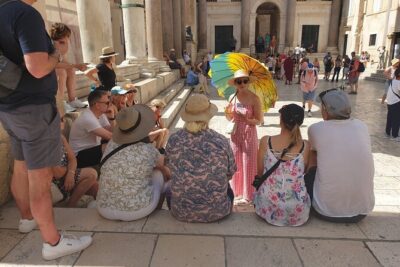
You start at Peristil ulica, and the first stop is the Peristyle itself. This is the central square of Diocletian’s Palace, and it’s where you can reach almost all other palace locations. In other words, it’s the best place to begin if you want the tour to feel logical.
At this point, focus on spatial relationships. Look at how the square functions like a hub, then imagine people moving in and out from surrounding passages and rooms. A good guide will help you connect what you see to what you’ll visit next, so the later stops don’t feel like unrelated “cool ruins.”
You also get a chance to take close-up photos of Diocletian’s Palace. If you’re planning to do your own street photography after, this first stop is a fast way to learn angles and lighting before you lose the best opportunities.
Two thousand years, one afternoon
Stop by stop: the palace route you’ll actually remember
This is where the tour earns its strong rating and recommendation score. The timing is tight, and the stops are chosen to teach you the palace from multiple angles: civic space, architecture below street level, the waterfront boundary, and the emperor’s personal spaces.
You’ll move through several key sections, most of them marked as admission ticket free. That’s a big value point, because the guide is steering you through meaningful areas without demanding extra entry fees at every turn. Still, two major moments are marked as admission not included, so keep that in mind as you plan your priorities.
Below is what you’ll encounter in sequence, plus how to get the most out of each stop.
Peristyle and the palace core: see the hub first
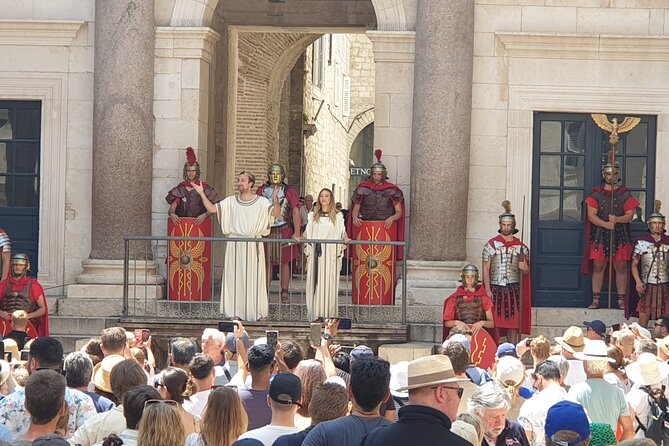
The tour’s first moment at the Peristyle is short but important, around 15 minutes. This isn’t a “look at columns and move on” stop. It’s where your guide can explain how the palace layout works as a system, not just a collection of buildings.
If you want to travel smarter in Split, treat this stop like your palace orientation brief. After this, you’ll recognize the palace walls and internal corridors in the rest of your sightseeing. That makes future wandering feel easier because you’re not constantly asking, where does this connect?
Diocletian Palace substructures: foundations and how the place evolved
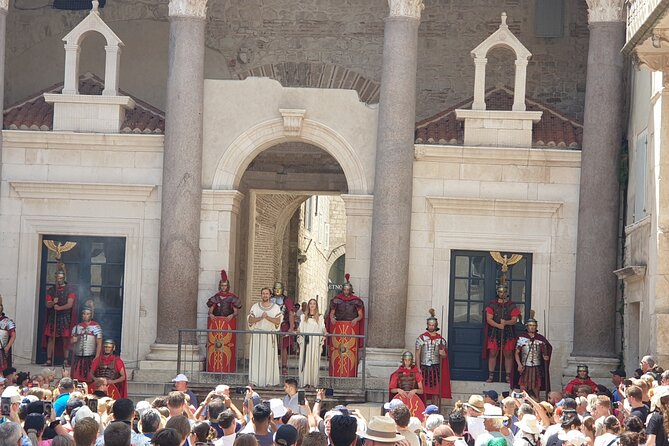
Next comes the Diocletian Palace substructures, about 10 minutes. This is the central hallway and the most important information about the palace foundation. The big payoff here is learning how these lower spaces worked and how their function changed over the ages.
Important detail: you won’t visit the museum part of the substructures on this tour. That means your time stays focused on the core story and the physical foundation clues. If you later decide you want museum content, you can visit that portion afterward.
A practical tip for this stop: go in with questions. Even if you’re not an architecture nerd, think about how a foundation shapes everything above it. When you see how the lower structure relates to the rest of the complex, the palace stops looking like a random ruin and starts looking like a designed environment.
Riva Harbor and the palace wall: the waterfront boundary
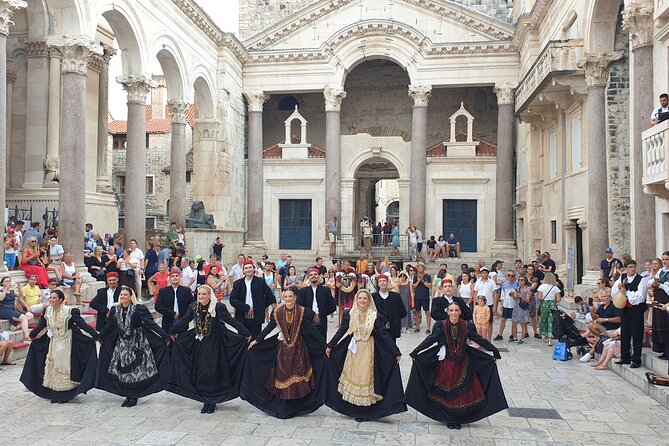
Then you’ll step toward the Riva Harbor area for about 10 minutes. Here the tour ties the waterfront of the city to the south wall of the palace. This is one of those connections that makes Split feel more coherent, because you see how the palace boundary shaped how people later lived beside the sea.
Look for how the city’s promenade and movement patterns line up with that wall. You’re basically learning how the Adriatic-facing edge became part of daily life, not only a defensive or ceremonial boundary.
Plenty more to do around Split
- Split: Old Town and Diocletian Palace Walking Tour★ 4.9 · 4,727 reviews
- Walking Tour of Split and Diocletian’s Palace★ 5.0 · 2,588 reviews
- Split & Diocletian’s Palace Walking Tour★ 5.0 · 1,125 reviews
- Split: Diocletian Palace & Old Town Guided Walking Tour★ 4.7 · 882 reviews
Fruit Square (Trg Brace Radic): a quick hit of Venetian layers
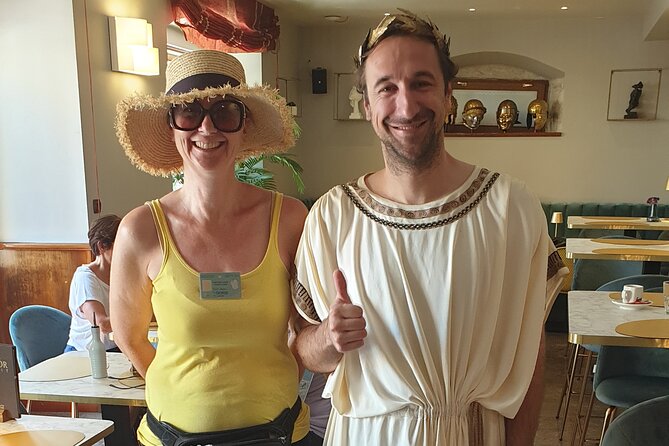
Fruit’s Square, also called Trg Brace Radic, gets about 5 minutes. You’ll see the old Venetian citadel atmosphere and a sculpture of Marko Marulić.
This stop is short by design. It acts as a bridge, reminding you that Split did not freeze in one historical era. It kept absorbing new rulers and new cultural priorities, and you can still spot those changes in square life and monuments.
If you like a tour that keeps momentum, you’ll appreciate how this stop gives you just enough context to carry forward without draining your energy.
The last remaining ancient Roman temple inside the palace
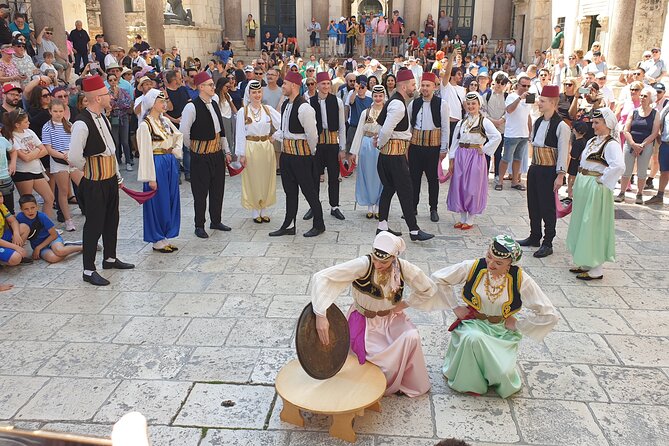
After that, you’ll reach the last remaining ancient Roman temple within the palace. The schedule doesn’t list a time number for this specific stop, but it fits as a key “high value” moment in the route.
This is exactly the kind of stop that changes how you perceive the complex. Instead of thinking of Diocletian’s Palace only as a fortress-like residence, you get a reminder that it also included Roman religious space. Even if you’re not sure what you’re looking at at first, a guide can help you spot the purpose behind the stone.
Take a few minutes here even if you feel rushed. Temple remains are often easier to appreciate when you pause and let the scale register.
Vestibulum and Triklinij: Diocletian’s personal spaces
You’ll then visit the Vestibulum of Diocletian’s Palace, about 5 minutes. This is the entrance hall of Diocletian’s personal quarters, and the tour focuses on the vestibule’s history. The information also notes you might hear traditional Dalmatian singing here, so it’s a moment to stay present and listen if it happens during your visit.
Next is Triklinij, about 5 minutes. This includes remains and a partial reconstruction of Diocletian’s personal walkway and dining hall. This stop is brief, but it’s valuable because “dining hall and walkway” turns the palace from a diagram into a lived-in place.
If you want better photos at these smaller interior transitions, aim for steady framing and clear sightlines rather than wide shots. The best results usually come from photographing from where the guide is standing, so you capture the right perspective with less guesswork.
The 15th-century Venetian palace, plus the mausoleum cathedral
The tour includes a 15th-century Venetian palace that now serves as the museum of the City. It’s another “layer” stop that shows you how later periods repurposed palace structures and nearby buildings.
You’ll also visit the cathedral in the mausoleum of emperor Diocletian. This is a major moment, because it’s the kind of sight that connects architecture to long-term meaning. Even if you only spend a few minutes there, you’ll come away understanding that this isn’t only about Roman time, it’s also about how the site continued to matter.
For this segment, pace your attention. Don’t feel like you must read everything. Let your guide highlight the key things, then absorb the space with your own eyes for a minute or two.
Grgur Ninski statue and the Golden Gate: language and identity
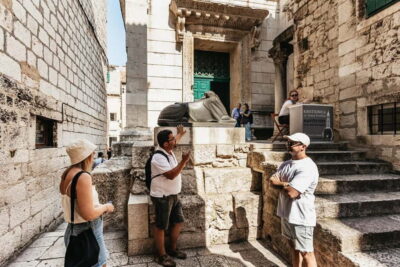
A longer stop comes next at the Grgur Ninski Statue, about 15 minutes. This statue, made by Meštrović, honors Grgur Ninski, often tied to the father of Croatian language. It’s placed in front of the north gate of Diocletian Palace, which makes it more than a random monument. It becomes a way to connect identity to place.
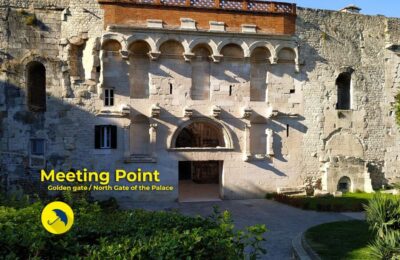
After that, you’ll reach the Golden Gate, about 10 minutes. This is the main entrance of Diocletian’s Palace, and you’ll learn about it along with the statue of Gregory of Nin and his importance to language and history.
One practical note: admission for the Golden Gate is listed as not included. So if you want everything here, plan your time and budget accordingly. If you only care about the exterior views and context, you can still get strong value from the explanation portion.
Second look at Riva Harbor: palace model and waterfront context
The tour finishes with another Riva Harbor stop, about 15 minutes, where you’ll see a bronze model of Diocletian’s Palace. This model can be a helpful “final boss” moment because it lets you translate what you learned in real space back into a simplified view.
However, the admission for this Riva Harbor segment is listed as not included. If that matters to you, decide before you reach the area how much you want to pay for the model experience.
Even without extra entry, the promenade setting helps lock the whole route in your mind. Once you’re back near the waterfront, it becomes obvious how the palace internal world and the city outside continually overlap.
Small group vs regular tour: pick based on how you like to travel
You can choose a small group option with a maximum of 5 people, or a regular tour with a maximum of 20. Both are led by an educated guide, and the whole activity caps at 20 travelers.
If you care about asking follow-up questions or you want a more relaxed pace, the small group is usually the better fit. Fewer people also tends to make it easier to gather around at the narrow palace transitions, where audio and sightlines can matter more.
If you just want the highlights and prefer a social atmosphere, the larger group option can work fine. In tight spaces, just remember to position yourself early at each stop so you don’t end up behind taller people.
Price and value: what $156.17 buys you in real terms
At $156.17 per person for about 1.5 hours, this isn’t a bargain-bin tour. But it can be strong value if you want structure and interpretation at Diocletian’s Palace without paying for every single entry.
Here’s the value logic I’d use to decide:
- You get an educated guide telling you what you’re seeing at multiple palace zones.
- Many of the stops are listed as admission ticket free, so your cost is less likely to balloon with additional fees.
- The small-group option can make the same route feel more personal.
The only clear value risk is the “not included” items. If your top priority is going inside ticketed areas such as the Golden Gate or paying for the model segment, your final cost might increase beyond the starting price. If you’re mainly after orientation, photo angles, and key context, the tour still makes sense.
Best time to go: morning and afternoon flexibility
You can choose morning or afternoon tours, which is genuinely useful at Diocletian’s Palace. You’ll likely find different lighting across stone surfaces, and the timing can help you avoid the heaviest crowd moments.
If you plan to do other Split walking after, the afternoon can work well because you can pair the tour with a slower dinner and waterfront time. If you prefer to explore on your own with clearer heads, the morning slot gives you more of the day left to wander.
If you can find an evening session, it may also suit you because the walk is compact and designed to help you understand the palace layout while you’re still fresh.
Who should book this tour (and who might skip it)
This tour is a great fit if you:
- Want a guided orientation to Diocletian’s Palace without getting lost in the layout
- Like photo-friendly pacing at the palace hubs and entrances
- Prefer a structured route that covers multiple layers, Roman and later uses
- Appreciate the story behind language and identity stops like Grgur Ninski and the Golden Gate
You might skip or reconsider if you:
- Only care about paid-entry interior experiences and you know you’ll want every ticketed spot
- Hate tours where some interesting elements are outside the included portion, since a couple areas are marked not included
- Need consistently loud audio, because hearing can be an issue in crowded, echoing stone spaces
Should you book Split and Diocletian Palace Historical Walking Tour?
Yes, if you want to understand Split’s most important site fast. This is the kind of tour that helps you connect the architecture to everyday city life, and it does it in about 90 minutes.
Book it if you’d rather spend your time learning the palace logic than guessing. Choose the small-group option if you value questions and easier movement in tight areas.
Skip it only if you’re mainly hunting for ticketed interiors and you would rather spend your time on your own with a longer, pick-what-you-like plan. Otherwise, this route gives you a strong foundation for the rest of your Split day.
FAQ
How long is the Split and Diocletian Palace Historical Walking Tour?
It lasts about 1 hour 30 minutes.
Where does the tour start and where does it end?
It starts at Peristil ulica, 21000, Split, Croatia, and it ends back at the meeting point.
Is the tour offered in English?
Yes, the tour is offered in English.
What group size options are available?
You can choose a Small group Tour with a maximum of 5 people, or a Regular Tour with a maximum of 20 people.
What is the maximum number of travelers for the tour?
This activity has a maximum of 20 travelers.
Are the stops included with admission fees?
Many stops are listed as admission ticket free, while some areas such as the Golden Gate and part of the second Riva Harbor segment are listed as admission ticket not included.
Does the tour include the museum part of the substructures?
No. The tour goes through the substructures, but it will not include the museum part of the substructures. You can visit it after the tour.
Are mobile tickets used for this experience?
Yes, a mobile ticket is included.
What is the cancellation policy?
You can cancel for a full refund up to 24 hours before the experience’s start time, and cancellation is free. If you cancel less than 24 hours before, the amount paid is not refunded.
Is the meeting point near public transportation and are service animals allowed?
Yes, it is near public transportation, and service animals are allowed.
More Walking Tours in Split




Recently added around Split
- Private VIP Brac and Hvar Day Trip from Split
★ 5.0 · 1 review - Private Transfer From or To the Split Airport
★ 5.0 · 1 review - Brač Half Day Beach Party Transfer to Olife Beach Club
★ 5.0 · 1 review - Private Transfer from Split to Zagreb, Hotel-to-hotel, English-speaking driver
★ 5.0 · 1 review - Airport transfers
★ 5.0 · 1 review - Private ”Game of Thrones” Walking Tour in Split (entrance tickets included)
★ 5.0 · 1 review
Diocletian's Palace Tours, compared.
Walking Tour of Split and Diocletian’s Palace
Read our review →
Diocletian Palace & Old Town Guided Walking Tour
Read our review →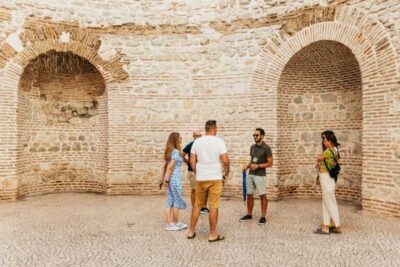

Game of Thrones Tour with Diocletian’s Palace Cellar
Read our review →
Diocletian’s Palace and Old Town SMALL GROUP Walking Tour
Read our review →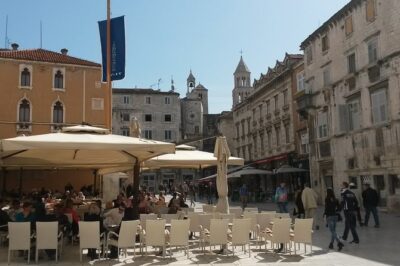
PRIVATE Walking Tour of Diocletian’s Palace & Old Town
Read our review →Browse the lists this tour appears in