

Reviewed · WALKING TOURS
Split Palace & Old Town -Private walking tour- Entrance included
Split’s palace is easier when someone maps it.
This private walking tour threads together the big Roman sites and the everyday old-town streets, so you do not just look, you understand what you are seeing. I like that the route is built around the palace complex first, then shifts into Old Split squares and markets.
What I especially like is the focus on real, entry-ticket sights. You get access to Diocletian’s palace basement and cellars, plus the Cathedral of Saint Domnius and the Temple of Jupiter.
One consideration: the program depends on site access, since events or church services can make some interiors unavailable. When that happens, the guide shifts the route a bit.
In This Review
- Key highlights that make this tour worth your time
- A private 2.5-hour route that makes Diocletian’s Palace click
- Starting on the Split Riva promenade, then moving into Roman walls
- Diocletian’s Palace: the interiors that turn guesses into facts
- Basement areas, cathedral interior, and the Temple of Jupiter zone
- What to watch for during the walk
- South Gate and the Diocletian’s Cellars: where you feel the size
- Practical tip
- Peristyle and key thresholds: how power and worship worked
- Saint Domnius Cathedral and the Jupiter story, tied to one building
- From Golden Gate to Old Split squares: following the city’s expansion
- Fruit’s Square and the Marko Marulić detail you will actually remember
- Fish Market stop: sulfur, baths, and why no one minds the smell
- Marmontova ulica and Prokurative: the end of the loop and where to go next
- Price and value: about $203.95 per person, and what you really pay for
- Small print that matters: access, worship times, and weather
- Who should book this tour, and who might prefer something else
- The guides matter, and Dana and Jana have impressed
- Should you book this Split Palace and Old Town tour?
- FAQ
- How long is the Split Palace and Old Town private walking tour?
- Is this tour in English?
- Is the tour private?
- What entrance fees are included?
- Where does the tour start and end?
- What happens if it is bad weather or a site is closed for services?
Key highlights that make this tour worth your time
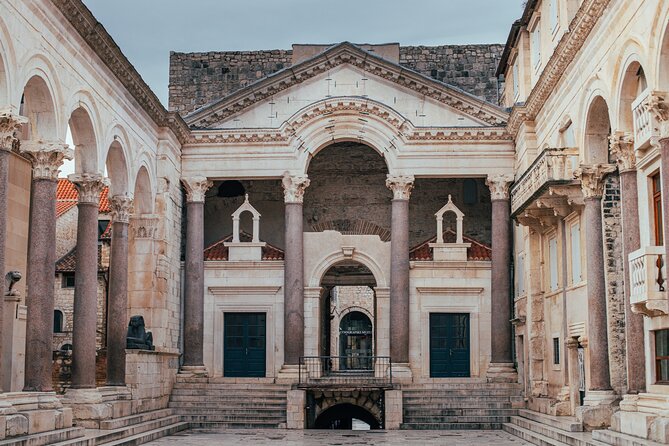
- Entrance included for major interiors like the cathedral and Jupiter area, not just outside photos.
- You get the palace scale by walking into the ancient cellars and seeing how the complex was laid out.
- The Old Town walk is practical after the palace, with stops that help you find your bearings.
- Private means you can adapt to pace and needs during the 2.5-hour loop.
- Strong guidance reputation if you are lucky enough to get Dana or Jana, their history skills and helpful directions are repeatedly praised.
A private 2.5-hour route that makes Diocletian’s Palace click
Diocletian’s Palace in Split can feel like a maze if you just wander. The streets are charming, but the Roman logic is not obvious right away. This tour solves that with a smooth sequence: palace complex first, then the medieval city that grew around it.
The private format also matters. You are not waiting for a crowd to regroup. You can pause when something catches your eye, ask why a space changed function over time, and keep moving at a pace that feels right. It is a good length too. At about 2 hours 30 minutes, you finish with energy for lunch, gelato, or a short self-guided follow-up.
Starting on the Split Riva promenade, then moving into Roman walls
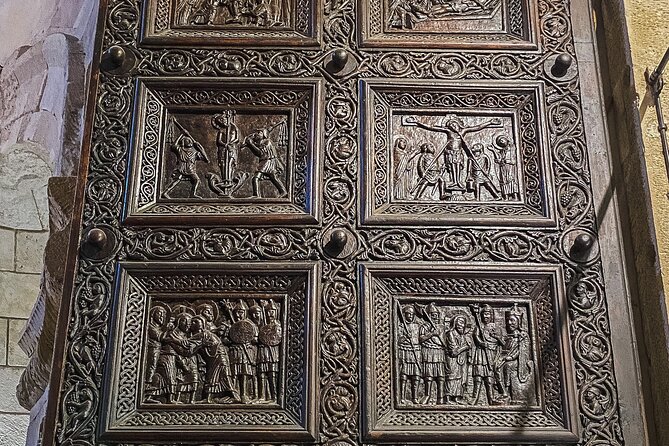
You begin at the Riva, Split’s waterfront promenade. That first stretch is more than a scenic warm-up. It gives you context for the city: trade, maritime life, and why Split became the kind of place where big power centers could thrive near the sea.
From there, you transition into the palace area. The tour keeps the movement simple, walking you from one key threshold to the next. This matters because Diocletian’s Palace is not a single monument. It is a whole urban system, with passages, gates, and spaces that held different roles for different people.
Plenty more to do around Split
Diocletian’s Palace: the interiors that turn guesses into facts
The palace complex is the heart of the experience, and the tour does not waste time with only exterior viewpoints. You get a structured look at the spaces that tell the story of how the site evolved.
Basement areas, cathedral interior, and the Temple of Jupiter zone
After getting an overview, you head into the palace complex where the tour includes entrance to three major sights: Diocletian’s palace basement, the Cathedral of Saint Domnius interior, and the Temple of Jupiter. These are the stops where a guide really helps, because the walls and ceilings can be impressive without you knowing what you are looking at.
Here is the key idea you should walk away with: the palace started as a Roman power center, and later Christian worship reshaped parts of it. The Cathedral of Saint Domnius is a perfect example. It began as Diocletian’s mausoleum, then the pagan role shifted as Christianity spread. That kind of transformation is one of the reasons Split feels like history layered instead of history frozen.
What to watch for during the walk
Keep an eye on transitions: entrances, corridors, and how spaces connect. Even if you only catch a bit of the explanation at each stop, the tour’s flow helps you piece it together later when you return on your own.
If you care about architecture, the Jupiter area is especially worth your attention. The Temple of Jupiter is now a baptistery, and its ceiling design has had influence beyond Split. Even just spotting the ceiling work and noticing how later builders adapted the ancient structure helps you understand why this place mattered.
South Gate and the Diocletian’s Cellars: where you feel the size
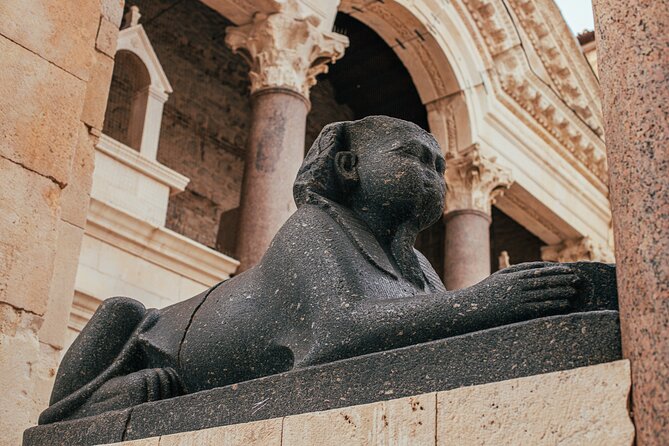
Then you go through the South Gate and into the cellars. This is one of those stops that changes the way you picture the palace. From street level, the palace can look like a set of buildings. In the cellars, it becomes clear you are dealing with something far more dimensional and complex.
The cellars are very well preserved, and the visit is built to show you the real dimensions of what Diocletian’s Palace was. That is the value of an included interior. You do not just read about the site. You walk through it, and the scale hits you fast.
Two days in Split? Here's how to fill the second.
- Split: Krka Waterfalls Trip with Boat Cruise and Swimming★ 4.8 · 10,519 reviews
- From Split: Krka Waterfalls, Food & Wine Tasting Tour★ 5.0 · 9,326 reviews
- Blue cave, Mamma Mia and Hvar, 5 islands speedboat tour★ 5.0 · 7,150 reviews
- From Split: Krka Waterfalls, Food & Wine Tasting Tour★ 4.9 · 6,598 reviews
Practical tip
Cellars and indoor areas can feel cooler than the open streets. Bring a layer if you are traveling in warm weather. You do not want to spend the last hour of the tour overheating in the old town afterward.
Peristyle and key thresholds: how power and worship worked
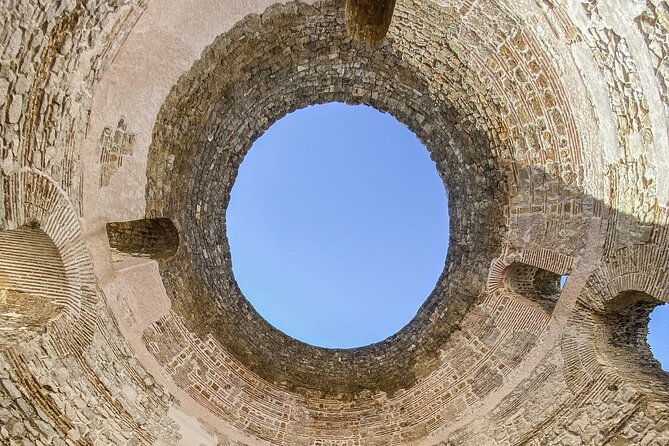
Next you reach the Peristyle, described as a sacred meeting place in Diocletian’s time. This is a crucial stop for understanding the palace as a performance space, not just a fortress.
Right after that comes the Vestibulum of Diocletian’s Palace, the entrance area connected to Diocletian’s private chambers. These are smaller visits, but they give you the map of daily movement, public viewing, and controlled access. It helps you grasp why some areas felt ceremonial while others felt more personal and restricted.
And if you are wondering why people still stop here for photos, it is because the design makes you want to look up and around. The tour keeps those moments brief, but meaningful.
Saint Domnius Cathedral and the Jupiter story, tied to one building
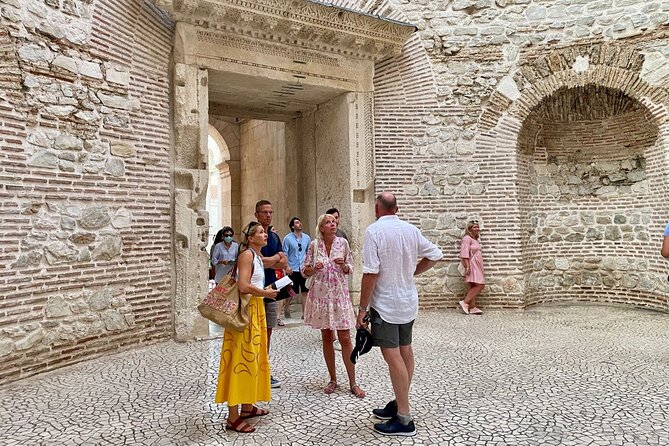
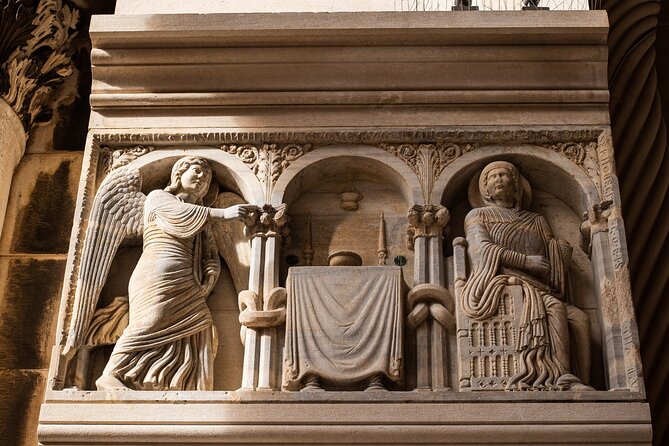
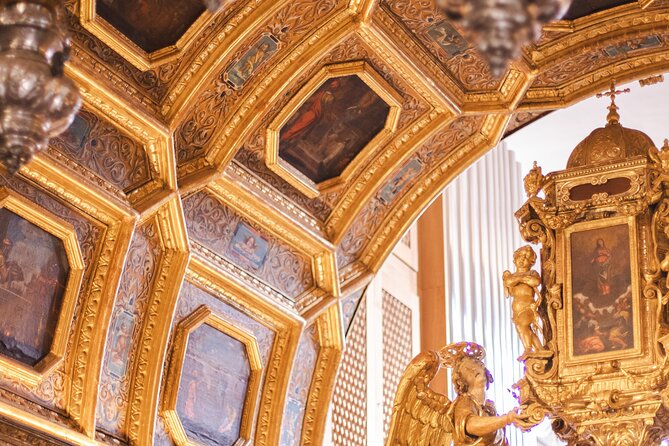
You then visit the Cathedral of Saint Domnius, which the tour frames as the former mausoleum turned Christian cathedral. Even without a long explanation at every step, you can feel the shift in purpose when you see the space used in a Christian context after its original imperial role.
The Temple of Jupiter stop rounds out this Roman-to-Christian arc. The tour explains how its current use as a baptistery connects to the older architecture, including the ceiling design that later influenced Renaissance-era builders in the region.
If you like “why this matters” answers, this is where you get them. Instead of collecting random facts, you learn to connect the dots between function, faith, and architecture.
From Golden Gate to Old Split squares: following the city’s expansion
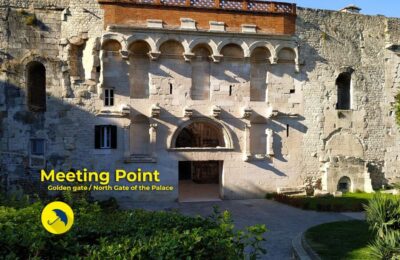
After the palace core, the tour moves along the north side and into the medieval city shape. You pass through the Golden Gate, described as the most important gate in Roman times with a road leading toward Salona, the capital of the Roman province.
Then you walk toward Narodni Trg and Voćni Trg, following the route west of the palace where the city developed during the Middle Ages. This is not just sightseeing. It is also a navigation lesson. When you know where the palace walls ended and the town grew, you understand why old streets turn the way they do.
You stop at Pjaca (People’s Square), the city center since the Middle Ages. The square is surrounded by significant buildings, including old Venetian palaces and a neo-Gothic city hall. Even if you only spend a few minutes there, it helps you calibrate where the civic heart of Split beats.
Fruit’s Square and the Marko Marulić detail you will actually remember
In Voćni Trg (Fruit’s Square), you learn how the area worked as a market place in earlier centuries. Today, there is a monument tied to Split’s Renaissance author, Marko Marulić.
This is the kind of stop that makes a walking tour feel personal. It turns a small square into a location with a time stamp. You start to notice that Split’s old town is not one uniform style. It is an evolving set of uses, from market to square to civic landmark.
Fish Market stop: sulfur, baths, and why no one minds the smell
The Split fish market is brief but memorable. You also get the idea that next door are sulfur baths, and even Diocletian understood that sulfur water could help with rheumatism and other ailments.
The most practical detail is the smell. The tour explains that sulfur is also the reason there are not many flies in the market area. That is one of those helpful “now I know” bits that makes the experience feel local, not generic.
Wear shoes you can stand in. Markets are uneven, and you might linger a little when you see how active it is.
Marmontova ulica and Prokurative: the end of the loop and where to go next
The tour finishes at Prokurative, near Republic Square. Before that, you walk through Marmontova ulica, a lively pedestrian shopping street built under French rule during Napoleon’s time. It is a good transition because it feels like the modern city layered onto the old one.
Prokurative is an easy place to land after the walking. It is lined with cafes and restaurants, so you can slow down fast. If you want a simple next step, head here for lunch, then keep exploring on your own while the palace story still feels fresh in your head.
Price and value: about $203.95 per person, and what you really pay for
At $203.95 per person, this is not the cheapest way to see Split. But for the mix you get, it can be strong value.
You are paying for:
- A private guide for about 2.5 hours
- A route that hits major Roman and old town nodes
- Included entrance fees to important interior sights
If you were to buy tickets yourself and then try to connect all the dots, it would take more time and likely cost more in the form of admissions plus guide time. This tour compresses that work into one efficient loop.
Also, it is booked about 73 days in advance on average, which usually means it holds appeal early in the planning season. If your dates are fixed, you might want to lock it in sooner rather than later.
Small print that matters: access, worship times, and weather
This tour requires good weather. If conditions are poor, you will be offered a different date or a full refund.
It is also possible that some sights cannot be visited due to events or church services. When that happens, the guide adjusts the program slightly. In real life, that is how walking tours survive. The good part is that the tour is flexible enough to keep you moving rather than canceling your day.
Who should book this tour, and who might prefer something else
This private Split palace and old town walk is ideal if you:
- Want more than photos, and you like explanations that connect spaces to time periods
- Prefer guided access to interiors like the cathedral and the Jupiter area
- Enjoy walking but do not want to manage tickets and route details alone
It might be less ideal if you:
- Hate walking or standing for stretches during markets and squares
- Are traveling on a day you suspect rain will ruin your plans, since the tour depends on good weather
The guides matter, and Dana and Jana have impressed
The most praised part in the feedback is the guide experience. Names that come up often are Dana and Jana. The common thread: they are described as skilled at history and comfortable giving practical direction, plus they make it easier to plan what you do after the tour.
If you can choose or request a specific guide through the booking process, you might try. If not, you can still feel confident that the format is built for a guided walkthrough, not a casual stroll with a brochure.
Should you book this Split Palace and Old Town tour?
Yes, if you want a clear, guided path through the parts of Split that are easy to misunderstand on your own. The big selling point is the combination: Diocletian’s Palace interiors with tickets included, plus a sensible old town walk that helps you locate the city center and enjoy the squares and market atmosphere afterward.
Skip it only if you are planning a lightning-fast trip with no time for a 2.5-hour structured walk, or if you are very sensitive to changes when sites are closed for services or events.
If you do book, go in with one mindset: you are not just sightseeing. You are learning how Split grew around a Roman palace, and you will feel that story in almost every stop.
FAQ
How long is the Split Palace and Old Town private walking tour?
It runs for about 2 hours 30 minutes.
Is this tour in English?
Yes, it is offered in English.
Is the tour private?
Yes. It is a private tour/activity, meaning only your group participates.
What entrance fees are included?
Entrance fees are included for Diocletian’s palace basement, the Cathedral of Saint Domnius interior, and the Temple of Jupiter, plus Diocletian’s Cellars. Some other stops are outside and have free admission.
Where does the tour start and end?
It starts at Model of the historical core of the city of Split, Obala Hrvatskog narodnog preporoda 23 and ends at Republic Square, Prokurative.
What happens if it is bad weather or a site is closed for services?
The tour requires good weather. If it is canceled due to poor weather, you will be offered another date or a full refund. If a sight cannot be visited due to events or church services, the guide will adjust the program slightly.
Recently added around Split
- Private VIP Brac and Hvar Day Trip from Split
★ 5.0 · 1 review - Private Transfer From or To the Split Airport
★ 5.0 · 1 review - Brač Half Day Beach Party Transfer to Olife Beach Club
★ 5.0 · 1 review - Private Transfer from Split to Zagreb, Hotel-to-hotel, English-speaking driver
★ 5.0 · 1 review - Airport transfers
★ 5.0 · 1 review - Private ”Game of Thrones” Walking Tour in Split (entrance tickets included)
★ 5.0 · 1 review
Walking Tours, compared.
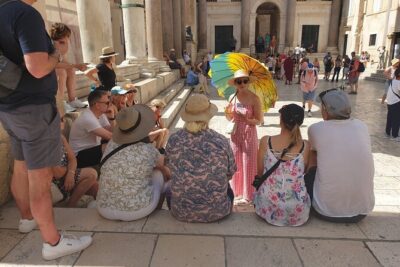
Walking Tour of Split and Diocletian’s Palace
Read our review →
Krka Waterfalls tour with Trogir Walking tour and Krka panoramic boat cruise
Read our review →

Walking Tour of Split with a ‘Magister’ of History
Read our review →
Split Walking Tour with Professor of History
Read our review →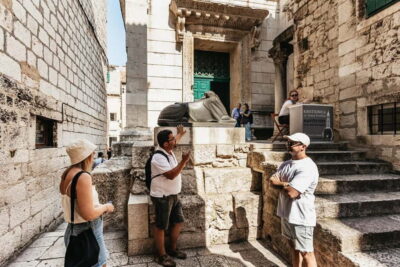
Diocletian Palace & Old Town Guided Walking Tour
Read our review →
Browse the lists this tour appears in