
Reviewed · WALKING TOURS
Split Walking Tour
Roman emperors still leave fingerprints here. On this Split walking tour, Elena of Elena’s Walks and Talks (8 years guiding) takes you through Diocletian’s Palace, a UNESCO site that’s still the town’s living core.
I love how the route blends big architecture with human details, from the Golden Gate to the Peristyle’s courtyard space. You’ll pick up clear context for 1,700 years of history, legends, and building styles, with fun pop culture references like Game of Thrones filming locations, plus personalized suggestions for where to eat afterward.
One thing to plan for: not every major stop is included for free. Temple of Jupiter is outside only, and the Cathedral of Saint Domnius requires a separate admission fee, so decide in advance if you want to add those costs.
In This Review
- Key things that make this tour worth your time
- Split’s Roman core: why Diocletian’s Palace still runs the show
- Elena’s guiding style: stories that stick (and a guide you’ll enjoy listening to)
- From Strossmayer Park to the Golden Gate: entering Diocletian’s Palace like a local
- Peristyle Square: the palace’s ceremonial heart in open air
- Descending into the Substructures: cellars, craft stalls, and Roman storage logic
- Vestibulum and Temple of Jupiter: Roman ceremony, Christian reuse, and singer-friendly acoustics
- Pjaca, Fruit’s Square, and the waterfront finish: ending with real Split energy
- Price and logistics: what you pay for, and how to judge value
- Stop-by-stop guide: what to watch for at each moment
- Who should book this tour, and who might want a different option
- Should you book Split Walking Tour with Elena’s Walks and Talks?
- FAQ
- How long is the Split Walking Tour?
- What is the price per person?
- Is there a mobile ticket?
- What is the group size limit?
- Where does the tour start and end?
- What sites are free to view, and what requires extra admission?
- Does the tour include an inside visit to Temple of Jupiter?
- Are service animals allowed?
- Is the tour near public transportation?
- When do I get confirmation, and can I cancel?
Key things that make this tour worth your time
- Diocletian’s Palace, UNESCO level, but walked at a friendly pace
- Elena’s storytelling style, funny and clear, tied to what you see in front of you
- Roman spaces that still feel active today, from medieval lanes to artisan stalls
- Real sound and space details, including why singers show up in the Vestibulum area
- Most stops are free to view, with only a couple paid entrances you can choose
Split’s Roman core: why Diocletian’s Palace still runs the show
Split can feel like two cities at once: the seaside town you see at the waterfront, and the older, tighter maze of stone that formed the backbone of everything. This tour focuses on the reason that switch happens, by taking you through Diocletian’s Palace, one of the world’s best-preserved Roman imperial palace complexes and a UNESCO World Heritage site.
What I like about the format is that you do not need to be a Roman history nerd to enjoy it. You learn by watching how the buildings connect: gates lead to courtyards, courtyards lead to chambers, and the palace walls wrap around daily life. Even if you only know a few Roman facts, you’ll leave with a mental map of how emperors, later residents, and modern Split all share the same streets.
Also, the “palace as a living core” angle matters for your experience. You are not just looking at ruins behind glass. You are walking through spaces where you can still sense the original planning, then see later layers added on top, including Christian-era reuse.
Elena’s guiding style: stories that stick (and a guide you’ll enjoy listening to)
The biggest reason people end up recommending this tour is the guide. Elena gets high praise for being sweet, funny, and genuinely interesting, with history delivered in a way that feels like a conversation rather than a lecture.
You’ll get more than dates. Expect explanations that help you picture how power worked in this part of the Roman world, why certain buildings were placed where they were, and what later communities did with the same structures. That’s the difference between memorizing facts and understanding place.
And there’s a practical bonus: Elena also shares personalized recommendations for local eats. That’s useful on an evening in Split when you want something good but do not want to gamble blindly. Pair the tour with a simple plan, like asking for one meat option and one non-meat option, then matching it to your dinner schedule.
If you’re the type who gets distracted when explanations are too long, this tour’s structure helps. It’s a steady sequence of stops, each one tied to a visible feature, so you get regular “aha” moments as you walk.
Plenty more to do around Split
From Strossmayer Park to the Golden Gate: entering Diocletian’s Palace like a local
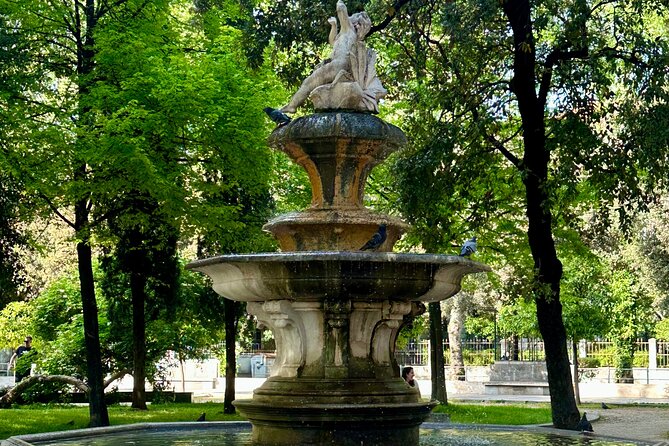
You start just outside the palace walls in Strossmayer Park, a small green pocket that gives your brain a quick reset. It’s shaded, calmer than the stone streets, and it helps you shift into the right mood for what’s ahead. It also keeps the beginning of the tour from feeling rushed.
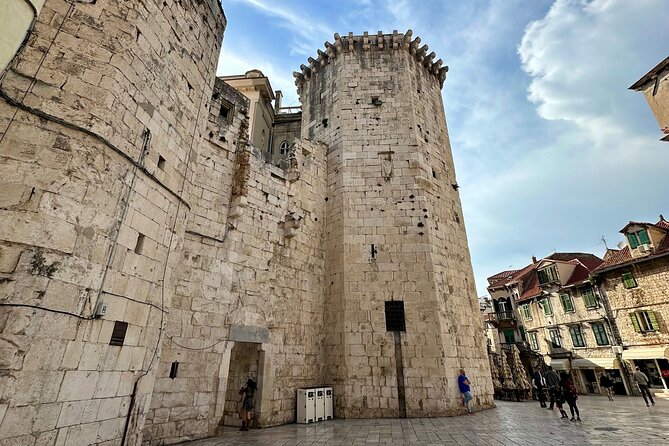
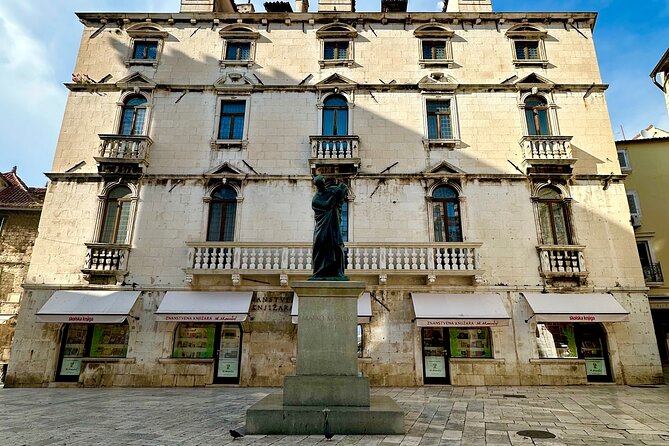
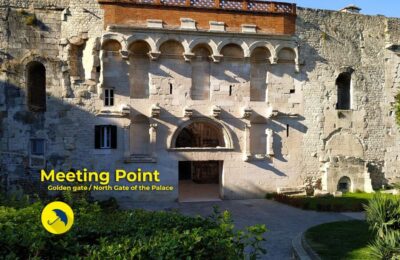
Then you move to the Golden Gate, the northern gate where emperors entered. Standing near it, you get that immediate sense of ceremony, because Roman gates were designed to look impressive and to control movement. You’ll also learn a local tradition connected to the statue of Gregory of Nin, where rubbing his toe is said to bring good luck.
This is one of those moments where a small detail changes how you see the whole area. Once you know the gate’s meaning and the symbolism around the statue, the place stops feeling like a random landmark and starts feeling like a story you can follow.
Practical tip: if you’re interested in the statue tradition, go early in the tour. You’ll be better positioned to see everything clearly before foot traffic builds.
Peristyle Square: the palace’s ceremonial heart in open air
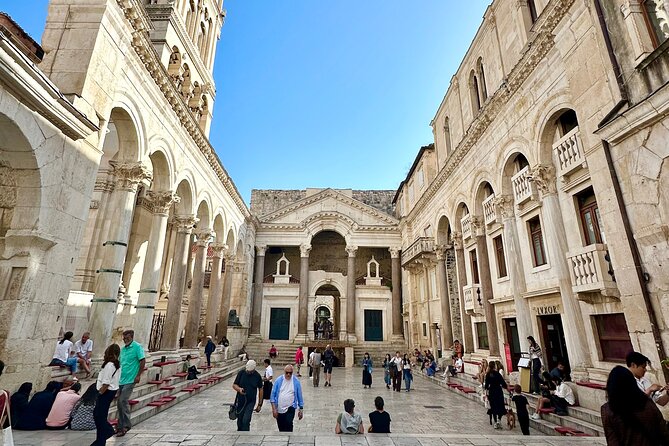
Next comes the Peristyle of Diocletian’s Palace, the dramatic Roman courtyard that served as a ceremonial center. This is where the palace plan becomes obvious, because the open space contrasts with the tight lanes around it.
What makes this stop special is how it teaches you to read architecture. You learn how courtyard space can communicate authority, because the design funnels attention to key areas while giving enough room for movement and gatherings. It’s not just “cool Roman stuff,” it’s a lesson in how space shapes behavior.
You’ll also notice how the palace courtyard connects to the rest of Split’s everyday life. The location keeps pulling modern energy into the ancient setting, so you get both history and a sense of current use.
If you like photos, this is also one of your best chances for shots that feel meaningful, not just scenic. The shape and layout make it easier to capture the “Roman planning” effect.
Descending into the Substructures: cellars, craft stalls, and Roman storage logic
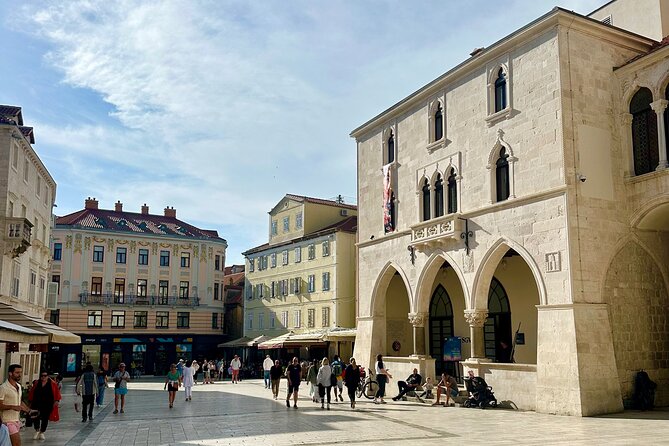
From the open courtyard, you go downward into the Diocletian Palace substructures, the preserved cellars beneath the palace. This part is a real change of pace. You leave daylight and enter a more enclosed space where Roman ingenuity feels practical, not abstract.
The cellars were originally used for storage, and that matters. Romans planned for supply and control, and you can sense how a palace needed systems behind the scenes. Today, the same underground areas are home to artisan stalls, so you see continuity rather than dead history.
A drawback to note, though: if you’re sensitive to crowds or enclosed spaces, this is the stop where you might feel a bit more compression, because these underground areas attract visitors. It’s still worth it, just be mentally ready for a tighter environment.
If you love “how did they actually run the place” questions, this is one of the most satisfying segments. It turns palace romance into logistics, which is often where the real history gets interesting.
Vestibulum and Temple of Jupiter: Roman ceremony, Christian reuse, and singer-friendly acoustics
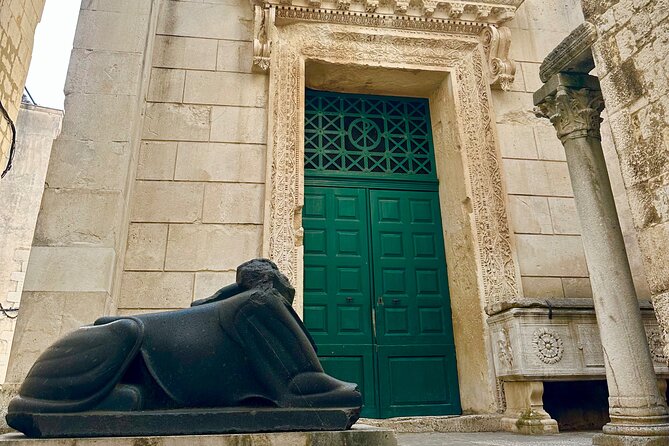
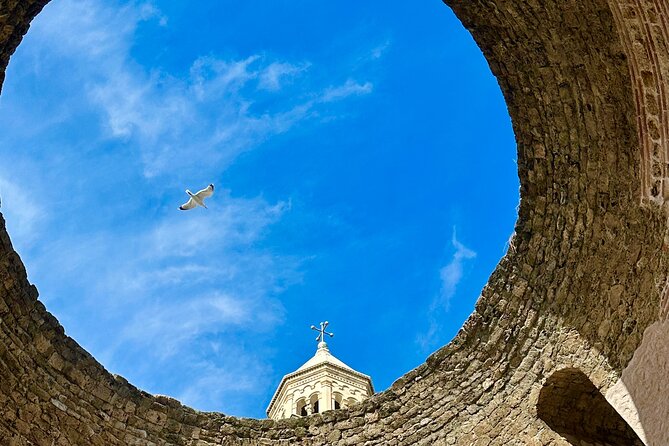
The tour continues with the Vestibulum of Diocletian’s Palace, a circular, open-roofed chamber where the emperor would greet guests. The design is the point here, because the architecture supports an idea of presence and reception. You’re not imagining the scene from a book, you’re standing in the physical setup.
There’s also a practical sensory detail: the acoustics often attract traditional Dalmatian singers. Even if you do not catch a performance at that exact moment, knowing this makes you listen differently to the space, and that’s a fun way to make architecture feel alive.
After that, you visit the Temple of Jupiter, which is now a Christian baptistery. This stop shows how later communities reused earlier sacred spaces. You’ll see intricate carvings and get the spiritual thread that runs through Roman and Christian eras.
Important limitation: the Temple of Jupiter visit is only from the outside, and inside entry is not included on the tour. If you want the full interior experience, plan on separate entry and keep that extra time in mind.
This is also where you’ll want to think about your priorities. If your goal is maximum site access, you may spend additional money at the end. If your goal is story and place-reading, the outside view still works well.
Two days in Split? Here's how to fill the second.
- Split: Krka Waterfalls Trip with Boat Cruise and Swimming★ 4.8 · 10,519 reviews
- From Split: Krka Waterfalls, Food & Wine Tasting Tour★ 5.0 · 9,326 reviews
- Blue cave, Mamma Mia and Hvar, 5 islands speedboat tour★ 5.0 · 7,150 reviews
- From Split: Krka Waterfalls, Food & Wine Tasting Tour★ 4.9 · 6,598 reviews
Pjaca, Fruit’s Square, and the waterfront finish: ending with real Split energy
Not every stop is about marble and emperors. The tour balances the heavy history with everyday city life through Pjaca and Fruit’s Square.
At Pjaca, you walk through a historic square surrounded by elegant architecture and plenty of café energy. It’s a good reset after the palace complexity, and it gives you time to absorb the city’s rhythm without constant stone details demanding your attention.
Then comes Fruit’s Square (Trg Brace Radic), a square that once held a bustling market and now functions as a social spot where you can grab coffee and watch life move. This kind of stop is not “filler.” It’s your chance to connect the Roman and post-Roman city to how people actually live.
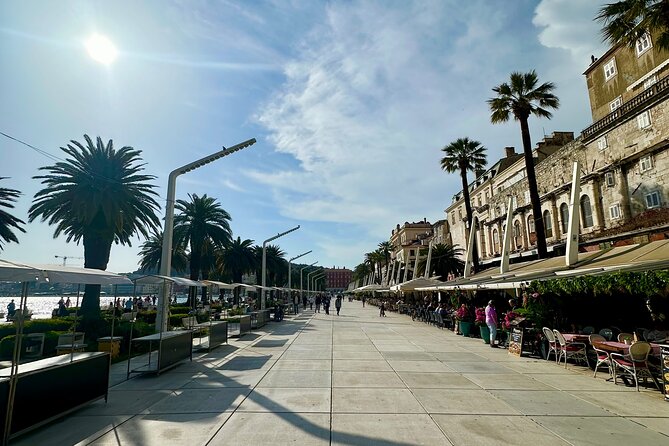
Finally, the tour ends along Split Riva Harbor, the waterfront promenade with palm trees and cafés. You close with the Adriatic breeze, and it’s an ideal spot to linger and follow through on the food recommendations Elena gives you.
If you want the tour to feel complete, plan for a post-walk hour. Sit down near the end, take a breath, and then decide what to do next based on what clicked during the stories.
Price and logistics: what you pay for, and how to judge value
The price is $17.90 per person, and the tour runs about 1 hour 45 minutes. For that time, you’re paying mostly for guided interpretation of a UNESCO-level site, plus access to a free-view route that links major palace features in a logical order.
Here’s how I judge value on a tour like this:
- You’re not paying for museum tickets at every stop. Most areas are admission-free to view, so your money goes to the guide and the route design.
- The group size is capped at 15 travelers, which helps keep the experience from feeling chaotic.
- You get a mobile ticket, which is convenient if you’re bouncing between stops on a busy travel day.
- Elena’s track record and style are a big part of the package, and the reviews back that up with consistent praise.
The main cost consideration is what is not included. You may want to add admission for the Cathedral of Saint Domnius and for Temple of Jupiter if you decide to go inside elsewhere. Since those fees are not included, think of the $17.90 as the price of the walking and interpretation, then add optional sites if your interests match.
Also, the tour is typically booked about 24 days in advance on average. If you’re traveling in a peak season window, it’s smart to lock your slot earlier rather than waiting until the last minute.
Stop-by-stop guide: what to watch for at each moment
Here’s a quick, practical way to get the most from every part of the walk.
- Strossmayer Park
Look for shade and quiet first. It helps you settle in, and it sets up the palace walk that follows.
- The Golden Gate
Watch for the gate’s ceremonial feel and the statue detail. The Gregory of Nin toe-rubbing tradition is a small moment, but it’s memorable once explained.
- Peristyle of Diocletian’s Palace
Focus on the open courtyard geometry. It’s the space that makes the palace plan click.
- Diocletian Palace substructures
Plan for a tighter feel underground. Stay patient and take your time, because this is where Roman storage logic turns into today’s craft areas.
- Vestibulum
Listen with your ears, not just your eyes. Knowing that Dalmatian singers often show up changes how the room feels.
- Temple of Jupiter
Go in with the expectation that you’re seeing it from outside only. It’s still a powerful example of Roman to Christian reuse, just not a full interior visit.
- Pjaca
Use this square as your breathing room. It’s a chance to reflect, take photos, and get oriented for your next walk.
- Fruit’s Square
Aim for a coffee break if you need one. This stop helps you reconnect the historic core to current daily life.
- Riva Harbor
End here with time to linger. It’s the best way to let the stories settle, then reward yourself with views and a meal plan.
Who should book this tour, and who might want a different option
This tour is a great fit if you:
- Want a structured walk that connects multiple major palace spaces without wasting time
- Like stories that make buildings make sense
- Prefer a small group experience rather than a large crowd shuffle
- Appreciate practical guidance, including where to eat afterward
It might be less ideal if you:
- Only want paid, inside visits at major sites, since Temple of Jupiter inside access is not part of this tour
- Are looking for a super-fast hit list, because the value is in the pacing and explanation
- Hate enclosed areas, since the substructures are underground
If you’re visiting Split for the first time, this is one of the best ways to get your bearings fast. It gives you a coherent “map in your head” that makes the rest of your day easier.
Should you book Split Walking Tour with Elena’s Walks and Talks?
Yes, if you want Diocletian’s Palace explained in a way that feels fun and easy to remember. The combination of UNESCO-level architecture, a story-forward guide named Elena, and a route that ends on the waterfront makes this a strong value at $17.90.
Book it with one simple mindset shift: this is not just sightseeing. It’s learning how the palace was designed, then watching how Split kept using those same spaces. If you’re okay with optional extras like Cathedral and Temple of Jupiter interior access, you’ll get a complete, satisfying first look at the city’s ancient and modern layers.
FAQ
How long is the Split Walking Tour?
It lasts about 1 hour 45 minutes.
What is the price per person?
The price is $17.90 per person.
Is there a mobile ticket?
Yes, the tour uses a mobile ticket.
What is the group size limit?
The tour has a maximum of 15 travelers.
Where does the tour start and end?
It starts at Strossmayerova Fountain, Ul. kralja Tomislava 12, 21000 Split, Croatia, and ends at Split Riva (the Split promenade area).
What sites are free to view, and what requires extra admission?
Admission fees are not included for the Cathedral of Saint Domnius and Temple of Jupiter. Temple of Jupiter is only visited from the outside on the tour.
Does the tour include an inside visit to Temple of Jupiter?
No. You only see Temple of Jupiter from the outside, and inside entry is not included.
Are service animals allowed?
Yes, service animals are allowed.
Is the tour near public transportation?
Yes, it is near public transportation.
When do I get confirmation, and can I cancel?
You receive confirmation at the time of booking, and you can cancel for a full refund up to 24 hours in advance.
Recently added around Split
- Private VIP Brac and Hvar Day Trip from Split
★ 5.0 · 1 review - Private Transfer From or To the Split Airport
★ 5.0 · 1 review - Brač Half Day Beach Party Transfer to Olife Beach Club
★ 5.0 · 1 review - Private Transfer from Split to Zagreb, Hotel-to-hotel, English-speaking driver
★ 5.0 · 1 review - Airport transfers
★ 5.0 · 1 review - Private ”Game of Thrones” Walking Tour in Split (entrance tickets included)
★ 5.0 · 1 review
Walking Tours, compared.
Walking Tour of Split and Diocletian’s Palace
Read our review →
Krka Waterfalls tour with Trogir Walking tour and Krka panoramic boat cruise
Read our review →

Walking Tour of Split with a ‘Magister’ of History
Read our review →
Split Walking Tour with Professor of History
Read our review →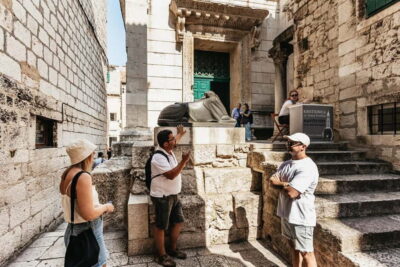
Diocletian Palace & Old Town Guided Walking Tour
Read our review →
Browse the lists this tour appears in