
Reviewed · HISTORICAL TOURS
Experience Split History Walking Tour With Local Historian
Split history feels close enough to touch. This small-group walk connects Roman Diocletian’s Palace to the way people live in Split today, using a local historian’s stories and visuals to make the stones easier to read.
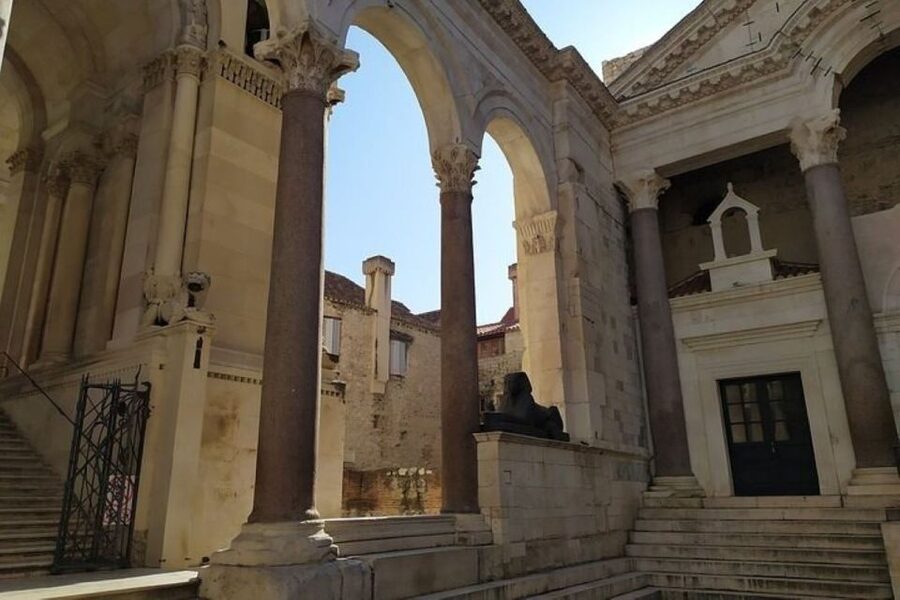
I like how you get a guided path through the palace highlights, especially Peristil and the main palace square feeling like a real stage of everyday life, not just ruins. I also like the added help of 3D reconstruction images and pictures, which makes the palace complex much less mysterious.
One consideration: it is still a street-and-stone walking tour, and it is not suitable for wheelchair users or people with mobility impairments. Bring water and wear comfortable shoes, because sunny days in Split can be warm.
In This Review
- Key things you will notice on this Split history walk
- Golden Gate Start: the northern gate that sets the story
- Entering Diocletian’s Palace: from Roman control to city life
- Peristil and the main palace square: learning to read the layout
- Jupiter’s Temple and the palace religious shift
- Cathedral of Saint Domnius: Roman forms, later faith
- Vestibule and the palace in-between spaces
- Diocletian’s cellars: the underworld that explains the whole building
- Riva promenade: where Roman and modern meet
- Fruit Square and People’s Square: two medieval corners with stories
- Narrow street, lost sphinx head, and a secret garden
- Price and value: is $37 a fair deal for two hours?
- What to bring and how to pace your day
- Who this tour suits best in Split
- Should you book this Split History Walking Tour?
- FAQ
- Where is the meeting point?
- How long is the Split History Walking Tour?
- What is the maximum group size?
- What is included in the ticket price?
- Are food and drinks included?
- Is hotel pickup or drop-off included?
- What languages does the tour run in?
- Does the tour help you skip the ticket line?
- Is the tour suitable for wheelchair users or mobility impairments?
- What should I bring?
Key things you will notice on this Split history walk
- Golden Gate kickoff: you start at the northern gate and learn why it matters before you even enter the palace
- Diocletian’s Palace, explained in human scale: major spaces like Jupiter’s Temple, Vestibule, and the cellars get clear context
- Peristil as a living square: you understand how this palace centerpiece shaped life, then and now
- Two medieval squares: Fruit Square and People’s Square are treated as story-rich corners, not side stops
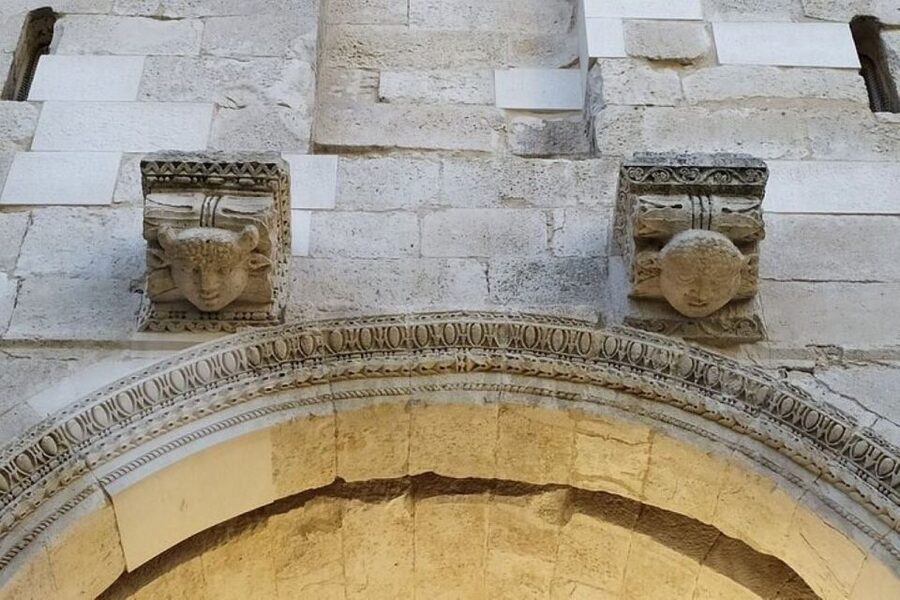
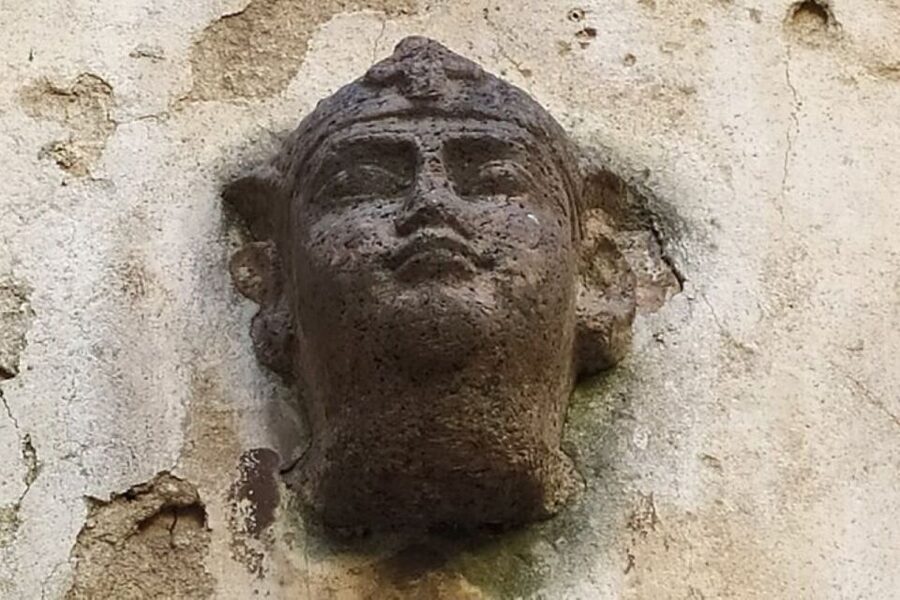
- Extra-tight details off the main route: narrow church, narrow street, lost sphinx head, and a secret garden add surprise
Golden Gate Start: the northern gate that sets the story

Your tour begins at the Golden Gate, the northern entrance to Diocletian’s Palace. This is not just a convenient meeting point. It is the moment your guide helps you understand what you are looking at, including the name, purpose, and importance of this gate.
From there, you will also see Gregory of Nin, the famous statue that sits nearby. The guide uses that location to introduce who Gregory of Nin is, and why he is tied to Split’s identity. It is a smart setup, because once you know the landmarks in the right order, the palace feels less like a maze and more like a designed city.
In the first stretch, you will also get an orientation to Split and Croatia. That matters because the tour jumps across time, Roman to medieval and onward. If you start with the big picture, each stop later feels earned, not random.
Entering Diocletian’s Palace: from Roman control to city life
Crossing from the street into Diocletian’s Palace feels like stepping into a world where architecture is the main storyteller. The guide frames the palace as something more than old stone, it is a living historical monument that later generations kept adapting.
You will move through major palace areas with stories built around how they worked. That includes spaces tied to ceremony and power, but also the practical parts that made daily life possible. Your guide’s master’s degree in history helps keep the facts grounded, while the legends and intrigues keep it fun.
A nice detail here is the small-group size. With a maximum of 12 people, you are not stuck listening to a script at full volume for hours. You are more likely to get answers to questions and little course corrections that match your pace.
And yes, the tour includes a skip-the-ticket-line approach, which saves you time if you are also trying to fit other sights into your day.
Two thousand years, one afternoon
Peristil and the main palace square: learning to read the layout
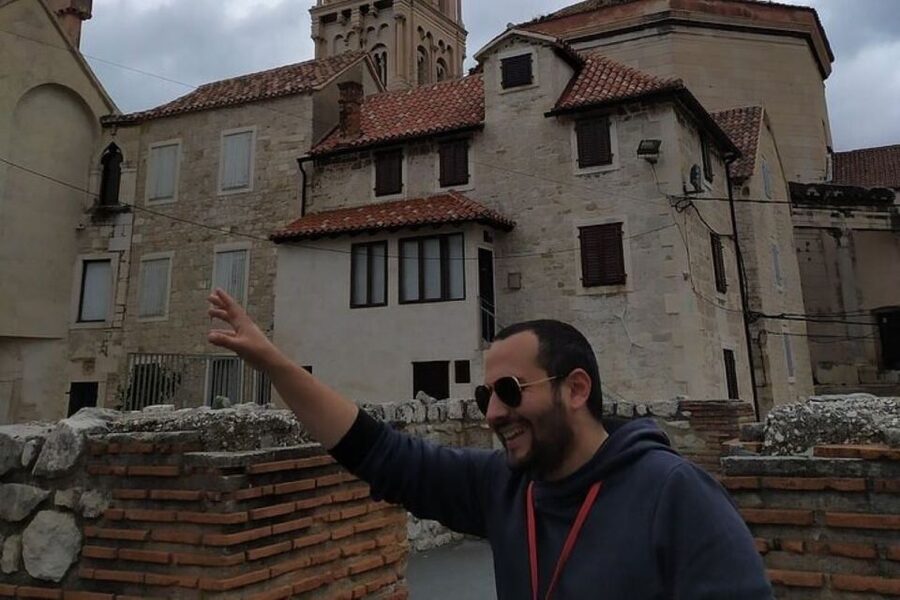
Peristil is the palace centerpiece, and you will spend real time there. This is the kind of place where it is easy to just take photos. The guide makes Peristil make sense by explaining what surrounded it and how the palace layout shaped movement, visibility, and social life.
You will hear how Peristil connects to the bigger palace idea, including monumental surroundings and the feeling of a public square inside a fortress. It helps you understand why this space stayed important as centuries passed.
If you like “architecture with meaning,” Peristil is where the tour clicks. Once you understand the palace as a designed system, the later stops become easier to track, even if you are not an archaeology expert.
Jupiter’s Temple and the palace religious shift
Next comes Jupiter’s Temple, one of the palace’s standout points. The guide treats it as more than a landmark by linking it to what the Romans were doing in the palace complex and why that mattered for imperial life.
You get guided sightseeing and the kinds of story details that turn the site into a timeline. You start to see how Roman symbolism was built into the environment, not just stored in books.
This stop also helps you grasp a key theme of Split. Croatia’s modern identity sits on top of a long sequence of rule and adaptation. The palace is the physical reason that theme is visible, day or night, to anyone walking the streets.
Cathedral of Saint Domnius: Roman forms, later faith
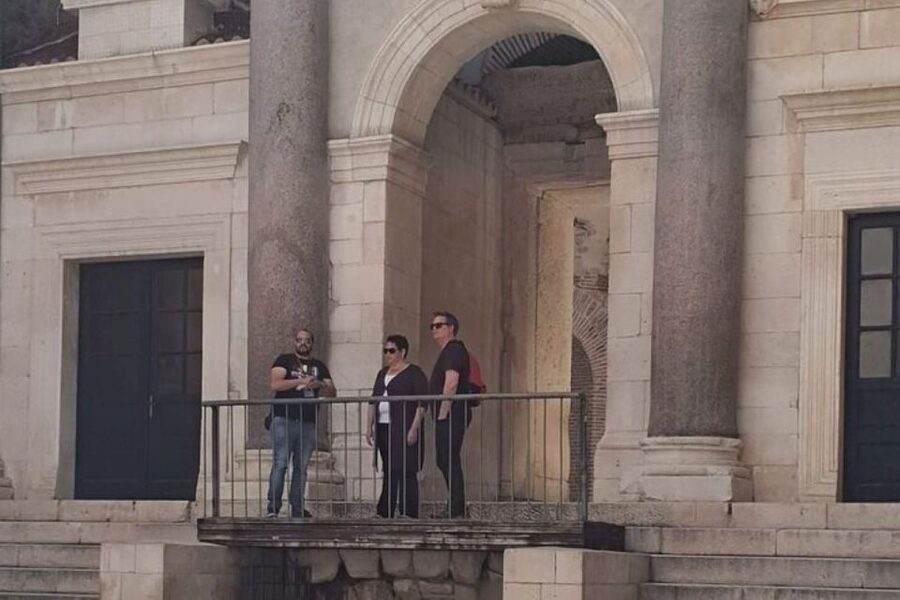
The Cathedral of Saint Domnius is a perfect example of what makes Split unusual. You will stand in a sacred space that reflects layers of time rather than a single moment frozen in place.
The tour connects the cathedral area to the palace story so it feels like one continuous setting. That reduces the usual confusion where you feel like you are jumping from one “separate attraction” to the next.
The guide also brings attention to how the architecture carries meaning across centuries. You are not just looking at a building, you are learning why that building ended up here and why it kept mattering.
Vestibule and the palace in-between spaces
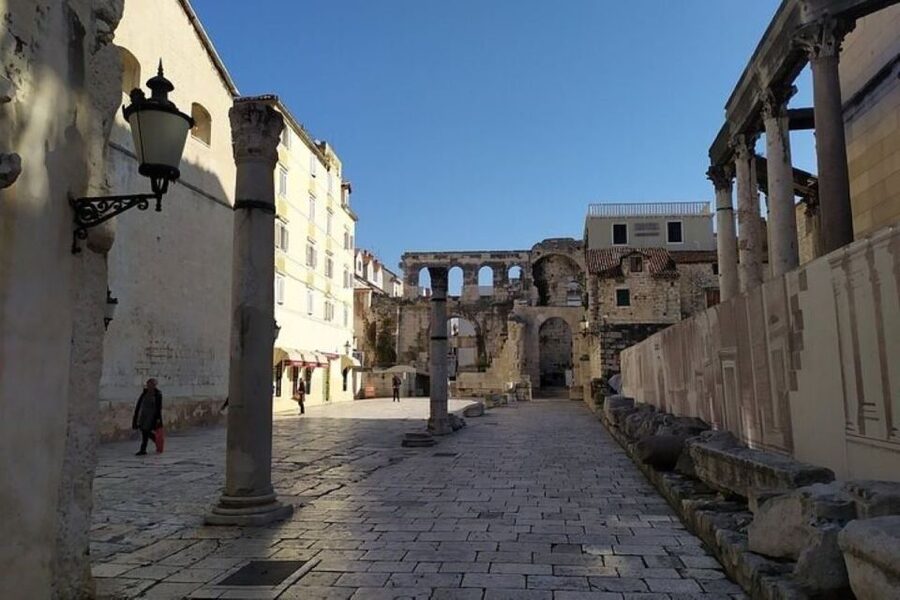
The Vestibule might sound like a minor stop, but it is one of those places that helps you understand the palace as a whole. In a palace complex, the spaces between the grand rooms are often what control flow and function.
You will hear what the vestibule is tied to inside the palace layout, and the guide uses that to explain movement patterns and how people used different sections. If you have ever walked around ancient ruins thinking, I do not know where people actually went, these “in-between” moments help solve that.
This is also where the See, Hear and Feel approach makes sense. You start to feel how your route matches the palace logic, even if you are not reading a plan.
Plenty more to do around Split
- Split: Old Town and Diocletian Palace Walking Tour★ 4.9 · 4,727 reviews
- Walking Tour of Split and Diocletian’s Palace★ 5.0 · 2,588 reviews
- Krka Waterfalls tour with Trogir Walking tour and Krka panoramic boat cruise★ 5.0 · 1,659 reviews
- Split & Diocletian’s Palace Walking Tour★ 5.0 · 1,125 reviews
Diocletian’s cellars: the underworld that explains the whole building
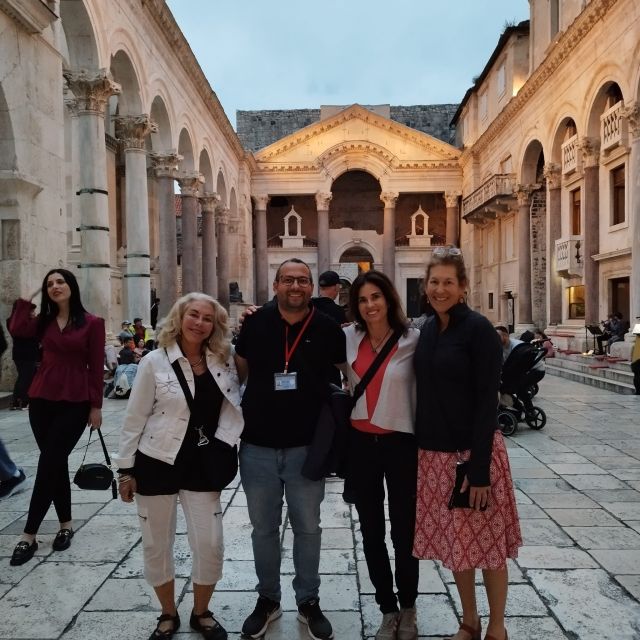
One reason this tour feels satisfying is that it goes below ground level. The Diocletian’s Cellars are part of your walking route, and you will get guided sightseeing that explains why the substructures matter.
The cellars add a practical layer to what you just learned above. Instead of only hearing about monuments and squares, you also get context about how the palace supported living, storage, and the everyday mechanics of running a complex.
If you want to leave Split with a clearer mental map, the cellars help. They make the palace feel complete, not just visible from the surface. It also adds contrast, because cellars and courtyards create a different sense of scale and atmosphere.
Riva promenade: where Roman and modern meet
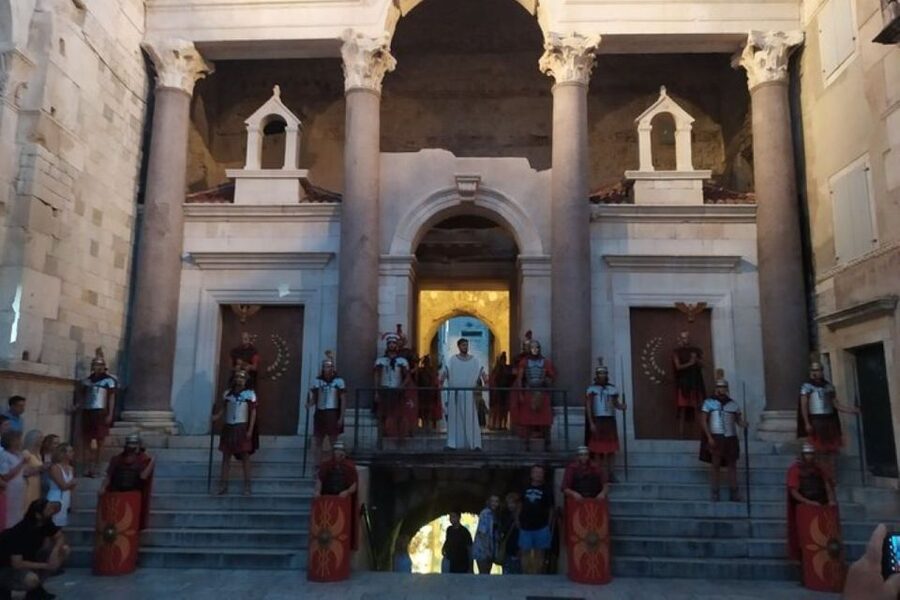
After the palace interior work, you shift to the Riva promenade. This is where the tour connects the historic environment to present-day strolling. You get the sense of continuity, how the Roman and medieval periods connect to the modern street experience.
Your guide brings in the idea of a local rhythm, the pomalo way of life, so you can picture how Split works when it is not being photographed for postcards. You are not expected to “perform” the lifestyle. You just get the background to understand what you are seeing as you walk.
This part works especially well if you are doing Split as a short stop between other Croatian destinations. By the time you reach Riva, you have enough context to appreciate why the waterfront matters culturally and emotionally.
Fruit Square and People’s Square: two medieval corners with stories
Fruit Square and People’s Square are the tour’s medieval payoff. Instead of treating them like quick photo spots, the guide explains how their architecture and history shaped events across centuries.
At Fruit Square, you will learn the kinds of secrets tied to the space, including what the square held in the past and how it fits into the broader city pattern. The guide’s storytelling approach helps you notice details you would normally walk past.
Then you move to People’s Square, where the focus turns to the way public life evolved. These squares feel like outdoor rooms, and the tour helps you understand them as meeting points, not just empty space surrounded by stone facades.
Together, these squares balance the Roman concentration. You leave with the sense that Split is not only Diocletian’s Palace, it is a layered city that kept using its inherited structure.
Narrow street, lost sphinx head, and a secret garden
The tour saves some of its most fun mystery for the smaller stops. You will get a chance to see and hear about places described as tight and special, including the narrowest church and the narrowest street.
You will also hear about the lost sphinx head and a secret garden. These are the kinds of stops that only work when you have a guide who knows where to point and what to say, because you would not necessarily spot the meaning on your own.
This section is short by design, but it adds variety. After long stretches of palace structure and squares, these quick hits create a change in pace without breaking the theme.
It is also a practical reminder: Split’s charm often lives in details. A guide is the difference between seeing buildings and actually understanding why those odd little corners feel important.
Price and value: is $37 a fair deal for two hours?
At about $37 per person for a 2-hour walk, the value is strongest if you care about meaning, not just movement. You are paying for a local licensed guide and a professional historian with a master’s degree in history, plus the added visual support of 3D reconstruction images and pictures.
This price can be especially good for short stays. Two hours is long enough to get real context, but short enough to fit around other plans. It also includes skip-the-ticket-line, which saves time you can put toward other sights, meals, or simply wandering.
What is not included is food and drinks. That is normal for a walking tour, but it does mean you should plan a snack or lunch separately. The tour also does not include hotel pickup and drop-off, so your own logistics start and end at public meeting points.
Overall, the cost feels fair because the tour focuses on high-impact locations, plus guide-led context that would be harder to piece together quickly on your own.
What to bring and how to pace your day
This is a walking tour, so plan for uneven stone and lots of looking up. The basics are simple: bring comfortable shoes and have water ready. On sunny days, a hat or cap helps a lot.
Because it runs for two hours, you do not need to rearrange your entire day. But you should avoid scheduling something tight right before it. You will want time to absorb what you just learned, and you may feel the urge to revisit certain areas afterward.
If you are traveling with a group or family, the small size helps. Maximum 12 participants means your experience stays personal, and your guide can keep the flow smooth.
Who this tour suits best in Split
I think this tour fits best if you like your sightseeing with a backbone. If you enjoy connecting architecture to human stories, you will feel satisfied. The palace spaces, the medieval squares, and the extra detail stops all serve one goal: making the city easier to understand quickly.
It is also a good fit if Split is not your only stop in the region. When you have limited time in Dalmatia, a focused historical walk helps you choose what to explore later with more confidence.
Not everyone will love it. If you have mobility limitations or need wheelchair access, this one is not a match. And if you hate walking, you might feel the route is more active than you want.
Should you book this Split History Walking Tour?
If you want Diocletian’s Palace explained in a way that makes sense on the street, not just in a museum, I would book it. The mix of big landmarks like Peristil and the Cathedral of Saint Domnius, plus the medieval squares and the story-driven small stops, gives you a balanced picture of Split.
The best reason to choose it is the format: small group, expert historian guide, and support through 3D reconstructions. That combo helps you turn what could be confusing ruins into a readable city.
If your plans are tight and you want history that actually connects to everyday Split life, this is a smart use of two hours.
FAQ
Where is the meeting point?
The tour meets at the Golden Gate, the northern gate of Diocletian’s Palace, opposite the eight meter high statue of Gregory of Nin.
How long is the Split History Walking Tour?
It lasts 2 hours.
What is the maximum group size?
The tour is limited to a maximum of 12 participants.
What is included in the ticket price?
The tour includes a local professional guide with a master’s degree in history, and 3D reconstruction images and pictures.
Are food and drinks included?
No, food and drinks are not included.
Is hotel pickup or drop-off included?
No, hotel pickup and drop-off are not included.
What languages does the tour run in?
The tour is offered in English and Croatian.
Does the tour help you skip the ticket line?
Yes, it offers skip ticket line.
Is the tour suitable for wheelchair users or mobility impairments?
No, it is not suitable for people with mobility impairments and wheelchair users.
What should I bring?
You should plan for comfortable shoes and bring water or a hat/cap on sunny days.
Recently added around Split
- Private VIP Brac and Hvar Day Trip from Split
★ 5.0 · 1 review - Private Transfer From or To the Split Airport
★ 5.0 · 1 review - Brač Half Day Beach Party Transfer to Olife Beach Club
★ 5.0 · 1 review - Private Transfer from Split to Zagreb, Hotel-to-hotel, English-speaking driver
★ 5.0 · 1 review - Airport transfers
★ 5.0 · 1 review - Private ”Game of Thrones” Walking Tour in Split (entrance tickets included)
★ 5.0 · 1 review
Historical Tours, compared.

Walking Tour of Split with a ‘Magister’ of History
Read our review →
Split Walking Tour with Professor of History
Read our review →

Split History and Gastro Small-Group Tour with Food and Drinks
Read our review →
PREMIUM Emperor’s Walking Tour for History Lovers + Museum
Read our review →
Local History and Culture 90-Minute Walking Tour
Read our review →
Private History Split Walking Tour in English
Read our review →
Historical & Gastro Treasures Tour with Green Market
Read our review →Browse the lists this tour appears in