
Reviewed · HISTORICAL TOURS
History Split Walking Tour in German – Small group
Split feels Roman from the first step. This German small-group tour gives you the map and the story inside Diocletian’s Palace, plus a handful of nearby old-town stops that explain how Split grew around Roman walls.
I love how the pacing stays practical: in about 90 minutes you cover the palace core and key city landmarks, so you leave knowing where you are and what you’re looking at. I also like the way the guides teach the big picture, from Diocletian’s rise to how later cultures layered onto the same stones.
One caution: it’s not recommended if you struggle with high steps, so if your legs are the weak link, ask your host ahead of time. Otherwise, this is a straightforward walk with plenty of places to stop and ask questions.
In This Review
- Key highlights worth your time
- Getting oriented fast inside Diocletian’s Palace
- Peristyle square, the palace hub you should know first
- Vestibulum and possible Dalmatian singing moment
- Substructures walkthrough, construction logic without the museum
- Golden Gate, Gregory of Nin, and why language matters
- Riva Harbor and the bronze palace model
- Fruit’s Square (Trg Brace Radic) and Venetian layers
- Split Synagogue: a quick pass with Jewish history context
- Guides, group size, and why this tour feels fun
- Price and what you actually get for about $165
- Practical tips for walking this route
- Where the tour starts, where it ends, and how to use it after
- Should you book the History Split Walking Tour in German?
- FAQ
- What language is this tour in?
- How long is the History Split Walking Tour in German?
- How big is the group?
- Where does the tour start?
- Where does the tour end?
- Is admission included for the stops?
- Are tips included in the price?
- Is the tour suitable if I have difficulty with stairs?
- Can I get a mobile ticket?
- Is free cancellation available?
Key highlights worth your time
- Max 20 people keeps the tour personal, and questions actually get answered
- German-language focus with guides like Antonella and Josip, plus a fun teaching style
- Free admission at most stops, so you’re not juggling tickets mid-walk
- You get the whole palace layout logic, not just random facts
- Riva Harbor and the bronze palace model help you visualize what you’re seeing
Getting oriented fast inside Diocletian’s Palace
If you only do one thing on your first day in Split, make it getting your bearings. Diocletian’s Palace is not a museum you walk through in a straight line. It’s a maze of streets, courtyards, gates, and stories, and that can be confusing if you wander alone.
This tour solves that. You get a guided route in German that starts in the palace core and then expands into the immediate city center. The payoff is simple: after you understand the palace layout, Split’s old town stops feeling like a pile of sights and starts feeling like a place with a brain.
And because it’s a small group, you’re not trapped listening from the back. Guides like Antonella and Josip show up with humor and the confidence to answer your questions on the spot, even when you ask something a little off-script.
Peristyle square, the palace hub you should know first
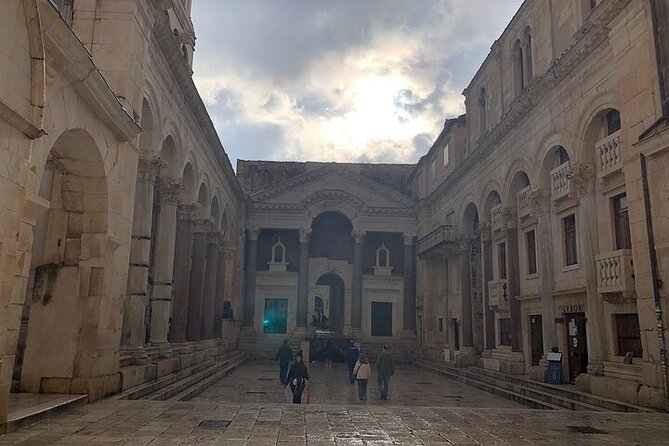
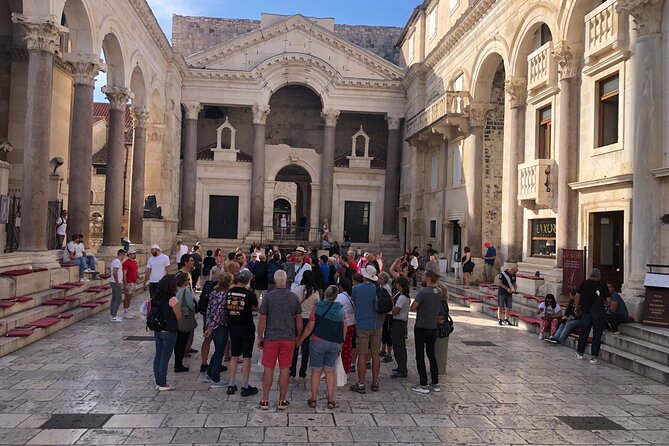
The tour opens at the Peristyle, the central square of Diocletian’s Palace. This is the key junction where you can reach many other areas of the palace. Standing here, you’ll understand why this space mattered: it functioned like the palace’s main crossroads, not just a pretty courtyard.
What I like about starting here is that it turns your brain on. Once you grasp where the Peristyle sits, the rest of the palace makes more sense. You start noticing axes, connections between spaces, and why certain entrances and corridors were built the way they were.
This stop is also time-efficient, around 15 minutes. It’s long enough to orient you, but short enough that you don’t spend your whole tour stuck in one spot.
Two thousand years, one afternoon
Vestibulum and possible Dalmatian singing moment
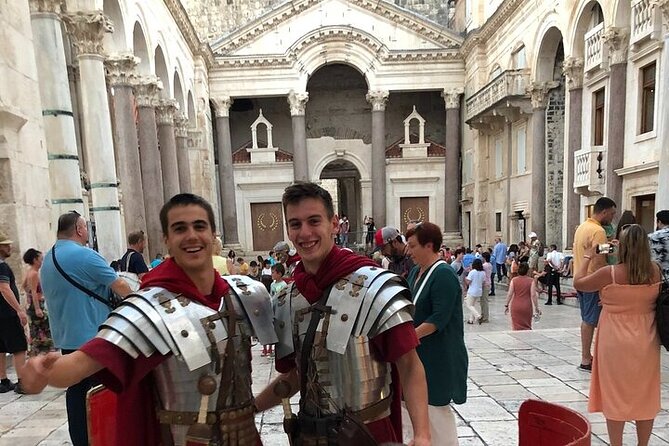
From the Peristyle, you move to the Vestibulum of Diocletian’s Palace. This is the vestibule tied to Emperor Diocletian, and the guide uses it to set context and history. You’ll learn what this area represents in the palace world, not just what it looks like.
Here’s the fun variable: you may hear traditional Dalmatian singing. It’s not something you can schedule like a show, but it’s the kind of cultural bonus that makes a historical site feel alive rather than frozen in time.
The time at this stop is brief, about 5 minutes. That works well because it keeps momentum. Still, you’ll leave with a sharper sense of how the palace communicated power, even before you move into the deeper under-structure areas.
Substructures walkthrough, construction logic without the museum
Next comes the substructures of Diocletian’s Palace. This area is where the palace’s build and function over time becomes more tangible. Instead of thinking of the palace as only above-ground grandeur, you get a peek into what supported it and how the space changed as centuries passed.
Important detail: you won’t visit the museum part of the substructures during this tour. You’re focused on the walk-through and the story, and you can visit the museum afterward if you want to go further on your own.
That choice is smart for most people. In about 10 minutes, you get the “why” behind the structure without committing to extra ticket time during the guided segment. If you’re the kind of traveler who likes to separate guided context from independent exploration, you’ll appreciate this setup.
Golden Gate, Gregory of Nin, and why language matters
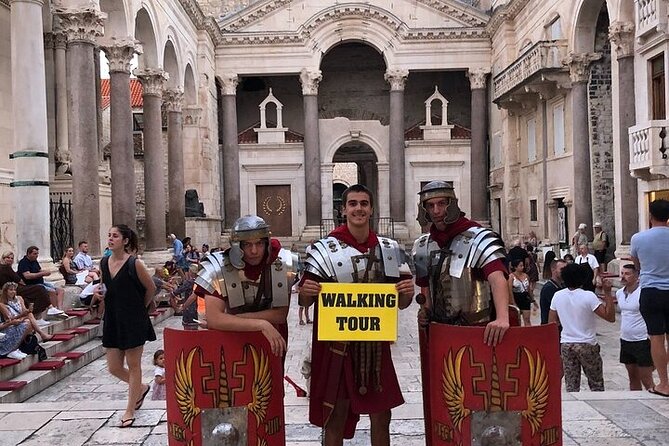
The Golden Gate is the main entrance of Diocletian’s Palace, and it’s one of the stops where history clicks into modern identity. You’ll learn about what this gate meant in the palace system and how later figures shaped what people associate with Split today.
One standout teaching point is the statue of Gregory of Nin. The guide connects his importance to Split’s history and even to language. That part surprised me in a good way because it turns a statue into an explanation: how religion and cultural influence leave traces that you can still feel in everyday life.
Time here is about 10 minutes. It’s enough for a clear explanation, plus time to look around without feeling rushed.
Riva Harbor and the bronze palace model

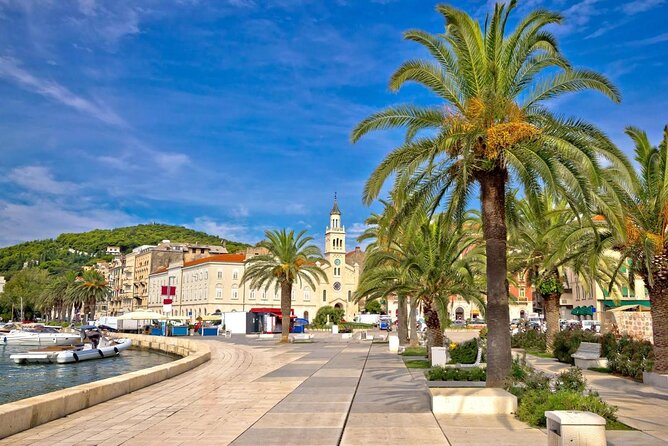
After the palace focus, the tour shifts to the waterfront at Riva Harbor. This is a good breath break. You’re still in history land, but the vibe changes from stone corridors to open-air city perspective.
At Riva, you’ll see a bronze model of Diocletian’s Palace. This is one of those practical tools that makes the whole guided story click. Even if you’ve been paying attention, your brain may still struggle to picture how everything aligns in 3D. The bronze model helps you connect what you just walked with what the palace looks like as a whole.
You’ll also learn about the history of the Riva promenade. That’s valuable because Split’s modern center did not grow in isolation. It grew around the palace, and the waterfront became part of how the city lives today.
This stop runs about 15 minutes, giving you time to look at the model and then step back mentally to connect the dots.
Plenty more to do around Split
- Split: Old Town and Diocletian Palace Walking Tour★ 4.9 · 4,727 reviews
- Walking Tour of Split and Diocletian’s Palace★ 5.0 · 2,588 reviews
- Krka Waterfalls tour with Trogir Walking tour and Krka panoramic boat cruise★ 5.0 · 1,659 reviews
- Split & Diocletian’s Palace Walking Tour★ 5.0 · 1,125 reviews
Fruit’s Square (Trg Brace Radic) and Venetian layers
Then you’re at Fruit’s Square (Trg Brace Radic). This is where the tour widens its lens beyond Roman walls. You’ll learn about an 15th-century Venetian citadel and why that matters for how this city developed.
The guide also highlights Marko Marulić, described here as the father of Croatian literature. That’s the kind of detail that makes a place feel more “real” than just Roman ruins. You’re seeing how Split became part of a broader Croatian cultural story.
This stop is about 10 minutes. It’s brief, but it lands because it gives you a second layer of context: Roman foundations, then Venetian and Croatian cultural identity.
Split Synagogue: a quick pass with Jewish history context
The last cultural stop is the Split Synagogue. You’ll pass by it and learn about the history of the Jewish people in Split, tied to the site itself.
A key practical note: the synagogue admission is not included. The tour describes it as a pass-by rather than a full visit. So if you want to go inside, you’d need to plan that separately.
Even as a pass-by, this stop is worth it because it nudges your understanding beyond the usual Roman-and-Venetian loop. Split has more threads than that, and this gives you one more strand to follow later.
Guides, group size, and why this tour feels fun
A big part of why this tour earns top marks is the human factor. The guides are consistently described as well educated, entertaining, and willing to answer questions. Names that stand out in the guide chatter include Antonella, Josip, and a guide named Marko who delivered palace stories in an engaging way.
That matters for your experience because Diocletian’s Palace can easily turn into a lecture. Here, it feels more like a guided walk with explanations that stay connected to what you’re seeing right now.
Also, the group size caps at 20 travelers. In a site like this, that size helps. Smaller groups keep you from getting lost in the shuffle, and they make it easier to ask follow-ups without the tour moving on too fast.
Price and what you actually get for about $165
At $165.08 per person for about 1 hour 30 minutes, you’re paying for a guided orientation plus storytelling. This isn’t a long day tour, but it is dense in key stops, which is why the price can make sense.
Here’s what improves the value:
- The tour includes admission where listed as free for major stops like the Peristyle, Vestibulum, substructures area, Golden Gate, and Riva Harbor
- You get a clear route that covers both palace highlights and nearby city context
- You receive a mobile ticket, which is convenient when you’re moving quickly through old town
Also worth knowing: it’s described as having group discounts. If you’re traveling with friends, it can be worth checking whether your booking qualifies for any savings.
One cost consideration: the synagogue entrance is not included. Since you’re passing by, you may not need to pay during the tour, but if you plan to go in afterward, budget that separately.
Finally, on average, people book around 44 days in advance. If you have firm dates, you’ll likely get better odds by booking early.
Practical tips for walking this route
A tour like this moves at a steady pace through older stone streets. Here’s how to prepare smartly using what’s explicitly noted and what the route implies.
- If stairs are an issue, take that seriously. It’s not recommended for travelers who have issues with high steps.
- Wear shoes with good grip. Old town surfaces can be tricky, especially in warm weather.
- Bring patience for short stops. Some locations are only around 5 to 15 minutes, because the real value is the order of sights.
If you like asking questions, do it. The guides are repeatedly praised for staying open and answering beyond the basic script.
Where the tour starts, where it ends, and how to use it after
The meeting point is Peristil ul., 21000, Split, Croatia. The ending point is near Diocletian’s Palace in Grad, Split, Split Croatia.
Convenient detail: the tour ends not far from where it started. If you want to return to the Peristyle area, the guide can take you back if you ask. That’s a small thing, but it can save you time if you’re trying to connect to another plan, like lunch or a museum visit.
If you plan to continue exploring afterward, this ending layout helps. You’re not stranded across town.
Should you book the History Split Walking Tour in German?
If you want a German-language start in Split that makes Diocletian’s Palace easier to navigate, I think it’s a strong choice. This is ideal when you want clear orientation fast, a guide who tells the story behind the stones, and a short, well-paced walk that doesn’t drag.
Book it if:
- You want Diocletian’s Palace explained in a way you can remember during your own exploration
- You like asking questions and getting answers, not just hearing facts
- You value a small group format and a route that covers both Roman and later layers
Skip it or reconsider if:
- You have trouble with high steps
- You prefer long, deep museum time rather than a tight guided route
If your goal is to understand Split quickly and then wander with confidence, this tour delivers that payoff in about 90 minutes.
FAQ
What language is this tour in?
This is a German-language walking tour.
How long is the History Split Walking Tour in German?
It lasts about 1 hour 30 minutes.
How big is the group?
The tour has a maximum of 20 travelers.
Where does the tour start?
It starts at Peristil ul., 21000, Split, Croatia.
Where does the tour end?
The tour ends near Diocletian’s Palace in Grad, Split. It is not far from where it started.
Is admission included for the stops?
Admission tickets are listed as free for several stops, including the Peristyle, Vestibulum, substructures area, Golden Gate, and Riva Harbor. The Split Synagogue stop is described as not included.
Are tips included in the price?
No. Gratuities are not included.
Is the tour suitable if I have difficulty with stairs?
It is not recommended for travelers who have issues with high steps.
Can I get a mobile ticket?
Yes, the tour includes a mobile ticket.
Is free cancellation available?
Free cancellation is available up to 24 hours in advance for a full refund.
Recently added around Split
- Private VIP Brac and Hvar Day Trip from Split
★ 5.0 · 1 review - Private Transfer From or To the Split Airport
★ 5.0 · 1 review - Brač Half Day Beach Party Transfer to Olife Beach Club
★ 5.0 · 1 review - Private Transfer from Split to Zagreb, Hotel-to-hotel, English-speaking driver
★ 5.0 · 1 review - Airport transfers
★ 5.0 · 1 review - Private ”Game of Thrones” Walking Tour in Split (entrance tickets included)
★ 5.0 · 1 review
Historical Tours, compared.

Walking Tour of Split with a ‘Magister’ of History
Read our review →
Split Walking Tour with Professor of History
Read our review →
Split History and Gastro Small-Group Tour with Food and Drinks
Read our review →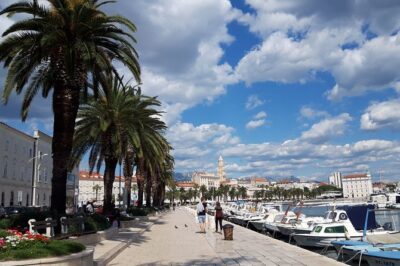
PREMIUM Emperor’s Walking Tour for History Lovers + Museum
Read our review →
Local History and Culture 90-Minute Walking Tour
Read our review →
Private History Split Walking Tour in English
Read our review →
Historical & Gastro Treasures Tour with Green Market
Read our review →Browse the lists this tour appears in