
Reviewed · HISTORICAL TOURS
Private History Split Walking Tour in Spanish
History feels close when you walk inside it. This private Spanish tour turns Diocletian’s Palace from a pile of stones into a story you can follow, stop by stop. I especially like how it orients you fast at the Peristyle, and how the guide explains the connections between Roman power and everyday life in Split. One thing to consider: it’s a lot of ground for 1 hour 30 minutes, and it’s not recommended if you struggle with high steps.
This is built for getting your bearings and understanding what you’re looking at. You’ll learn why Diocletian went from nobody to the most powerful man in the world, then see how that palace shaped the city that grew around it. The tour ends near the start, and the guide can point you right back to the Peristyle if you want to continue exploring on your own.
In This Review
- Key highlights to watch for
- How a private 90-minute palace walk feels in Split
- Start at the Peristyle, where Diocletian’s Palace runs the show
- Jupiter, temple clues, and why Diocletian needed divine cover
- Substructures under your feet, and why you skip the museum here
- Golden Gate details, Gregory of Nin, and language you can see
- Riva Harbor with a bronze palace model you can actually understand
- Fruit’s Square (Trg Brace Radic), Venetian walls, and Marko Marulić
- Passing the Split Synagogue and learning the Jewish story
- Vestibulum of Diocletian’s Palace, and maybe a Dalmatian song
- The substructures again, and how to extend your visit smartly
- Spanish guide quality is the secret weapon here
- Price and value, is $63.05 fair for this format?
- Who should book this tour, and who might skip it
- Should you book this Spanish private history tour?
- FAQ
- How long is the Private History Split Walking Tour in Spanish?
- What does the tour cost?
- Is this a private tour?
- Where does the tour start and end?
- What language is the tour in?
- Are admission tickets included?
- What sights will we see?
- Is the tour suitable if I have trouble with steps?
- Can I cancel for a full refund?
- Are service animals allowed?
Key highlights to watch for
- Peristyle as your map, the central square that links most key areas of Diocletian’s Palace
- Jupiter and divine politics, the Roman temple angle that explains Diocletian’s self-image
- Substructures focus, walking through the lower palace areas without doing a museum detour
- Golden Gate details, including the Gregory of Nin statue and why it matters for language
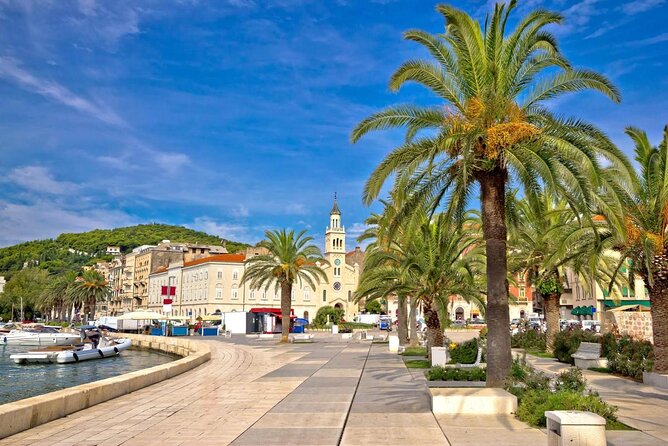
- Riva Harbor context, with a bronze palace model that makes the promenade’s story click
- Optional Dalmatian singing, a small moment at the vestibule if conditions allow
How a private 90-minute palace walk feels in Split
Split can feel like a maze at first. This tour is designed to fix that quickly. It’s private, so you’re not listening to a crowd steamrolling the pace, and you can ask questions as you go. The duration is about 1 hour 30 minutes, which sounds short until you realize the stops cluster around the palace core and the immediate historic center.
Price is $63.05 per person, with the format typically booked well in advance. For me, the value comes from focus. You’re not doing a random walk through pretty streets. You’re getting guided context for the big Roman structures, the city layers added later, and the meaning behind specific landmarks.
Logistically, you get a mobile ticket, and the meeting point is very clear: the tour starts at Peristil ul. (Peristil ulica, 21000 Split). It ends not far from where it starts, at the Diocletian’s Palace area, in Grad, Split. That makes it easy to pick up your own exploring right after.
Start at the Peristyle, where Diocletian’s Palace runs the show
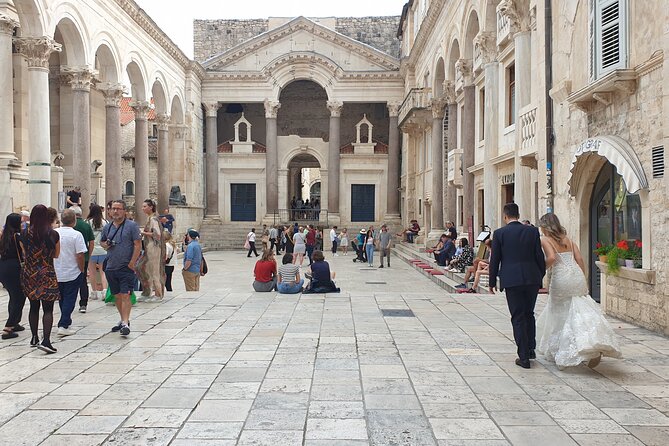
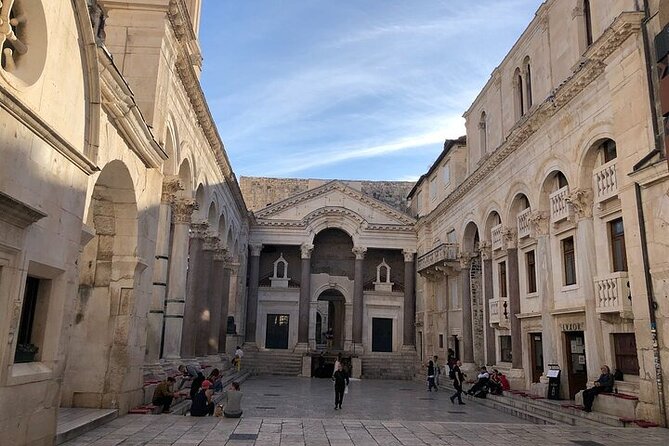
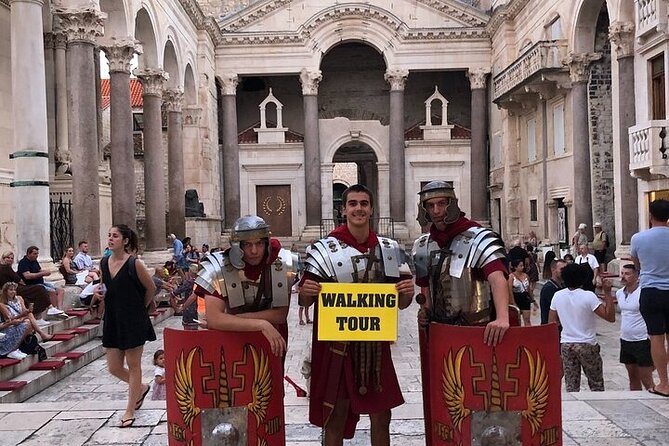
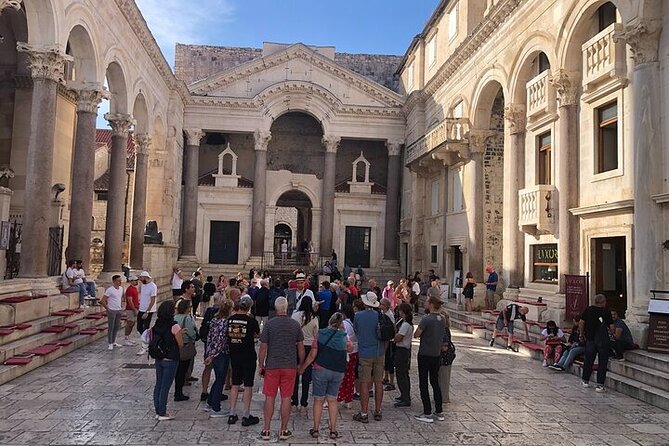
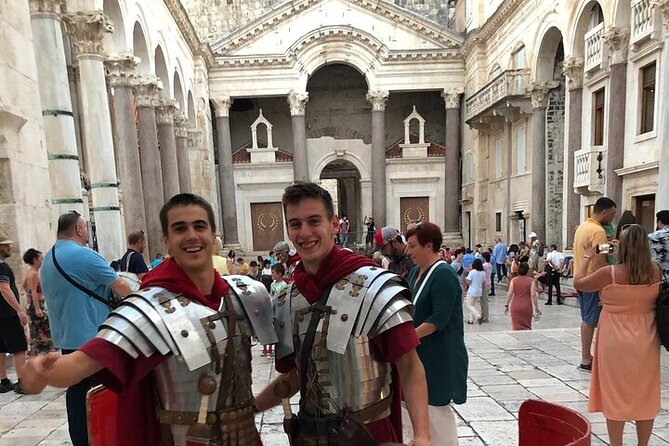
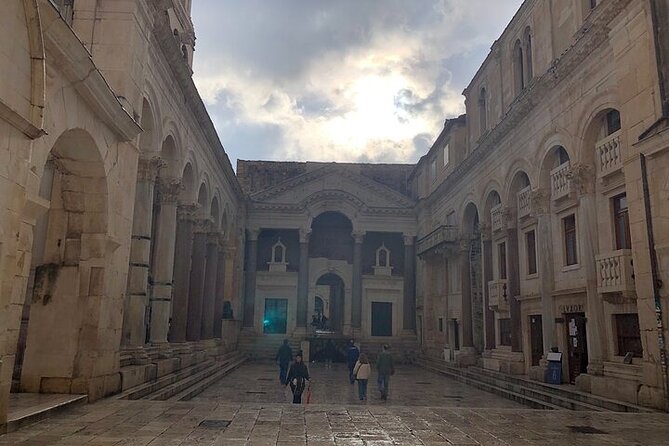
Your first stop is the Peristyle area inside Diocletian’s Palace. This is the central square, and the guide uses it like a real orientation tool. From here, you can reach many of the other important locations, so it’s the smart starting point.
I like this because it reduces that early “where am I” stress. When you understand the Peristyle as the hub, the rest of the palace starts making sense. You’re not memorizing directions, you’re learning the logic of how the palace is laid out.
Also, the stop is timed around an easy pace, with free admission ticket indicated for this segment. That means you can stay in the flow of the walk without pausing for ticket logistics.
Two thousand years, one afternoon
Jupiter, temple clues, and why Diocletian needed divine cover
Between the palace spaces, the tour adds the Roman temple thread, focusing on the Roman temple of Jupiter. The key idea is Diocletian’s relationship to power. He didn’t just rule with politics and armies. He also used religion and symbolism, and the tour frames Jupiter as Diocletian’s divine father.
For your visit, this matters because it changes how you interpret what you see. Roman architecture can look like ruins until someone connects it to what people believed. When you learn what a ruler wanted to project, details like temple placement and intended meaning feel more purposeful.
If you like history that explains motivations, not just dates, this stop does that job quickly and clearly.
Substructures under your feet, and why you skip the museum here
Next comes the Diocletian Palace substructures. This is one of those “wait, there’s more below” moments. You walk through the lower palace areas and learn about how they were constructed and what their functions were as the site changed over the ages.
A key note here: the tour is set up so you do not visit the museum part of the substructures. You can visit it afterward if you want a deeper museum-style experience.
I think that approach is smart. Museum sections can be time-eaters, and you only have about 90 minutes total. By focusing on the structure itself, you get the spatial story first. Then, if you feel like staying longer, you can choose to add the museum at your own pace.
The substructures stop is also marked as free admission ticket. That keeps the tour feeling smooth, and it helps you stay focused on what the guide is pointing out in the space around you.
Golden Gate details, Gregory of Nin, and language you can see
At the Golden Gate, the guide shifts from palace layout to cultural impact. This is the main entrance area of Diocletian’s Palace, and you’ll hear about the gate itself. Then comes a standout landmark: the statue of Gregory of Nin.
What makes this stop especially useful is the way the tour ties Gregory of Nin to Split’s later history and even to language. That’s not something most people expect from a stop inside a Roman palace entrance, and it’s exactly why guided context helps. You start connecting the Roman foundations to later identity, not treating them like separate eras.
Admission for this segment is also listed as free, so you can spend your time on the story instead of paperwork.
Riva Harbor with a bronze palace model you can actually understand
Then the tour moves toward Riva Harbor, and the pace stays easy. You’ll see a bronze model of Diocletian’s Palace. This matters because palace ruins and palace models are different things. A physical model helps you “translate” what you’re seeing on the ground.
From there, you learn about the history of Split’s Riva promenade. You’re not just standing by the water admiring the view. You’re getting a reason for why the promenade developed the way it did and how the palace space influenced the city’s later shape.
This stop is listed at about 15 minutes, with free admission ticket. It’s a nice balance point after the palace-centric stops.
Plenty more to do around Split
- Split: Old Town and Diocletian Palace Walking Tour★ 4.9 · 4,727 reviews
- Walking Tour of Split and Diocletian’s Palace★ 5.0 · 2,588 reviews
- Krka Waterfalls tour with Trogir Walking tour and Krka panoramic boat cruise★ 5.0 · 1,659 reviews
- Split & Diocletian’s Palace Walking Tour★ 5.0 · 1,125 reviews
Fruit’s Square (Trg Brace Radic), Venetian walls, and Marko Marulić
At Fruit’s Square, also known as Trg Brace Radic, the tour shifts into the later layers around the palace. You learn about a 15th-century Venetian citadel and how Venetian-era power left marks in the area.
The other big name here is Marko Marulić, described as the father of Croatian literature. For me, this stop is one of the best examples of how a walking tour should work. You’re in a square, yes, but you’re also learning why Croatia’s literary history is anchored in a place like this.
The stop is about 10 minutes, marked with free admission ticket. It’s short enough to stay brisk, but it gives you enough context to recognize why the square isn’t just pretty scenery.
Passing the Split Synagogue and learning the Jewish story
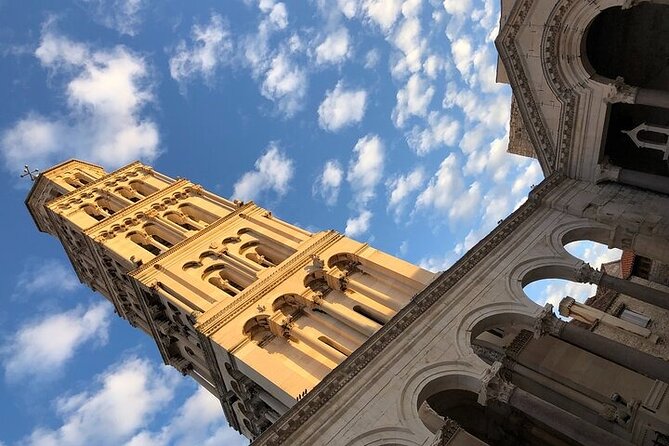
Next is a pass-by of the 16th-century Split Synagogue. The tour doesn’t present it as a quick photo stop. It’s used as a window into the history of the Jewish community in Split.
Important detail: this stop notes admission ticket not included. That means you shouldn’t expect the tour to be centered on entering the synagogue. Plan for it to be more of a learning-and-observe moment.
Even so, it adds variety. A Diocletian’s Palace tour can easily become purely Roman and medieval-crumbled. This adds a different thread of city history in a respectful, low-pressure way.
Vestibulum of Diocletian’s Palace, and maybe a Dalmatian song
At the vestibulum of Diocletian’s Palace, you’ll see the space connected to the emperor, and the guide explains its background. There’s also a fun possibility here: you might hear traditional Dalmatian singing.
I like this kind of “maybe” moment. It doesn’t promise the impossible, but it gives you a chance for something atmospheric while you’re already in a history-heavy setting.
This segment is listed at about 5 minutes with free admission ticket. It’s short, but it gives the tour a human feel, not just stone facts.
The substructures again, and how to extend your visit smartly
The tour returns once more to the Diocletian Palace substructures. That sounds repetitive until you remember what guides do when they know you’ve just built a mental map. The second pass can feel more like confirmation: you notice details you might have missed earlier and you understand how parts connect.
The second substructures stop is also free for admission ticket purposes, and it keeps you in the same theme: the palace below the palace, and how functions changed over time.
From there, you end close to where you started. The guide can take you back to the Peristyle area if you ask, which is handy if you want to continue wandering independently.
If you’re the type who likes to add depth after a guided overview, this tour pairs well with a later visit to the museum part of the substructures, since the tour itself skips that section. You’ll have the structure and story in your head first, so the museum visit is less like random exhibits and more like follow-up.
Spanish guide quality is the secret weapon here
The biggest “value” signal from past guests is the guide. People describe the guide as well educated, attentive, and good at explaining the history of the palace and Diocletian. They also highlight that the Spanish was quite good and that the guide stayed responsive to questions.
That matters more than you’d think. In a place like Diocletian’s Palace, there are tons of architectural fragments. Without a strong guide, you can end up reading your own notes to figure out what you’re looking at. With a guide who speaks clearly and stays engaged, you get a smoother story.
So if Spanish is your comfort language, this is a strong match. You get the benefits of guided context without forcing yourself to piece together complicated history in a second language.
Price and value, is $63.05 fair for this format?
For $63.05 per person, you’re paying for three things: a private group experience, a trained guide focused on the palace highlights, and a tight 90-minute route that avoids wasting time.
You’re not paying for admission tickets inside the package, since the tour notes that no admission tickets are included. Some listed stops are marked as free admission ticket, but you still should mentally separate guided learning from paying for museum entries.
To me, the price makes sense when you want guided clarity. If you already know Roman history and you prefer total freedom, you might choose a self-guided plan. But if you want to leave with real context, especially around Diocletian’s rise, Jupiter symbolism, and the city layers around the palace, this tour is built for that.
Who should book this tour, and who might skip it
This tour is a good fit if you:
- Want a fast orientation to Diocletian’s Palace without getting lost
- Like history that connects architecture to politics and identity
- Prefer a Spanish guided explanation
- Appreciate a guide who answers questions and keeps you comfortable
You might think twice if you:
- Have trouble with high steps, since the tour is not recommended for that situation
- Need a slow, museum-heavy experience, since the museum part of the substructures is not included in the walk
Should you book this Spanish private history tour?
Yes, if your goal is to understand what you’re seeing in Split’s most dramatic site without spending hours piecing it together. The tour’s route is compact, the stops hit meaningful landmarks like the Golden Gate and the Gregory of Nin statue, and the story stays focused on why Diocletian mattered and how Split grew around his palace.
I’d book it sooner rather than later if you’re traveling in peak season, since this kind of private format tends to be scheduled in advance. And if you’re curious about the mix of Roman, Venetian, and Jewish threads, this tour does a good job keeping those layers connected.
If steps are an issue for you, talk with the provider before you commit, because the walk is not designed around step-free touring.
FAQ
How long is the Private History Split Walking Tour in Spanish?
It runs about 1 hour 30 minutes.
What does the tour cost?
The price is $63.05 per person.
Is this a private tour?
Yes. It’s a private tour/activity, and only your group participates.
Where does the tour start and end?
It starts at Peristil ul. (Peristil ulica, 21000 Split) and ends near Diocletian’s Palace in Grad, Split. The guide can take you back to the Peristyle if you ask.
What language is the tour in?
The tour is in Spanish.
Are admission tickets included?
No. Admission tickets are not included. Also, one stop notes admission ticket not included for the synagogue area.
What sights will we see?
You’ll cover the Peristyle of Diocletian’s Palace, the Roman temple of Jupiter area, Diocletian Palace substructures, the Golden Gate (with the Gregory of Nin statue), Riva Harbor (with a bronze model), Fruit’s Square (Trg Brace Radic), the Split Synagogue area from outside, and the vestibulum, plus additional time through the substructures.
Is the tour suitable if I have trouble with steps?
It is not recommended for travelers who have issues with high steps.
Can I cancel for a full refund?
Yes. You can cancel up to 24 hours in advance for a full refund.
Are service animals allowed?
Yes, service animals are allowed.
Recently added around Split
- Private VIP Brac and Hvar Day Trip from Split
★ 5.0 · 1 review - Private Transfer From or To the Split Airport
★ 5.0 · 1 review - Brač Half Day Beach Party Transfer to Olife Beach Club
★ 5.0 · 1 review - Private Transfer from Split to Zagreb, Hotel-to-hotel, English-speaking driver
★ 5.0 · 1 review - Airport transfers
★ 5.0 · 1 review - Private ”Game of Thrones” Walking Tour in Split (entrance tickets included)
★ 5.0 · 1 review
Historical Tours, compared.

Walking Tour of Split with a ‘Magister’ of History
Read our review →
Split Walking Tour with Professor of History
Read our review →
Split History and Gastro Small-Group Tour with Food and Drinks
Read our review →
PREMIUM Emperor’s Walking Tour for History Lovers + Museum
Read our review →
Local History and Culture 90-Minute Walking Tour
Read our review →
Private History Split Walking Tour in English
Read our review →
Historical & Gastro Treasures Tour with Green Market
Read our review →Browse the lists this tour appears in